Short Thoughts July 15, 2026 PYPL/IBM/HCA/More
원문 보기 (영문) →한국어 번역이 곧 추가됩니다. 그 동안 아래 영문 원문 또는 출처 사이트를 참고해주세요.
PayPal Buyout Offer
Privately held payments firm Stripe, and Advent, a PE firm, are offering $60.50/share for portfolio company PayPal (PYPL), which closed at $47.37 today.
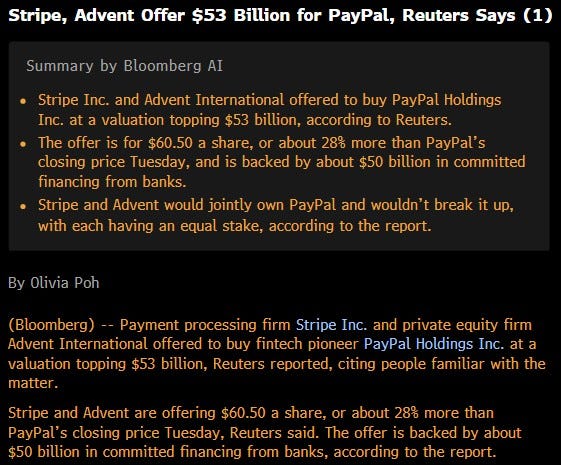
The bid is at 1.21x IV15 and simply too low.
This validates the value in PayPal, and I believe the bid will have to rise. The company is well below intrinsic value, and any successful bid should be well above intrinsic value to account for the control premium.
PayPal is one of the cheapest quality businesses in the portfolio. IV15 is what a minority investor would pay. There is no control premium in my IV15 calculation.
A control premium should take any buyout well above IV15, and 21% more is not nearly enough.
True intrinsic value by my methodology is around IV8-IV10.
IV10 is $75-$80. IV8 is $110-$115. A buyout should be in that range. IV10 plus a control premium puts the winning bid at roughly $100. That is still below my IV8.
With control over the cash flows, those businesses and the personnel, the new owner will have many levers to increase value and make for a better overall business.
$60.50 is just too low. I am not selling, and I believe it is only an opening bid.
Most since 1968
On July 7th IBM stock was at $312.
This July 14th morning IBM stock hit $213, an unfortunate palindrome.
In fact, today IBM stock was down 26% at its lows, the most since at least 1968.
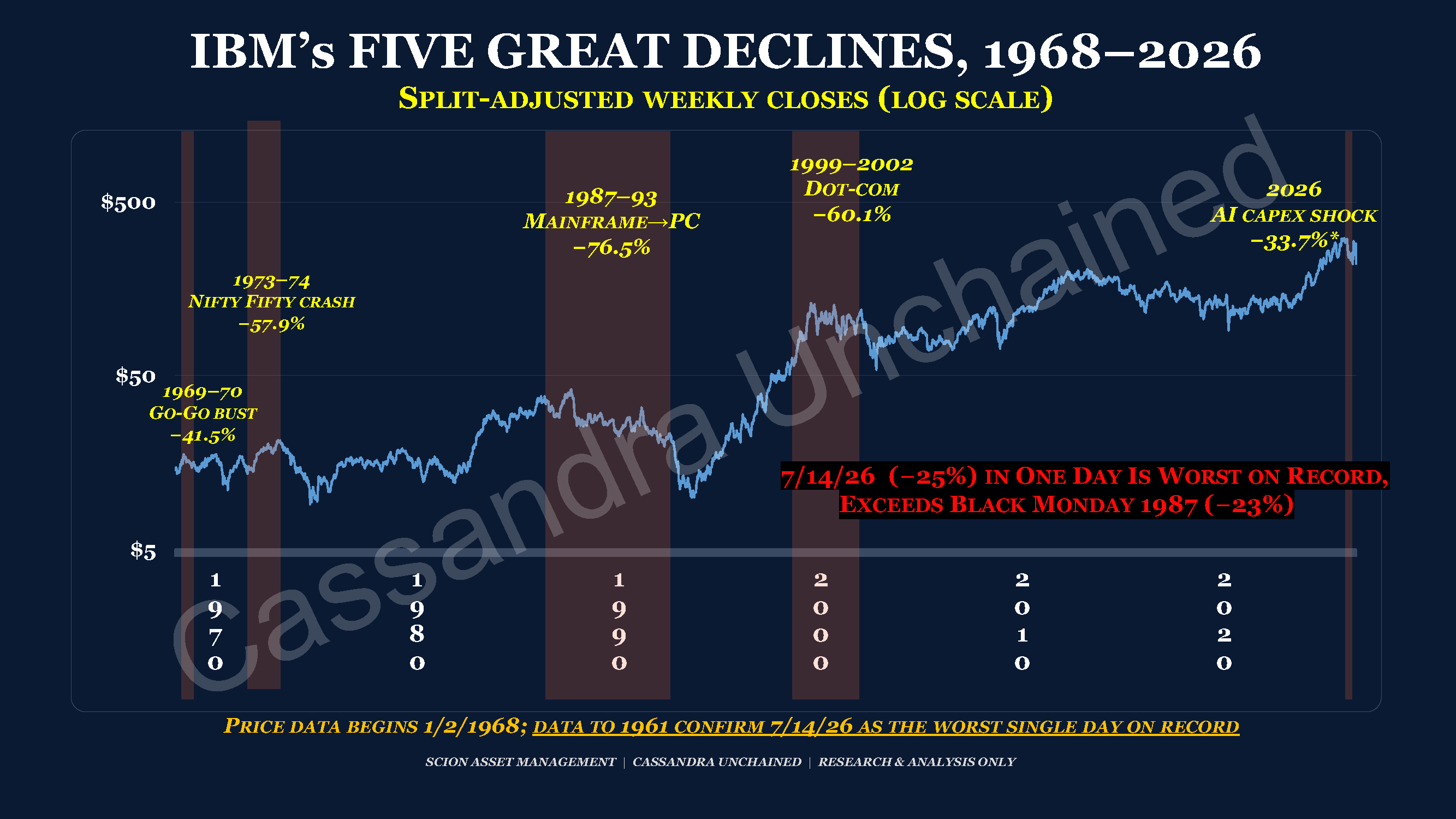
Some are reporting the fall is the worst daily decline since 1961, or even the worst all-time. 1968 works too, and that is my data.
Back in 1968, IBM was a leading Go-Go stock, a momentum king.
IBM would crash 41.5% at the end of the Go-Go era, only to recover to a new high in 1973 as a leading member of the Nifty 50, a group of stocks thought to be one-decision forever stocks that could be bought profitably at any price.
Other leading Nifty 50 stocks included Xerox, Polaroid, Eastman Kodak, Avon, Coca Cola, McDonald’s, Disney, and Johnson & Johnson.
Xerox would fall 71%, Avon 86%, Polaroid 91%, during the 1973-1974 bear market. IBM fell 58%, and none of its one-day drops during that time were greater than 10%.
IBM’s second biggest daily drop of 23% happened on Black Monday, October 19, 1987. The fifth biggest daily drop of 13.1% happened in February of this year with the Anthropic COBOL news.
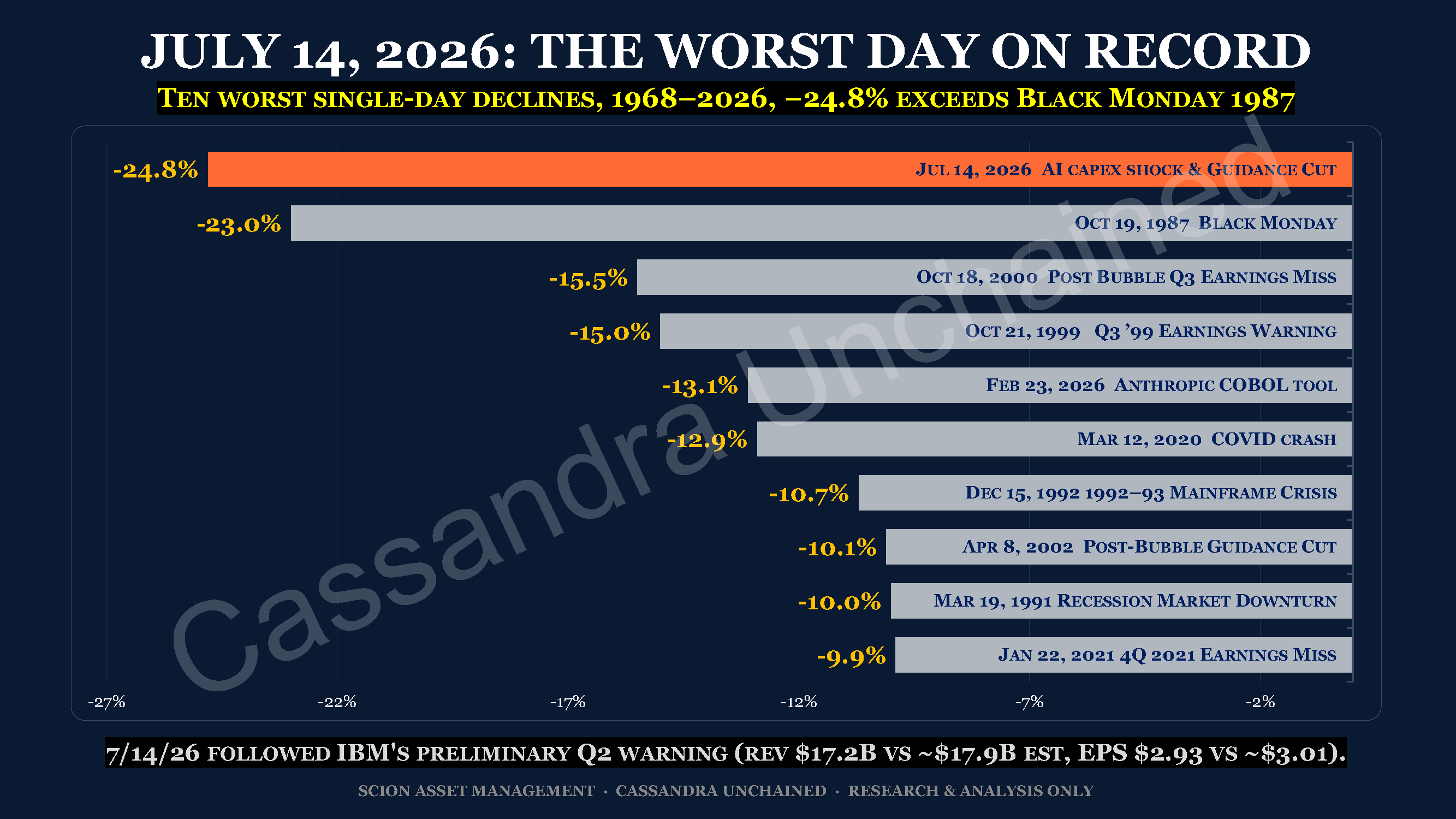
Still, investors in IBM had every right to expect not to be down 26% in a single day. A thick slice of history supported that conclusion.
IBM has certainly been an expensive stock many times before. In 1968, IBM traded at about 50x earnings, and it had compounded earnings at 20% or more for nearly two decades.
Thereafter, IBM’s stock fell with the other Go-Go stocks. Fundamental trouble clouded IBM’s horizon.
During 1968, IBM, the great computing giant of the time, moved to unbundle its software business from its hardware business. It did this, perhaps, to stave off a Department of Justice investigation.
The Department of Justice nevertheless started what would become a 13-year antitrust case against IBM that would ultimately be dropped in January 1982 as “without merit.” Robert Bork called the DOJ’s case against IBM “the antitrust division’s Vietnam.”
Really, the Department of Justice took long enough that IBM’s competitive advantage waned, as often happens for even dominant tech companies.
The difference with IBM is it possibly has more lives than the proverbial cat.
IBM was back with a vengeance in the 1980s. Major corporations globally ran their compute through IBM’s PCs and rooms full of IBM’s mainframe computers.
I worked at IBM during that heyday, as I discussed in My 1989.
I remember how flush those times felt, and how fast they disappeared.
IBM Reborn
This was evident in how far margins fell in the 1990s. That happened because IBM’s mainframe server business model shrunk tremendously, and IBM had to make a wholesale transition as a company to a software/consulting-led model.
This was a painful, long transition that changed the whole face of the company, again. And with great success.
Gross margin fell from 56% in 1990 to 36% in 1999, a remarkable 20 points lost over a decade that saw tech stocks boom and pushed IBM stock up anyway through 1990s.
IBM’s good performance in recent years can be chalked up to margin expansion. Its multiple on earnings and sales rose dramatically the last few years, as gross margins rose from about 47% pre-COVID to 60% recently.
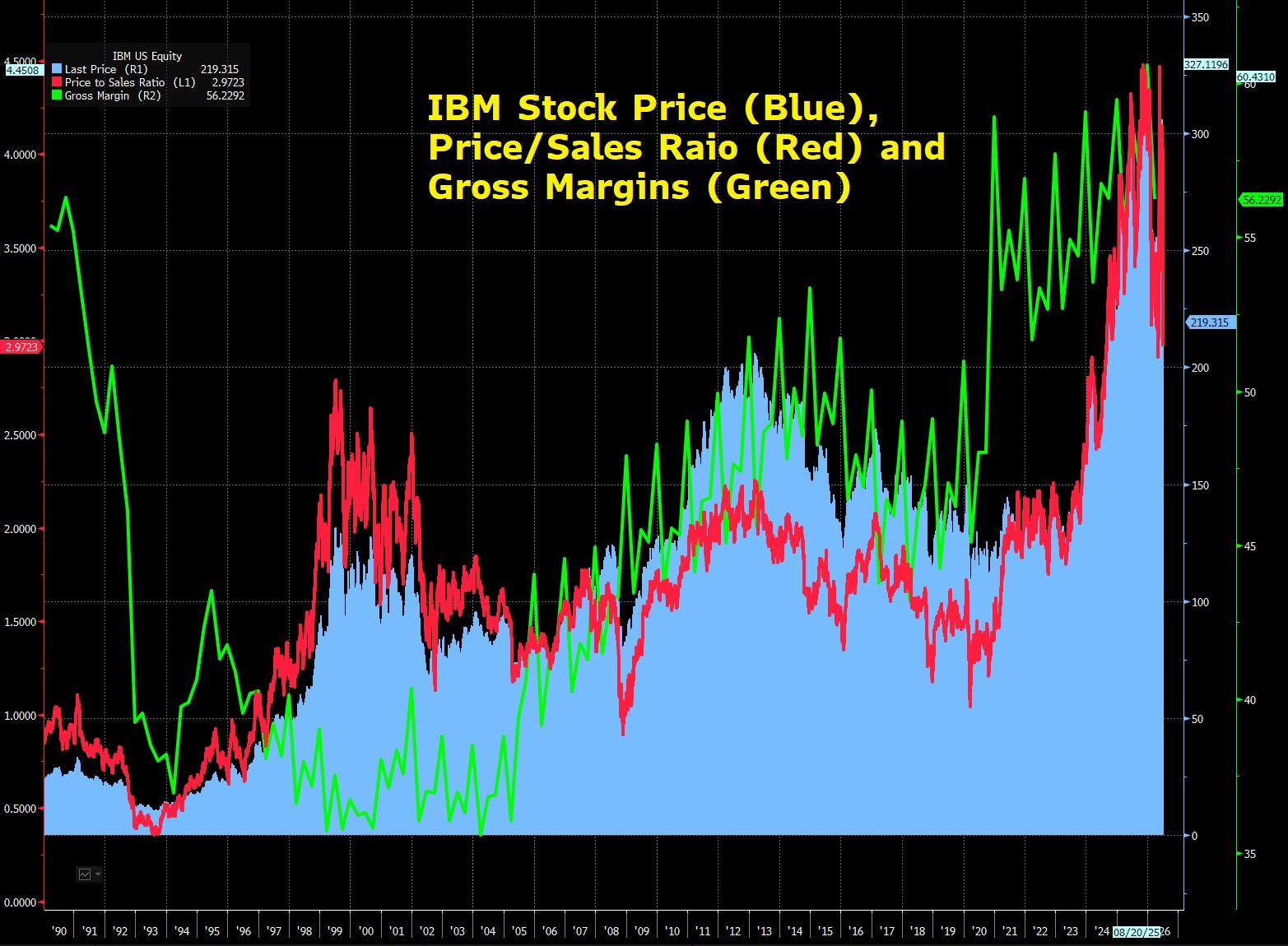
IBM’s enterprise-wide pivots from hardware and software giant to hardware giant to software and consultant giant is perhaps one of the most impressive arcs in the annals of American industry.
IBM has risen from the ashes many times.
That brings us to today. This most historic fall in the history of this most historic company.