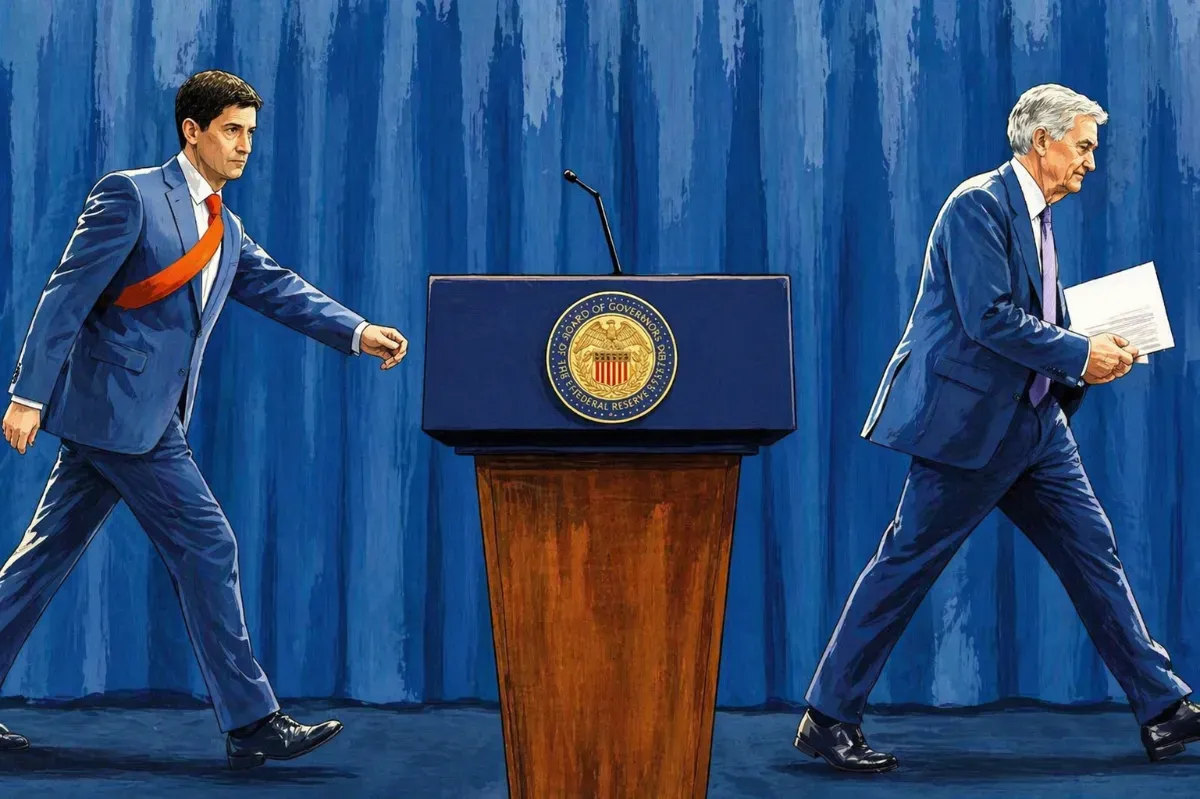
President Donald Trump will swear in Kevin Warsh as the 17th Federal Reserve chair at a White House ceremony on Friday, May 22. The handover comes roughly one week after Jerome Powell's formal term as chair expired — marking what many analysts call the most politically charged Fed leadership transition in modern history.
A single sentence from a Fed chair can move the S&P 500, reprice the dollar, and reshape the entire yield curve. This transition is not just a personnel change. It is the moment that determines whether Trump's two-year push for lower rates will become reality — or whether Fed independence survives under new leadership.
Thinnest Confirmation in Fed History — 54 to 45
The Senate confirmed Warsh on May 13 by a 54-45 vote, the narrowest margin for any Fed chair in history. Only one Democrat crossed the aisle: Pennsylvania Senator John Fetterman. Every other Democrat voted no. The vote reflects the political minefield Warsh now inherits.
At his confirmation hearing on April 21, Warsh stated that the Fed "will operate independently." Democrats remained skeptical, warning he would bend to White House pressure and cut rates prematurely.
Powell Stays as Governor — A Board Anchor
On May 15, the Fed board named Powell "chair pro tempore" to bridge the gap until Warsh is sworn in. More significant: Powell will remain on the board as a governor after the handover.
Powell's term as chair has ended, but his governor term runs through 2028. He cited Trump's "unprecedented attacks" on the central bank as his reason for staying.
Jerome Powell / Former Fed Chair
This creates an unusual internal dynamic: Warsh chairs the Fed while Powell remains a voting board member. Markets are reading this as a built-in institutional check on Warsh's flexibility.
Trump's Expectations, Market's Concerns
Trump made no secret of his intentions when nominating Warsh, publicly calling him someone who would "lower rates." The federal funds rate currently sits at 4.25-4.50%, and Trump has repeatedly called for cuts.
The problem is that the macro backdrop makes easing difficult to justify.
- The US-Israel war with Iran has pushed WTI crude above $100 per barrel — reigniting inflation fears
- Tariff policy continues to drive import prices higher
- 10-year Treasury yields at 4.6% — markets are still pricing in higher-for-longer
If Warsh cuts early, he gets labeled a political actor. If he holds, he clashes with Trump. Either path carries a cost.
Who Is Kevin Warsh?
Kevin Warsh, 46, combines Fed institutional experience with Wall Street credentials — an unusual profile for a central bank chief. He served as a Fed governor from 2006 to 2011, playing a central role in crisis-era decisions during the 2008 financial collapse. After leaving, he joined Stanford's Hoover Institution to research monetary policy.
Trump considered Warsh for the Fed chair role in 2017 before selecting Powell instead. This is his second shot, nine years later. He has long been classified as a hawk, but recent comments emphasizing data-driven flexibility have led observers to call him a "pragmatic hawk."
First Test — FOMC Meeting June 16-17
Warsh's first FOMC meeting as chair is June 16-17. The May CPI release expected June 11 and jobs data published before that meeting will effectively dictate his first policy decision. Current market consensus: hold in June, one cut in September.
For Korean investors, the dollar-won direction is the key variable. If the Fed eases faster than expected, a weaker dollar means a stronger won — a headwind for export-heavy Korean equities. A hold scenario sustains dollar strength and adds to domestic import cost pressure.