
Daehan Shipbuilding Posts 28% Operating Margin — Can It Become the ASML of Shipbuilding?
While most shipbuilders languish in single-digit margins, Daehan Shipbuilding hit 28%. Tandem construction, a 7-year fuel efficiency moat, and shuttle tanker expansion — we break down how they did it.
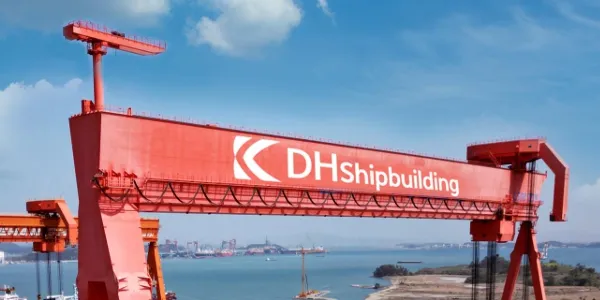
As Korean shipbuilding enters a second golden era backed by formidable technological moats, Daehan Shipbuilding's fundamentals are drawing serious attention for profitability that far exceeds market consensus. While shipbuilding stocks typically operate on single-digit margins, Daehan posted a remarkable 27–28% operating margin in Q4 of last year, emerging as an undisputed profitability outlier within the industry.
Low Cost, High Efficiency — A Reinvented Cost Structure
Daehan's commanding margins are no accident — they are the result of a meticulously engineered cost control strategy.
Process Optimization (Tandem Construction) — To overcome the physical constraints of operating a single dock in South Jeolla Province, Daehan adopted a tandem construction method that builds two vessels simultaneously within one dock. This maximizes dock utilization and dramatically reduces the fixed cost burden.
Cost Structure Innovation — While peers maintain foreign labor ratios of 10–20%, Daehan has pushed that figure to 40%, significantly lowering labor costs. The company also sources 80% of its steel plate — the key raw material — from China, securing a competitive cost advantage.
Focus and Specialization — By repeatedly constructing a single vessel type, the Suezmax tanker, Daehan has maximized process proficiency while minimizing design and construction costs.
The '7-Year Fuel Efficiency Wall' China Cannot Cross
But building cheaply is only half the story. Despite quoting prices roughly 10% higher than Chinese shipyards, Daehan commands dominant order share in global markets.
As of March 2026, Daehan has captured 55% of all global Suezmax tanker orders. The superior fuel efficiency of Korean-built vessels translates directly into profitability for shipowners. Even paying a premium over Chinese-built alternatives, owners can fully recover that upfront cost through fuel savings over approximately 7 years of operation. Much like ASML in semiconductors, this technological moat confers genuine pricing power.
Growth Visibility — Expanding into High-Value Vessel Segments
Daehan currently holds approximately three years' worth of order backlog. Beginning in 2026, shuttle tankers — priced more than 50% above standard Suezmax vessels — are set to begin contributing meaningfully to revenue. This represents a powerful upside catalyst that grows the total revenue base while sustaining the company's already-elevated profitability.
Valuation — Deep in Undervalued Territory
While peers such as HD Hyundai Heavy Industries and Hanwha Ocean trade at 15–20x P/E on a 2026–2027 basis, Daehan is valued at just 10–11x. The company leads the industry on margins yet trades at the cheapest valuation in the peer group — a clear pricing dislocation.
Risk Factors: An overhang exists from Anda Asset Management, the second-largest shareholder, which holds shares pending divestiture. That said, of the approximately $409M raised through its IPO, around $341M is earmarked for additional dock capacity, with roughly $34M allocated to shareholder returns via dividends and buybacks — suggesting the supply-side overhang is likely to dissipate gradually.
Technical Analysis — A Classic IPO Base Setup
From a chart perspective, the stock has entered a textbook IPO base setup. It is digesting the heavy supply zone established by the large-volume trades at the time of listing, building a consolidation base.
The critical near-term inflection point is whether the stock can clear the primary resistance zone between ₩90,000 and ₩95,000. A decisive breakout through the psychological round-number resistance at ₩100,000 on strong volume could ignite a sustained price advance driven by fundamental rerating.
Daehan Shipbuilding is evolving beyond a conventional shipbuilder into a cash-generative model that extracts superior returns through vertically integrated efficiency and technological differentiation. The convergence of valuation appeal and earnings visibility makes this a meaningful inflection point for potential institutional inflows.
 042660
Frequently Asked Questions
What drives Daehan Shipbuilding's high operating margin?
The company leverages tandem construction technology and a 7-year fuel efficiency moat over Chinese rivals, while expanding into the higher-margin shuttle tanker segment.
What does a 28% operating margin mean for a shipbuilder?
With the industry average in the single digits, a 28% margin is exceptional — it implies an ASML-like technological monopoly premium and a structural competitive advantage.
What should investors focus on when evaluating shipbuilding stocks?
Order volume alone is less important than technological differentiation and the sustainability of margins. The key question is whether Daehan Shipbuilding (042660) can justify a premium valuation through continued earnings superiority.

Wall Street's Defining Moments
See more



Sunday's SEC 8-K Earnings Filings Quiet, but Royal Gold Doubles Net Income and Launches Buyback
 RGLD
RGLDVeritone Earnings Shock Sends Shares Down 23%...York Space Systems Among 25 US Companies Filing SEC 8-K Earnings Reports
 YSS
YSS CODX
CODX IPWR+26
Applied Materials Posts Record Q3 Revenue of $9.1 Billion, All-Time High EPS
 AMAT
AMATSmart Money Briefing
Weekly summaries of Wall Street guru moves and crypto whale activity.