
Xpeng Begins Mass Production of China's First Robotaxi — H2 2026 Pilots, Fully Driverless by Early 2027
Xpeng unveiled China's first mass-produced robotaxi in Guangzhou, built on its GX platform with L4 autonomous capabilities and pure-vision AI — no LiDAR. Pilot operations launch H2 2026, fully driverless service targeted for early 2027.
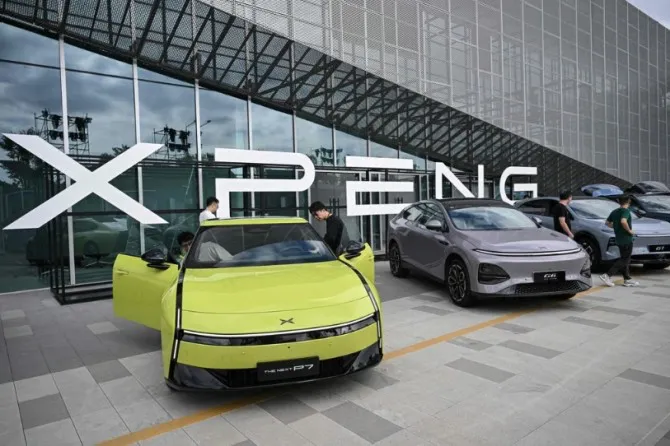
- Xpeng launched China's first mass-produced robotaxi in Guangzhou, targeting H2 2026 pilot ops and fully driverless service by early 2027
- The GX platform vehicle uses pure vision, four Turing AI chips at 3,000 TOPS, and VLA 2.0 — a direct challenge to Tesla and Baidu in the world's largest auto market
Chinese EV maker Xpeng launched China's first mass-produced robotaxi in Guangzhou on May 18, targeting pilot operations in H2 2026 and fully driverless service by early 2027. The L4-capable vehicle uses pure vision without LiDAR — a direct challenge to Tesla, Baidu, and Geely's growing robotaxi fleets.
Xpeng has fired the starting gun on mass-produced robotaxis in China. The company unveiled its first production robotaxi unit at its Guangzhou headquarters Monday, built on the GX platform — billed as China's first "production-ready, pre-assembled robotaxi model developed entirely with in-house technologies." Pilot operations begin in the second half of 2026, with fully driverless service targeting early 2027.
China's First Mass-Produced Robotaxi — Pure Vision, No LiDAR
Xpeng's robotaxi packs four in-house Turing AI chips delivering up to 3,000 TOPS of on-board computing power — currently the highest globally, the company says. Like Tesla, Xpeng's approach uses pure vision plus AI models rather than LiDAR or high-definition maps, aiming for a system that adapts to diverse global road environments.
- GX platform, L4 autonomous driving standard
- Four Turing AI chips — 3,000 TOPS (top global on-board compute)
- Pure vision, no LiDAR, no HD maps
- Dual-redundancy hardware architecture for fail-safe switching
Roadmap: H2 2026 Pilots, Early 2027 Fully Driverless
Xpeng will launch pilot robotaxi operations in Guangzhou in the second half of this year to test technical viability, user acceptance, and its business model. President Brian Gu told Reuters last month the company will likely produce hundreds to thousands of vehicles over the next 12 to 18 months. Full driverless operations — no on-site safety officers — are targeted for early 2027.
This represents a critical inflection point as the robotaxi industry transitions from technical validation to large-scale commercialization.
CNEVPost
VLA 2.0 Brain — Volkswagen Is the First Global Customer
The robotaxi runs on Xpeng's second-generation Vision-Language-Action model, VLA 2.0. The system is designed for generalization learning — adapting to traffic conditions worldwide — with international road testing set to begin soon. Volkswagen is the first external customer for VLA 2.0 in the Chinese market. An industry-first external sun visor display enables visual interaction with pedestrians during low-speed driving and parking, improving safety at the edge cases where robotaxis are most vulnerable.
Physical AI Triangle: Robotaxi, Humanoid Robot, Flying Car
Xpeng frames robotaxis as one leg of its broader Physical AI strategy. The humanoid robot IRON targets mass production by end of 2026, and flying car brand ARIDGE is pursuing a separate IPO. All three products share the same VLA AI foundation model — Xpeng's bet that a unified AI stack can power multiple intelligent machines.
- Robotaxi: GX platform, H2 2026 pilot operations
- Humanoid robot IRON: mass production target end of 2026
- Flying car ARIDGE: separate IPO in progress
- All three share VLA AI stack — "Physical AI Full Stack" strategy
China's Autonomous Race Is Heating Up
Competition is intensifying across the board. Geely's Caocao announced plans to deploy thousands of custom robotaxis in 2027. Baidu Apollo is already running paid robotaxi services in Wuhan and Shenzhen. Tesla's Supervised Robotaxi is operating in Austin but faces scrutiny after two crashes were confirmed in NHTSA filings. Xpeng's mass-production milestone reshapes the competitive hierarchy.
Xpeng's robotaxi launch marks the moment China's autonomous driving race shifted from "when is it possible?" to "who scales first?" The H2 2026 pilot results and the 2027 full driverless transition will determine who wins this race.
Frequently Asked Questions
When can passengers ride Xpeng's robotaxi?
Pilot operations begin in Guangzhou in H2 2026. The initial phase will use supervised operations with safety personnel on standby. Fully driverless service without on-site officers is targeted for early 2027.
Can L4 autonomous driving work without LiDAR?
Xpeng, like Tesla, is betting on pure vision plus AI models instead of LiDAR. Four Turing AI chips delivering 3,000 TOPS handle complex road environments without expensive LiDAR sensors. The approach lowers costs and enables adaptation to diverse global traffic conditions.
What is VLA 2.0?
VLA 2.0 is Xpeng's second-generation Vision-Language-Action AI model. It uses generalization learning to adapt to traffic conditions worldwide without relying on HD maps. Volkswagen is the first external customer for VLA 2.0 deployment in the Chinese market.
How does this compare to Tesla's robotaxi?
Tesla operates Supervised Robotaxis in Austin but has faced scrutiny after two crashes emerged in NHTSA filings, and full driverless transition remains uncertain. Xpeng has achieved China's first mass production milestone and is targeting early 2027 for fully driverless operations — positioning ahead of Tesla in the Chinese market.
What does this mean for XPEV as an investment?
Mass-producing robotaxis marks a potential transition from EV maker to autonomous driving platform company. However, execution risk remains at each stage: H2 2026 pilot, 2027 full driverless, and eventual monetization. Actual operational results versus Baidu Apollo and Geely Caocao will be the real valuation catalyst.

Veritone Earnings Shock Sends Shares Down 23%...York Space Systems Among 25 US Companies Filing SEC 8-K Earnings Reports
 YSS
YSS CODX
CODX IPWR+26
Coherent, Performance Food Among 25 US Firms File SEC 8-K Earnings Disclosures as AI Chip, Biotech Earnings Season Kicks Off
 COHR
COHR CBRS
CBRS AOSL+21
Datadog Q2 Revenue Hits $1.12B, Up 36% YoY — Stock Falls Despite Beat
 DDOG
DDOGWall Street's Defining Moments
See more

Sunday's SEC 8-K Earnings Filings Quiet, but Royal Gold Doubles Net Income and Launches Buyback
 RGLD
RGLDVeritone Earnings Shock Sends Shares Down 23%...York Space Systems Among 25 US Companies Filing SEC 8-K Earnings Reports
YSSCODXIPWR+26Applied Materials Posts Record Q3 Revenue of $9.1 Billion, All-Time High EPS
 AMAT
AMATSmart Money Briefing
Weekly summaries of Wall Street guru moves and crypto whale activity.