First full quarter since Zepbound's prescription reversal — while Novo Nordisk weighs earnings surprise potential against a declining revenue outlook
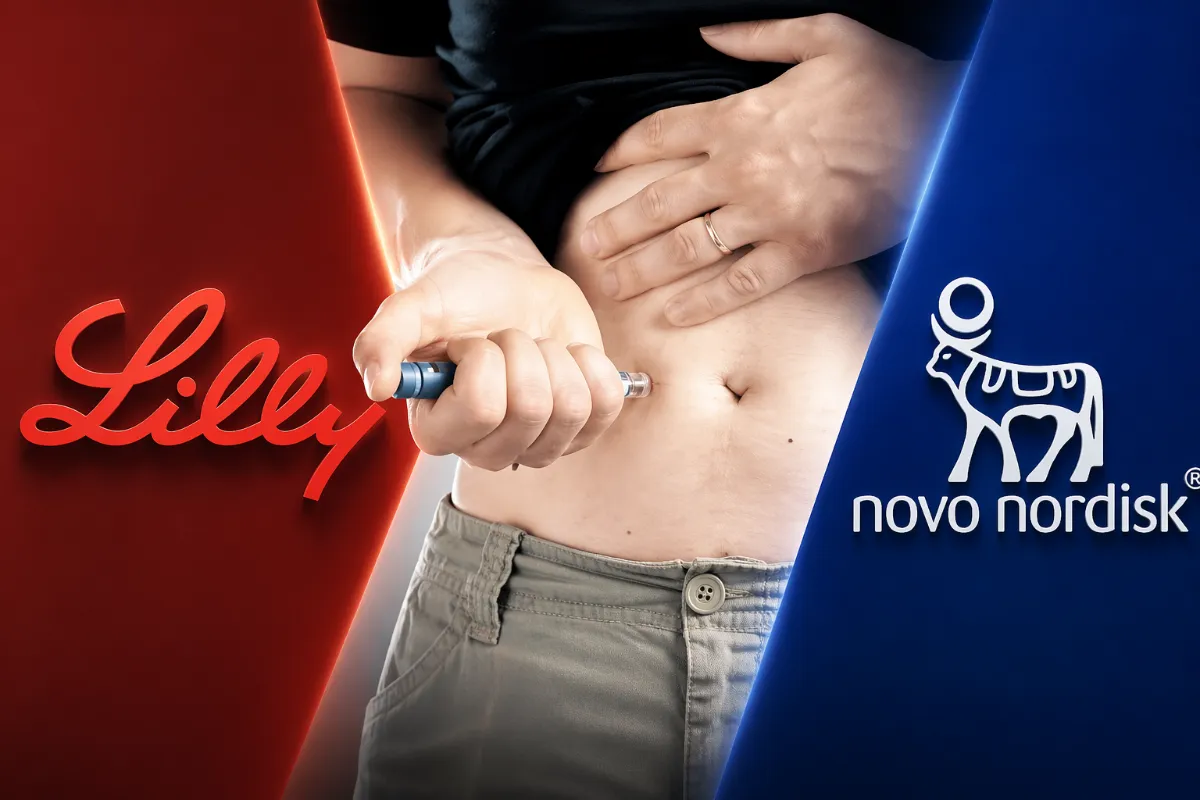
The two dominant players in the global obesity therapeutics market are approaching back-to-back earnings releases. Eli Lilly (LLY) reports its Q1 2026 results on April 30, followed by Novo Nordisk (NVO) on May 6. With the global obesity drug market having grown to an estimated $46 billion in 2025, the two companies are heading in starkly opposite directions — making these reports potential sector-wide catalysts.
Lilly: The 44.7% Growth Story Is Far From Over
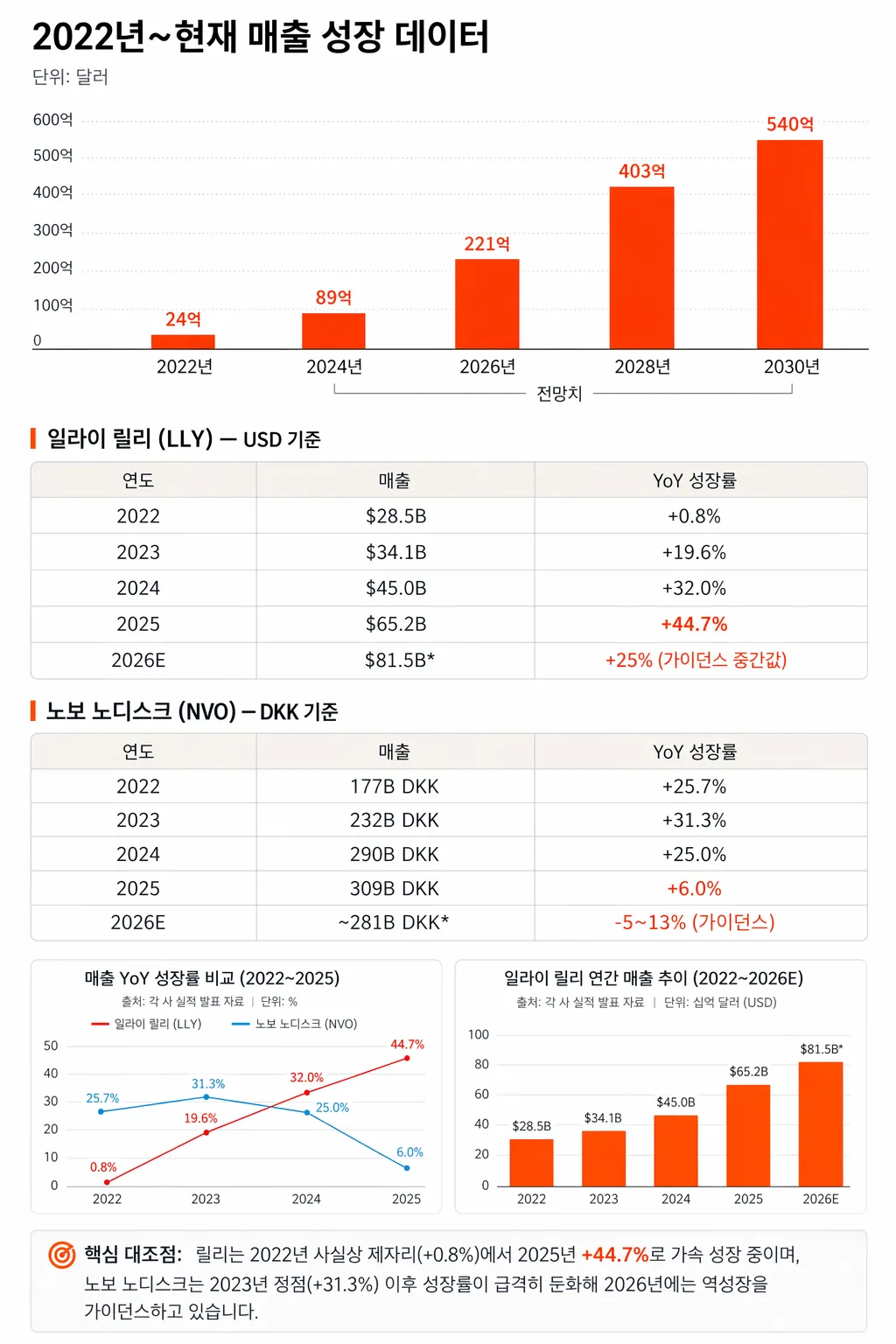
Eli Lilly's growth trajectory over the past four years has been exceptional by any standard. Revenue climbed from $28.5B in 2022 (YoY +0.8%) to $34.1B in 2023 (+19.6%), $45.0B in 2024 (+32.0%), and $65.2B in 2025 (+44.7%) — an accelerating curve where the growth rate itself has expanded each year. The midpoint of management's 2026 guidance stands at $81.5B (+25%), indicating some moderation in pace but still marking five consecutive years of double-digit top-line growth.
Last quarter's results reinforced this momentum. Lilly posted EPS of $7.54 (vs. consensus $7.48) and revenue of $19.29B (vs. consensus $17.85B), delivering a meaningful earnings beat. The standout was Zepbound (tirzepatide), which generated $4.3B in Q4 revenue against analyst expectations of $3.41B. Q1 consensus currently sits at EPS of $7.26 and revenue of $17.61B.
The key metric to watch in Q1 is how Zepbound performs as the first full quarter since it surpassed Wegovy in total U.S. prescriptions. With the global obesity drug market projected to reach $54B by 2030, investors will be focused on whether Lilly can continue pressing its market share advantage aggressively. The anticipated H2 2026 launch of orforglipron, Lilly's oral obesity candidate, is also being cited as an additional growth catalyst.
Novo Nordisk: A Sharp Deceleration Since Its 2023 Peak
Novo Nordisk's growth curve tells a very different story. Revenue rose from DKK 177.0B in 2022 (YoY +25.7%) to DKK 232.0B in 2023 (+31.3%), marking the company's apex, before decelerating to DKK 290.0B in 2024 (+25.0%) and DKK 309.0B in 2025 (+6.0%). The company's 2026 guidance points to roughly DKK 281.0B — implying the first outright revenue contraction in years, with a projected decline of 5–13%.
The market reacted swiftly. When Novo Nordisk issued its guidance flagging declining full-year revenue and operating income earlier this year, shares fell a cumulative 18%. The headwinds are multifaceted: pricing pressure from the Trump administration's push to slash GLP-1 drug costs (from over $1,000/month to $245/month), and the onset of generic competition as semaglutide patents expire in key markets.
That said, a growing contingent of analysts argues the bad news is already priced in. The consensus analyst price target sits at $57.40, implying roughly 15% upside from current levels, with 2027 EPS expected to rebound to $4.30–$4.70. For the upcoming Q1 print, investors will be watching early demand data for the recently launched oral Wegovy formulation, as well as the pace of label expansion into new indications including heart failure and chronic kidney disease.
The Market Share Shift Is Accelerating
The growth rate reversal between these two companies is more than a statistical curiosity — it reflects a fundamental shift in competitive dynamics. As recently as 2022, Novo Nordisk was growing at +25.7% while Lilly sat at just +0.8%. In three years, the situation has completely flipped. Zepbound's dual GLP-1/GIP mechanism has demonstrated superior average weight loss versus Wegovy in clinical trials, and that clinical edge has translated directly into prescription market share gains.
The global obesity drug market is forecast to reach $54B by 2030 — a more than 22-fold expansion from $2.4B in 2022 over just eight years. The central question heading into this earnings season is which company will capture a disproportionate share of that growth.
Korean Related Stocks — Short-Term Consolidation, Spotlight on Domestic Developers
Korean obesity drug theme stocks, despite gaining +112% over the past year, have entered a consolidation phase over the past month (-2.55%). Companies with proprietary pipelines — including Hanmi Pharmaceutical (in-house GLP-1 development), Peptron, and Inventage Lab — continue to trade on their own independent momentum, decoupled from the global incumbents. A strong Lilly print could lift sentiment for domestic GLP-1 developers on the back of broader market growth optimism, while any further warnings from Novo Nordisk could serve as a near-term headwind for the sector as a whole.
Data Reference
Eli Lilly Q1 2026 Earnings Date: April 30, 2026 | Novo Nordisk Q1 2026 Earnings Date: May 6, 2026 | Market size figures sourced from industry consensus estimates