First-ever release spans 1940s sightings to Buzz Aldrin testimony · Polymarket 21% bet · RTX backlog $268B
The Pentagon released 162 previously classified UFO (UAP) files for the first time on May 8 through a new portal at war.gov/ufo. The disclosures span 1940s sighting reports, Buzz Aldrin's 1969 testimony, and military camera footage from the East China Sea, Iraq, Syria, and the UAE. The release follows President Trump's February 2026 directive to federal agencies to declassify UAP documents. It is the first publication from the PURSUE program, a joint effort by the White House, ODNI, the Department of Energy, the FBI, and NASA.
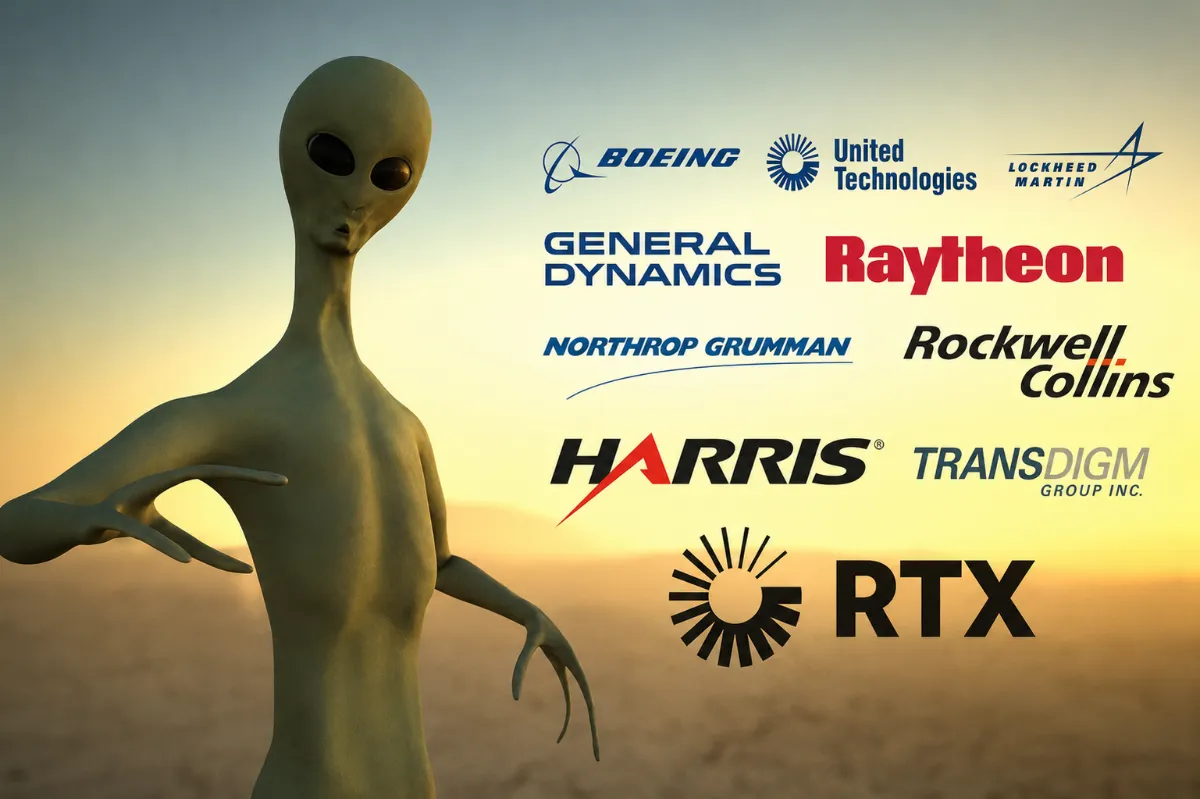
Barron's framed the news through an aerospace and defense investing lens. Two tickers got named: RTX and ITA.
What the files actually say — verdict: "we don't know"
The Pentagon's 2024 report concluded that no evidence had been found of recovered extraterrestrial technology or sightings of alien life. Most cases were attributed to weather phenomena, balloons, birds, or satellites. All 162 newly released files are classified as "unresolved." The government itself has not pinned down the nature of the phenomena. Fortune captured the Pentagon's posture: release the records, let the public draw its own conclusions.
RTX — why it gets named as a UAP detection beneficiary
RTX (Raytheon Technologies) is one of the largest U.S. defense primes, producing missiles, radars, and defense electronics. Q1 2026 revenue came in at $22.1 billion with 21% EPS growth. Total backlog stands at $268 billion, including $107 billion in defense.
Barron's mentioned RTX not for fundamentals but for positioning. RTX wins DARPA contracts for advanced sensor and detection systems, putting it on the short list of UAP-detection-tech beneficiaries. The thesis: as declassification proceeds, demand for detection and tracking infrastructure should rise structurally. RTX was modestly lower at the time of publication.
ITA — betting on the defense sector, not the UFO theme
ITA (iShares U.S. Aerospace & Defense ETF) is BlackRock's 44-stock sector ETF for U.S. aerospace and defense.
- Largest holding: GE Aerospace 19.5%
- Second: RTX 15.1%
- Third: Boeing 10.2%
- FY2026 return: 11.67%
Barron's logic for ITA is straightforward: investors who want exposure to the defense narrative without single-name UFO-theme risk get a diversified vehicle. ITA was up at the time of publication.
Polymarket 21% — what prediction markets see
On Polymarket, post-disclosure betting on whether the U.S. government will officially acknowledge extraterrestrial life pulled $33 million in volume, pushing the probability to 21%. Prediction market participants stake real money and tend to process information more carefully than polls. One in five betting on official acknowledgement is not a number to dismiss.
What Barron's warned — classified is still classified
Barron's sharpest point lands here. The 162 files are public, but a great deal of military technology remains classified. The information that actually matters could still be inaccessible to investors. UAP-related themes sit in a domain where information asymmetry is structurally extreme.
UFO-themed ETFs look like cleverly marketed bundles of overvalued defense stocks. Without actual disclosure of alien technology, they are likely to spike and revert.
Forbes
What this says
Barron's naming RTX and ITA in the UFO disclosure piece is not a recommendation to chase a theme. The point is twofold: defense-sector fundamentals are solid regardless of the UFO narrative, and continued declassification could structurally lift demand for detection and tracking infrastructure. Read the sector fundamentals, not the headline.