
OpenEden & Kaia Surge Together on Clarity Act — US Treasury Tokenization RWA Now
OpenEden surged 160% from its recent low after the Clarity Act cleared the U.S. Senate Banking Committee. Kaia rose in tandem through its USDO integration on the Kaia chain. Securing seven more Democratic votes in the Senate floor vote is the key variable.
- OpenEden (EDEN) surged 160% from its recent low after the Clarity Act passed the U.S
- Senate Banking Committee
- Kaia (KAIA) rose in tandem through OpenEden's USDO stablecoin deployed on the Kaia chain; securing seven more Democratic votes in the Senate floor vote is the key variable
On May 14, when the U.S. Senate Banking Committee passed the Clarity Act, the RWA sector moved in unison. Bitcoin reclaimed $85,700 and Coinbase and Robinhood each climbed more than 5%. OpenEden and Kaia surged together inside that wave.
To understand why two projects rose on the same day for the same reason, you need to see how they are connected.
What Is OpenEden
A Singapore-based RWA (real-world asset tokenization) platform. It issues U.S. Treasuries as an on-chain token called TBILL and distributes yields directly to holders — without complex off-chain procedures. Anyone can access U.S. Treasury income.
Its credentials are solid. S&P Global AA+ rating and a Moody's A-bf investment-grade rating — the first time a tokenized RWA product has received investment-grade credit ratings. It holds 63% of tokenized treasury market share on XRPL (Ripple blockchain). Binance Labs and Ripple have made strategic investments, and TVL crossed $150 million by end of 2024.
One point to be precise about: BlackRock's BUIDL leads the overall RWA market at over $2.2 billion TVL. OpenEden leads in the regulated treasury-tokenization category, not RWA overall.
Why Kaia Moved Too
The OpenEden-Kaia connection started in December 2025, when OpenEden officially launched USDO — a U.S. Treasury-backed yield-bearing stablecoin — on the Kaia chain. Kaia is a platform focused on connecting on-chain finance and everyday applications, primarily in Asian markets, with stablecoin infrastructure at its core.
USDO lets Kaia ecosystem users put U.S. Treasury yields to work as collateral for DeFi, payments, and on-chain financial products. If the Clarity Act clarifies the legal status of tokenized treasury products, USDO's use cases expand. When OpenEden benefits, demand for USDO on Kaia rises with it — a connected structure.
Why the Clarity Act Is a Direct Catalyst
The Clarity Act classifies digital assets as securities, commodities, or other assets and draws a clear line between SEC and CFTC jurisdiction. Until now, whether tokenized treasuries and corporate bonds are securities has been legally ambiguous. Resolving that uncertainty gives institutional investors a legal basis to deploy capital into RWA products more aggressively. OpenEden's TBILL and USDO are positioned to receive the most direct benefit.
Catalysts Stacking in 2026
- January: Launched institutional yield portfolio PRISM; FalconX and Monarq partnerships
- February: XRPL integration allows XRP and RLUSD holders to access Treasury yields
- April: Expanded product range with high-yield corporate bond (junk bond) tokenization
- May: USDO TVL crossed $50 million; Clarity Act momentum added
Total on-chain RWA TVL has surpassed $21 billion. RWA was a central theme at Davos 2026. DTCC, BlackRock, and JPMorgan are aggressively investing in tokenization infrastructure, lifting credibility across the RWA sector.
+160% from Recent Low, -96% from All-Time High
OpenEden's recent low was approximately ₩38.70 (about $0.028). It is now trading near ₩100. The 160% rebound is accurate. But the all-time high was approximately ₩2,603 in September 2025. From that peak, the token is still down 96%.
You can read that as 'undervalued,' but you need to first understand why it fell so far. Selling pressure from initial token unlock after TGE is cited as the main cause. If the early supply overhang has been absorbed, a sustained recovery is possible — but some argue meaningful FDV-based sell pressure remains.
Risk — The Clarity Act Still Needs the Senate Floor
The biggest variable is the Senate floor vote. Sixty votes are required. One Democratic senator is currently committed. Seven more are needed. Galaxy Research says that if the vote is not resolved before the August recess, passage this year becomes practically impossible.
- Expectations are already priced in — a delay could trigger a fast reversal
- Extreme volatility in low-liquidity periods
- Competition from BlackRock, Ondo Finance, and others with far greater capital
Frequently Asked Questions
Why should we look at EDEN and KAIA together?
OpenEden deployed USDO on the Kaia chain. If the Clarity Act passes and USDO demand grows, both the OpenEden (EDEN) and Kaia (KAIA) ecosystems benefit. This is why the two tokens moved on the same day for the same reason.
What is the difference between TBILL and USDO?
TBILL is a direct tokenization of U.S. Treasuries — an income-generating asset. USDO is a yield-bearing stablecoin issued on top of those Treasury yields. Holding it returns Treasury income on-chain. TBILL is closer to an investment product; USDO is more broadly used for payments and DeFi collateral.
How does OpenEden compare to BlackRock's BUIDL?
BlackRock BUIDL targets institutional investors with high minimum investments. OpenEden offers broader access and is integrated with XRPL and the Kaia ecosystem, making it more retail-friendly. They target different customer segments in the same treasury tokenization market.
What happens if the Clarity Act fails?
Expectations are already priced in, so a fast pullback is possible. That said, the structural growth of the RWA tokenization market continues regardless of the Clarity Act, so the medium-to-long-term direction would not fundamentally change.

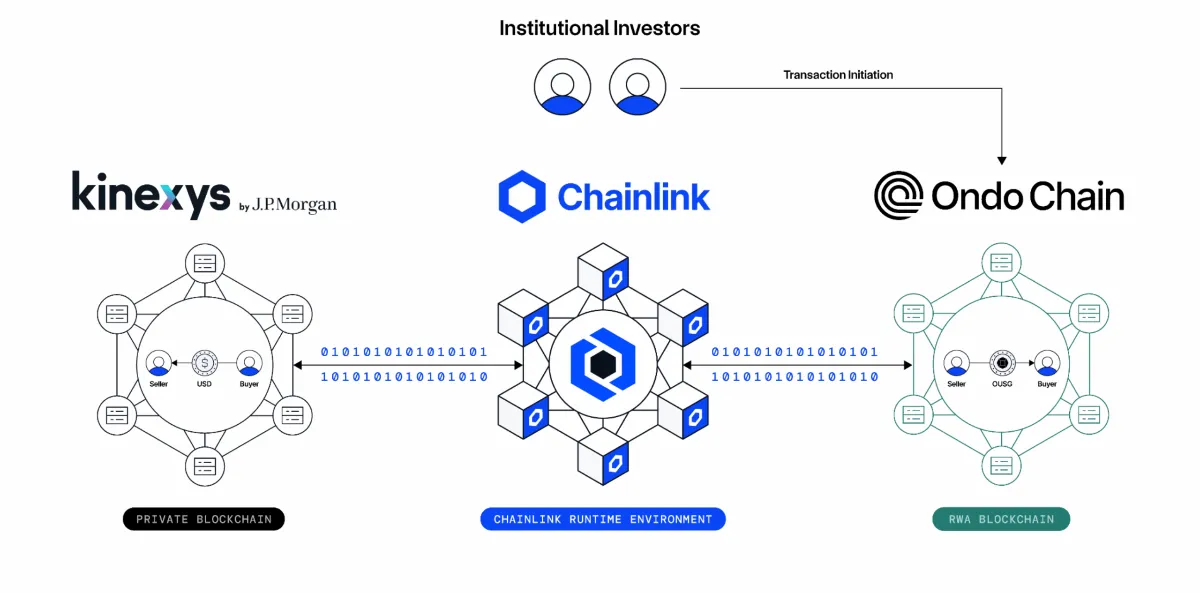
JP Morgan and Chainlink Lead the Top 15 On-Chain Finance Infrastructure Firms — Where Institutional Money Flows
 LINK
LINK BTGO
BTGO PYTH
PYTH
SEC Tokenized Stock 'Innovation Exemption' Expected Imminently — Hyperliquid Already Holds $1.2B Market
 COIN
COIN HOOD
HOOD
Goldman Sachs Dumps All XRP and Solana ETFs — Market Maker Exit or Strategic Profit-Taking?
 XRP
XRP SOL
SOL BTC
BTCWall Street's Defining Moments
See more
Sunday's SEC 8-K Earnings Filings Quiet, but Royal Gold Doubles Net Income and Launches Buyback
 RGLD
RGLDVeritone Earnings Shock Sends Shares Down 23%...York Space Systems Among 25 US Companies Filing SEC 8-K Earnings Reports
 YSS
YSS CODX
CODX IPWR+26
Applied Materials Posts Record Q3 Revenue of $9.1 Billion, All-Time High EPS
 AMAT
AMATSmart Money Briefing
Weekly summaries of Wall Street guru moves and crypto whale activity.