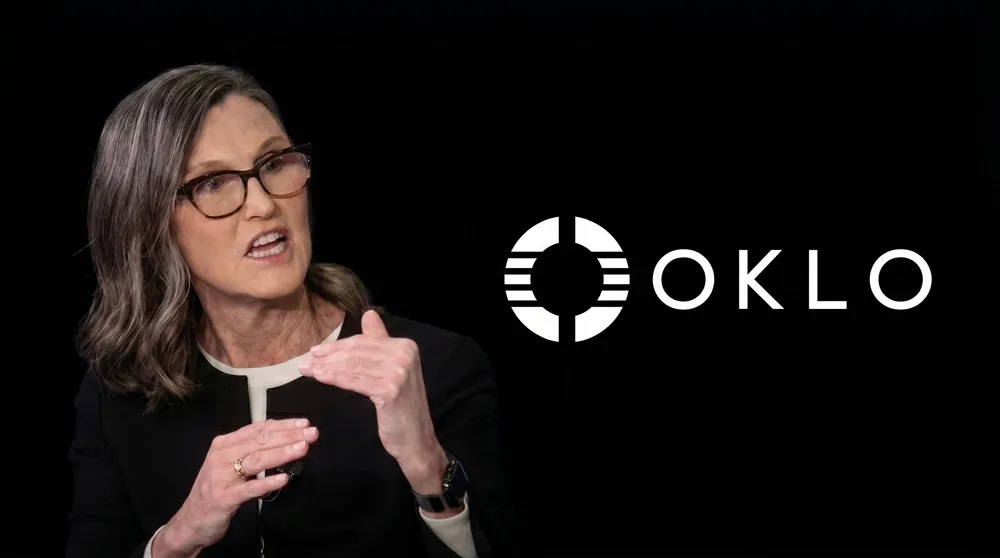
As the AI revolution shakes the dollar-based monetary order and the outlines of an 'Energy Standard' come into view, global Big Tech is shifting its gaze squarely toward power infrastructure. At the center of this shift, small modular reactor (SMR) company Oklo (NYSE: OKLO) and ARK Invest are commanding the market's attention.
Oklo's share price has endured a painful correction of roughly 74% from its 52-week high. What stands out is the trading pattern of Cathie Wood. Wood took profits on approximately 55,000 shares (~$7.7M) on the very day Oklo hit its 52-week high of $142.85 in September 2025 — then pivoted decisively as the stock collapsed from December 2025 onward. She purchased roughly 107,000 shares (~$8.93M) on December 23rd and an additional ~34,000 shares in January 2026, accumulating a total of approximately 360,000 shares (~$17.3M) during the drawdown without pause.
Sell at the top, accumulate at the bottom — a textbook contrarian playbook. It echoes the pattern of buying Tesla through skepticism during its 'Production Hell' era. Behind it all lies a single decisive milestone: July 4, 2026.
The Countdown to 'D-Day' — The DOE Criticality Deadline
The 'Reactor Pilot Program' launched by the U.S. Department of Energy (DOE) under Trump administration Executive Order 14301 has one clear objective: at least three advanced reactors outside national laboratories must achieve 'Criticality' by July 4, 2026 — the 250th anniversary of American independence. Criticality is the state in which a reactor sustains a self-sustaining nuclear chain reaction stably, without runaway escalation or shutdown — the critical gateway that proves a design actually works.
The DOE selected 11 projects in its first round last August, and Oklo secured the most slots of any participant — with three projects selected, including its subsidiary Atomic Alchemy. Unlike the conventional NRC licensing pathway, which typically takes years, Oklo is on a fast-track, leveraging DOE authority granted under the Atomic Energy Act to bypass the standard NRC license process.
Waste-to-Fuel — Oklo's Structural Moat
Oklo's 'Aurora' reactor is not a design drawn from scratch. It is a 75MWe-class liquid metal-cooled fast reactor that inherits the real-world operational data and legacy of the EBR-II (Experimental Breeder Reactor II), which ran at Idaho National Laboratory (INL) for over 30 years beginning in 1964.
Its most powerful advantage is spent nuclear fuel recycling capability. The single greatest bottleneck facing the global SMR industry today is the shortage of High-Assay Low-Enriched Uranium (HALEU) fuel. Oklo has adopted a closed fuel cycle that converts waste back into fuel. It has also been selected under the DOE's Nuclear Fuel Line Pilot Program to build three fuel fabrication facilities for the Aurora and its second project, 'Pluto.' Oklo is effectively the only SMR developer with a self-sustaining, vertically integrated fuel value chain independent of external supply disruptions.
The 1.2GW Contract with Meta — A Differentiated Business Model
On January 9, 2026, Meta announced a combined 6.6GW nuclear power agreement with three companies — Oklo, Vistra, and TerraPower. Oklo's share of the deal is a 1.2GW advanced nuclear campus in Pike County, Ohio. Pre-construction is slated to begin in 2026, with Phase 1 operations targeted for 2030 and full operations by 2034.
The critical detail is the contract structure. This is not a simple MOU — Meta is prepaying for electricity and funding early-stage development costs. Oklo's stock surged 15% on the announcement date. More notable still is the business model: Oklo has chosen a fully vertically integrated approach, handling design, construction, and operations through to direct power sales under long-term Power Purchase Agreements (PPAs). By distributing electricity as a direct commercial product, Oklo has positioned itself at the front lines of the coming energy dominance race.
Remaining Risks — And the Market's Verdict
The risks are clear-cut. Near-term dilution from the At-the-Market (ATM) equity program, a revenue gap until commercial sales ramp in late 2027, and the substantial CAPEX financing burden ahead of the expected profitability inflection around 2030 are all priced into the stock's decline.
Ultimately, the answer to this complex equation converges on a single question: will Oklo achieve criticality by July 4th? A successful technical demonstration would accelerate the Meta campus timeline and unlock non-dilutive financing pathways — including project finance (PF) structures backed by long-term PPAs. Cathie Wood's re-accumulation is squarely targeting the chain reaction of catalysts that single event would trigger.
At the threshold of an 'Energy Standard' era — where AI compute becomes capital and electricity functions as the de facto reserve currency — all eyes are on whether Oklo can establish itself as the Anchor of a new age on July 4th.
Key Sources: U.S. Department of Energy (DOE), official Meta and Oklo announcements, World Nuclear News, Utility Dive, ARK Invest trading disclosures