
Epstein's Alleged Suicide Note Unsealed After 7 Years in Federal Court
A memo believed to be Jeffrey Epstein's suicide note, sealed in New York federal court for seven years, was unsealed on May 6. A fellow inmate discovered it, but investigators never obtained it officially. The memo references failed investigations and contains a farewell message.
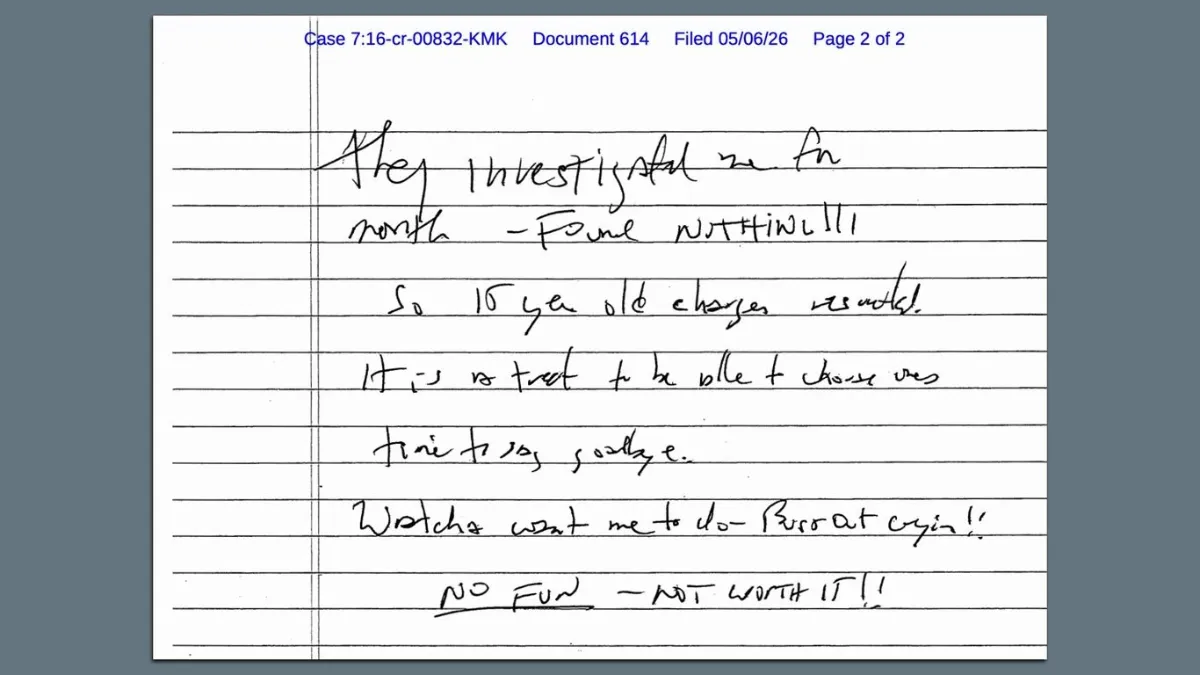
- Epstein's alleged suicide note was unsealed May 6 after seven years in federal court, containing references to failed investigations and a farewell
- Authorities never officially secured the memo, which was discovered by a cellmate and sealed due to attorney disputes
Discovered by fellow inmate; sealed due to attorney disputes; investigators ultimately failed to secure it
Seven years after billionaire sex offender Jeffrey Epstein's death in a New York jail in August 2019, a memo believed to be his suicide note has been made public. The U.S. District Court for the Southern District of New York unsealed the document on May 6.
From Discovery to Sealing
The memo was first discovered by Epstein's cellmate, Nicholas Tartaglione. In July 2019, after Epstein was found with neck wounds and transferred to another cell, Tartaglione claimed he found the note hidden between pages of a book left in the cell.
Tartaglione handed the memo to his attorney. Disputes between defense counsel led to the document being sealed by the court. Investigators never officially obtained it as part of their investigation. It was not included in the 2023 Department of Justice report.
Unsealing proceedings began after The New York Times reported the memo's existence on May 1 and petitioned the court for its release.
What Does the Memo Say?
The released memo contains three key elements: a statement that multiple investigations found nothing; the phrase "what do you want me to do, cry?"; and the words "it's time to say goodbye." Defense attorneys claimed to have authenticated it through handwriting analysis, but investigators have not officially confirmed its authenticity.
Official Cause of Death and Disputes
Both the New York Medical Examiner and the Department of Justice concluded the official cause of death was suicide. However, forensic pathologist Michael Baden, hired by Epstein's representatives, disputed this, noting that the neck fracture pattern was consistent with strangulation.
Why Renewed Attention Now?
This case continues to draw scrutiny seven years later because Epstein was not simply a sex offender. Over decades, he cultivated deep relationships with politicians, royalty, corporate executives, and academics. These connections risked being exposed through public trial proceedings. His pre-trial death left numerous unanswered questions.
The memo's release neither fully resolves nor reinforces these suspicions. However, the fact that a document investigators failed to secure for seven years was held in a federal vault underscores the opacity surrounding this case.


Over Half of America's Largest Cities See Home Price Declines — Case-Shiller Hits Weakest Since July 2023
 DHI
DHI LEN
LEN EQR+2
EQR+2
What a Kevin Warsh-Led Fed Means for Big Bank Stocks: Deregulation vs. Quantitative Tightening
 JPM
JPM BAC
BAC WFC
WFC
Inflation Fears Rattle Industrial Metals — Copper at $13,477, Aluminum and Zinc Face Dual Pressure
 FCX
FCXWall Street's Defining Moments
See more



Sunday's SEC 8-K Earnings Filings Quiet, but Royal Gold Doubles Net Income and Launches Buyback
 RGLD
RGLDVeritone Earnings Shock Sends Shares Down 23%...York Space Systems Among 25 US Companies Filing SEC 8-K Earnings Reports
 YSS
YSS CODX
CODX IPWR+26
Applied Materials Posts Record Q3 Revenue of $9.1 Billion, All-Time High EPS
 AMAT
AMATSmart Money Briefing
Weekly summaries of Wall Street guru moves and crypto whale activity.