
Low-Float Coin Market Manipulation Dissected — 5-Stage Short Squeeze, Bot Pump-and-Dump Patterns & Pre-Entry Checklist
A 7-month analysis of low-float tokens reveals two distinct market manipulation patterns: the 5-stage short squeeze and coordinated bot pump-and-dump. Learn 5 real-time detection indicators and a 15-point pre-entry checklist for retail investors.
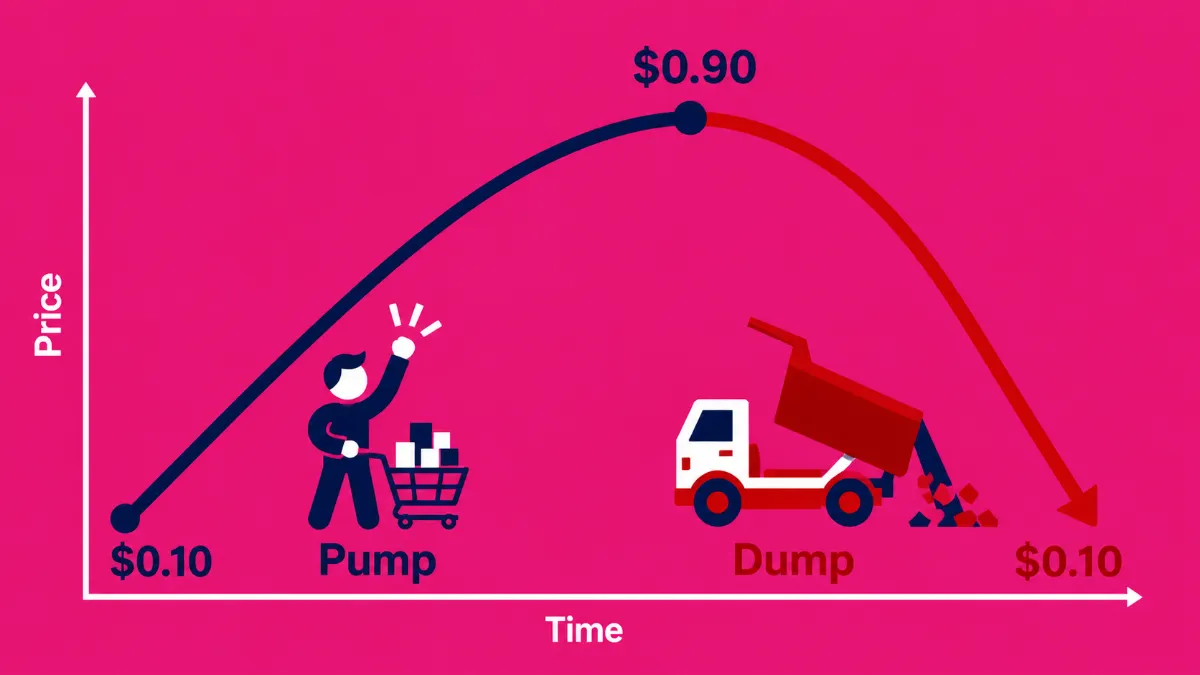
- Low-float token manipulation follows two repeating patterns: 5-stage short squeezes (accumulation→short bait→trap→squeeze→exit) and bot-coordinated pump-and-dumps
- Monitor funding rates, OI vs
- price, taker ratios, on-chain transfers, and Vol/OI ratios simultaneously to detect manipulation phases in real-time
Seven-month low-float token analysis — The blueprint behind 5-stage short squeezes and bot pump-and-dumps
Crypto remains one of the few markets where ordinary people can change their lives. But if the game is rigged from the start, the outcome is predetermined. Analysis of 7 manipulated low-float tokens on the BNB Chain over 7 months revealed two distinct patterns. The result is always the same — retail investors become exit liquidity.
Pattern 1 — Sophisticated 5-Stage Short Squeeze
Stage 1: Covert Accumulation
Multiple wallets execute thousands of micro-purchases. Each wallet fragments its trades to evade detection thresholds, accumulating tokens in small amounts. Simultaneously, other wallets relay USDT deposits into the liquidity pool in coordinated succession. When one wallet pauses, the next resumes — a relay structure designed to dodge surveillance while deepening the pool.
Stage 2: Short Bait
The token undergoes hundreds to thousands of percent in days. The pump is obviously unsustainable. Cautious traders who check fundamentals conclude "this screams short squeeze" and establish short positions. This is exactly the reaction the manipulators engineered.
Stage 3: The Trap
Sideways consolidation for roughly a month ensues. During this period, funding rates flip deeply negative. Short holders bleed -2% every 4 hours, -12% daily. The manipulators liquidate their initial long positions and re-enter at lower prices. More shorts accumulate.
Stage 4: The Squeeze
Price explodes upward, triggering cascading short liquidations. Each liquidation triggers buying pressure, which triggers the next liquidation — a chain reaction. Open interest balloons hundreds of percent; daily liquidation volume reaches tens of millions of dollars.
Stage 5: Exit
After shorts are fully liquidated, manipulators close longs, flip to shorts, and begin transferring tokens to exchanges. On-chain analysts spot the transfers and conclude "dump incoming" — so they short again. Those shorts get squeezed one more time before the actual dump begins.
Pattern 2 — Dozens of Bots Execute Blitzkrieg Pump-and-Dump
This variant requires no 5-stage orchestration. Extremely low float alone is sufficient — just deploy bots.
Dozens of wallets receive identical funding at the same time and execute nearly identical automated trading strategies. When viewed on Bubblemaps, the wallets are visibly sourced from the same fund, and their trading patterns are unmistakably algorithmic, not human.
On the day of derivatives exchange listing, price surges multiples of its pre-listing level. Open interest balloons to hundreds of millions, then collapses sharply post-ATH. The entire cycle completes in days.
Common Design Elements Across Both Patterns
Extreme Low Float: When circulating supply is only 10–20% at TGE, millions in capital can move price 10–100x. Both patterns collapse without this structural precondition.
BNB Chain: Ultra-low transaction fees and direct pipeline into Binance Alpha. Multi-chain deployment expands the attack surface.
Binance Alpha → Binance Futures Pipeline: The sequence is BNB Chain launch → Binance Alpha → Binance Futures listing. The futures listing is critical — it enables leverage liquidation cascades.
AI Narrative: AI agent and AI infrastructure branding supplies the pump with a story. Retail flows more readily into AI-labeled tokens than into random BNB Chain noise.
Coordinated Wallet Accumulation: Dozens to hundreds of wallets receive funding from an identical source and buy in coordinated patterns. Visually verifiable on Bubblemaps.
Real-Time Manipulation Detection — 5 Key Indicators
Funding Rate: Sustained negative funding signals an active squeeze. Flip to positive, and shorts are exhausted — no more fuel for squeezing.
Open Interest vs. Price: Both rising simultaneously means the squeeze is alive. OI rising as price falls signals shorts regaining control.
Taker Ratio: Buyers continuously absorbing sell-side order book for hours indicates squeeze in progress. Sellers dominating consecutively signals distribution (dump) phase.
Large On-Chain Transfers: Large wallet movements to exchanges can signal exit — or a trap to lure fresh shorts. Cross-reference with other indicators.
Volume-to-OI Ratio: Exceeding 20x suggests heavy wash trading. Normal tokens trade at 3–8x.
Pre-Entry Checklist for Retail Investors
Should you enter this token? Run through the items below before hitting buy.
Token Fundamentals
- Check circulating supply on CoinGecko — flag if below 20% of total supply
- Review vesting schedule — beware imminent large unlocks
- Does the project have real users and transaction volume, or only AI narrative?
Chain and Exchange Checks
- Is it BNB Chain + Binance Alpha + Binance Futures pipeline?
- Recently listed on derivatives exchanges? — Post-listing window is highest risk
- Is trading volume abnormally concentrated on a single exchange?
Wallet Analysis (Using Bubblemaps)
- Do a few wallets control 40%+ of circulating supply?
- Did wallets receive funding from an identical source?
- Do wallet trading patterns resemble bots more than humans?
Derivatives Checks (Using Coinglass, CoinAnk)
- Is Volume-to-OI ratio exceeding 20x? — Suggests volume manipulation
- Has funding rate stayed at extreme negative (-0.05%+) for an extended period?
- Did OI spike hundreds of percent in days?
Price Action Checks
- Did it surge hundreds to thousands of percent in recent days?
- Did a month-long consolidation follow the spike? — Classic Stage 3 trap signal
- Did large token transfers to exchanges coincide with the price surge?
Final Decision Rule: If 5 or more checklist items apply, do not enter. The odds of retail beating a rigged manipulation structure shrink with every passing hour. The only winning play is not to participate in a rigged game.
Frequently Asked Questions
What is a low-float token?
A token with only 10–20% of total supply in circulation at TGE (Token Generation Event). Lower float enables manipulators to move price dramatically with relatively small capital, making them prime manipulation targets.
What is exit liquidity?
The pool of buy orders that absorb a manipulator's sell-off (exit). In rigged structures, retail investors become the exit liquidity — they are the buyers when insiders dump.
What does negative funding rate mean?
Shorts pay longs every 8 hours in perpetual futures. Extreme negatives (-0.05%+) indicate too many shorts; -0.1%+ is critical. Sustained negative funding accumulates leverage for a short squeeze.
How do I use Bubblemaps to detect manipulation?
Enter the token address. The tool visually clusters wallets by funding source. If dozens of wallets appear in the same color (same origin), it indicates coordinated bot networks — a classic manipulation red flag.
Why does the Vol/OI ratio matter?
Volume ÷ Open Interest. Normal tokens: 3–8x. Above 20x suggests wash trading and volume inflation. The simplest single metric to flag manipulated tokens.
Which exchanges are highest risk?
BNB Chain tokens listing on Binance Alpha then Binance Futures. This specific pipeline enables leverage liquidation cascades — essential machinery for squeezes. Avoid this exact sequence.
What's a Stage 3 trap?
After an explosive pump, price consolidates sideways for ~1 month while funding rates turn deeply negative. This trap phase bleeds short traders while insiders reload longs at lower cost before Stage 4 squeeze.
Can retail win against manipulated tokens?
Statistical probability approaches zero over time. The best winning strategy is non-participation. If 5+ checklist items match, the odds are rigged — walk away.
How quickly do bot pump-and-dumps complete?
Days to weeks. On derivatives listing day, price surges multiples. OI balloons to hundreds of millions, then collapses post-ATH. The entire cycle is compressed and brutal for latecomers.
What's the AI narrative angle?
Manipulators brand tokens as AI agents, AI infrastructure, etc. Retail flows more readily into AI hype than random BNB Chain tokens. The narrative is bait to attract retail into the liquidity trap.

Bitwise's Jeff Park: Crypto Is 'NVIDIA Before the AI Boom' — Most Bullish Phase Ever
 BTC
BTC ETH
ETH IBIT+1
Harvard Endowment Trims Bitcoin ETF 43%, Dumps Ethereum ETF After One Quarter — $97M in Realized Losses
IBIT ETHABTC+1
Strategy Adds $2B More Bitcoin — 843,738 BTC Surpasses BlackRock, Becomes World No. 1
 MSTRBTC
Wall Street's Defining Moments
See more





Smart Money Briefing
Weekly summaries of Wall Street guru moves and crypto whale activity.