Best RWA Crypto Coins for the NYSE 24/7 Era — Chainlink, Ondo, USDC, Pendle
As NYSE and Nasdaq move to 24/7 tokenized stock trading, the real beneficiaries are infrastructure coins: Chainlink (LINK), Ondo (ONDO), USDC, Pendle, Solana, and Ethereum. Mechanism-level breakdown of who collects fees at every layer.
- NYSE and Nasdaq's 24/7 tokenized stock trading benefits infrastructure coins, not exchanges: LINK (oracle), ONDO (platform), USDC (settlement), SOL/ETH (layer), PENDLE (yields)
- Each layer collects fees proportional to trading volume
LINK, ONDO, USDC, PENDLE… Beneficiary coins, not beneficiary stocks. Real beneficiaries of 24/7 RWA and tokenized stock trading
NYSE and Nasdaq have begun rolling out 24-hour trading and blockchain settlement infrastructure. While direct beneficiaries include exchanges like Coinbase (COIN) and Robinhood (HOOD), there's a deeper infrastructure layer where specific coins collect fees on every transaction. This is the 'beneficiary coins' perspective, not beneficiary stocks.
The mechanics are straightforward. As tokenized stock trading volume grows, recurring demand emerges across four layers: oracle data, payment stablecoins, settlement Layer 1s, and yield derivative products. The coins positioned exactly at these junctures are LINK, USDC, SOL/ETH, PENDLE, and ONDO.
Chainlink (LINK) — The Utility Pipe for RWA
Every tokenized platform—NYSE, Nasdaq, BlackRock BUIDL, Franklin Templeton—uses Chainlink oracles. Beyond simple price data, it's the only infrastructure simultaneously handling three layers: real-time NAV (Net Asset Value) verification, Proof of Reserve, and Cross-Chain Interoperability Protocol (CCIP).
In March 2026, Amundi (€2.3T AUM), Europe's largest asset manager, launched a €100M tokenized fund with Spico, integrating Chainlink's NAV feed. SWIFT is also testing Chainlink-based bond transfers. As institutions expand RWA, LINK staking and CCIP fee demand grows proportionally.
More platforms generate more oracle queries; those fees flow to node operators and ultimately convert to LINK burning and staking demand. This mechanism directly correlates with RWA market growth trajectory.
Chainlink Benefit Mechanism
Ondo (ONDO) — 58% Tokenized Stock Market Share
As of Q1 2026, Ondo Finance has $3.53B TVL with 58.56% standalone market share in tokenized stocks. Fidelity, PayPal, Mastercard, and JP Morgan completed integration in Q1, and Ondo listed NVDAon and GOOGLon on Binance, enabling 24/7 trading.
Q2 plans include Solana multichain expansion plus a new fee model. Ondo Chain (proprietary L1) launch completes platform vertical integration. Q1 revenue reached $13.26M, representing one of the fastest revenue growth trajectories among on-chain protocols.
Key risk: token unlock schedules. Near-term price pressure is possible. There exists a gap between adoption growth and token supply increases.
USDC — Base Currency of 24/7 Settlement
NYSE's new 24/7 trading platform adopted USDC as the stablecoin payment infrastructure. Settlement between buyers and sellers in tokenized stock trades occurs in USDC. Each unit increase in trading volume correlates with increased USDC issuance and redemption.
Circle (USDC issuer) has fortified its position as the settlement rail for tokenized assets post-2025 IPO. While competition with Tether (USDT) persists, USDC dominance in U.S. institutional markets is solidifying.
Solana (SOL) and Ethereum (ETH) — Settlement Layers
Solana is the top candidate for tokenized stock trading settlement due to high TPS and low fees. Robinhood's L2 is Solana-based. Even with transaction volume spikes, processing costs remain low, ideal for 24/7 micro-trading.
Ethereum holds the #1 position in RWA TVL. Ondo's tokenized U.S. stocks are issued on Ethereum; BlackRock BUIDL also resides on Ethereum mainnet. It offers the highest security and institutional trust as the RWA base layer. Rather than competing, the two chains fulfill complementary roles.
Pendle (PENDLE) — RWA Yield Derivative Hub
Pendle separates future yields from tokenized assets into present-value trading instruments. As U.S. Treasury tokens, corporate bonds, and Nasdaq dividend yields flow into Pendle's platform, RWA-related TVL surged $151M in the last 8 months, with total TVL reaching $1.539B.
With stablecoin TVL exceeding $320B, Pendle's PT/YT (Principal/Yield) mechanism has emerged as a go-to rate hedge tool for institutional RWA assets. The May 2026 update introduced new pools for U.S. Treasuries, private credit, and Nasdaq dividend yields.
Stellar (XLM) — Institutional Payment Layer
Stellar ranks #2 by RWA market cap (FDV: $9B) with +15% seven-day return. The U.S. government and Franklin Templeton's BENJI fund operate tokenized Treasuries on the Stellar network. With low fees and fast settlement, it's positioned as a payment channel for emerging market institutional capital flows.
Quick Reference — Coin Roles and Risks
| Coin | Role Layer | Actual Partners | Key Metric (Q1 2026) | Risk |
|---|---|---|---|---|
| LINK | Oracle & Verification Infrastructure | Amundi, SWIFT, BlackRock, Mastercard | FDV $9.5B · Market Cap $6.9B | Competing oracles emerge |
| ONDO | Tokenized Stock & Bond Platform | Fidelity, JP Morgan, Binance, PayPal | TVL $3.53B · 58% market share | Token unlock pressure |
| USDC | 24/7 Base Settlement Currency | NYSE, Coinbase, Circle | Market Cap $60B+ | Competition from Tether |
| SOL/ETH | Settlement Layer | Ondo, BlackRock, Robinhood L2 | RWA TVL split between both | Competing L1/L2 emergence |
| PENDLE | RWA Yield Derivative Products | Aave, Treasury Pools, Private Credit | TVL $1.54B · RWA $151M | Complex mechanisms |
| XLM | Institutional Payment & Rail | Franklin Templeton, U.S. Government | FDV $9B · 7-day +15% | Potential displacement by L2s |
By analogy: LINK is RWA's utility pipe, ONDO is the purification system, PENDLE is the delivery service, USDC is the currency unit, and SOL/ETH are the roads. As tokenized stocks become routine, these five positions collect fees on every transaction.
Frequently Asked Questions
Which coins profit first when NYSE 24/7 trading launches?
LINK, ONDO, and USDC. LINK earns oracle query fees from every tokenized platform; ONDO directly operates the tokenized stock platform; USDC serves as settlement currency with issuance/redemption scaling to trading volume. Exchange coins (COIN, HOOD) benefit from stock valuation; these three benefit from infrastructure layers.
What's the difference between ONDO and PENDLE?
Ondo issues tokenized stocks and bonds. Pendle separates future yields from those tokenized assets into PT (principal) and YT (yield) instruments for trading. Ondo tokens must exist for Pendle to have yield pools to trade. They're not competitors—they're upstream and downstream partners.
Could USDT be adopted instead of USDC?
USDC dominates U.S. institutional markets. Circle's post-IPO regulatory alignment and reserve transparency strengthened adoption; NYSE and Coinbase prioritize USDC. USDT leads in global and Asian markets, but USDC is the de facto standard for U.S. institutional RWA settlement.
Where can Korean investors buy these coins?
LINK, SOL, ETH, and USDC trade directly on Korean exchanges like Upbit and Bithumb. ONDO, PENDLE, and XLM have limited Korean listings; most use BTC/USDT bridges to OKX or Binance. Alternatively, RWA and blockchain-themed ETFs (DAPP, BLOK) offer indirect exposure.

Bitwise's Jeff Park: Crypto Is 'NVIDIA Before the AI Boom' — Most Bullish Phase Ever
 BTC
BTC ETH
ETH IBIT+1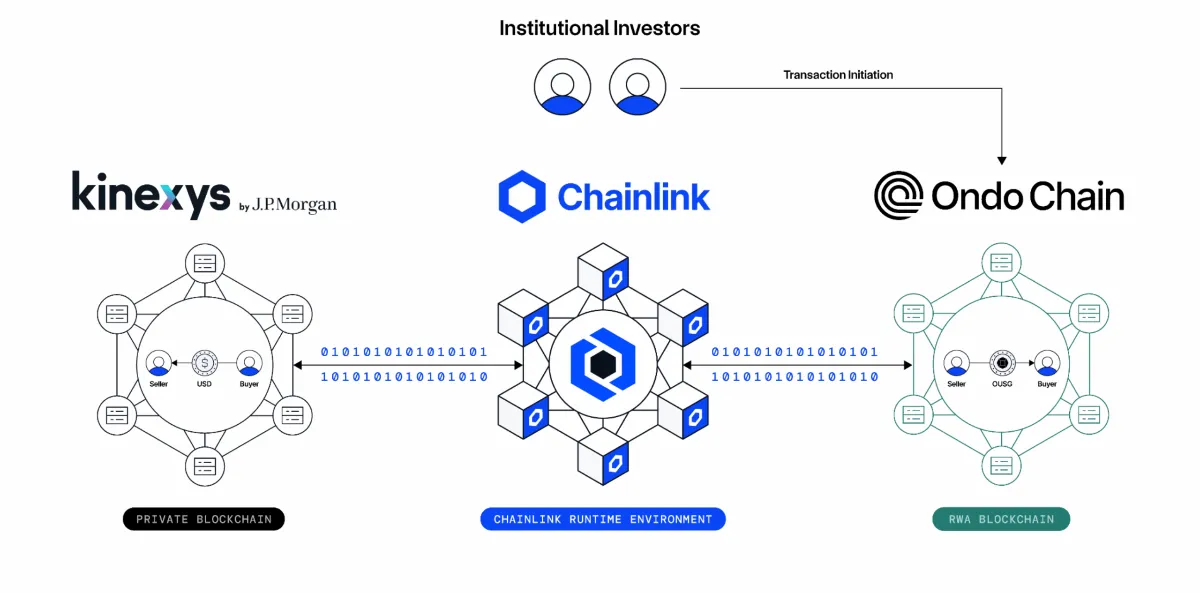
JP Morgan and Chainlink Lead the Top 15 On-Chain Finance Infrastructure Firms — Where Institutional Money Flows
 LINK
LINK BTGO
BTGO PYTH
PYTH
Inside SpaceX's IPO: Goldman Sachs Takes Lead-Left, Morgan Stanley Runs Retail Allocation Across 23 Banks
 GS
GS MS
MS SCHW+2
Wall Street's Defining Moments
See more





Smart Money Briefing
Weekly summaries of Wall Street guru moves and crypto whale activity.