A 242-Year-Old Bank Changed Its Ticker — Why BNY Dropped BK
BNY changes its NYSE ticker from BK to BNY on May 21. The completion of an 18-month digital-asset pivot — Ripple custody, Goldman blockchain, UAE custody, tokenized deposits. The stock is up 65% YTD.
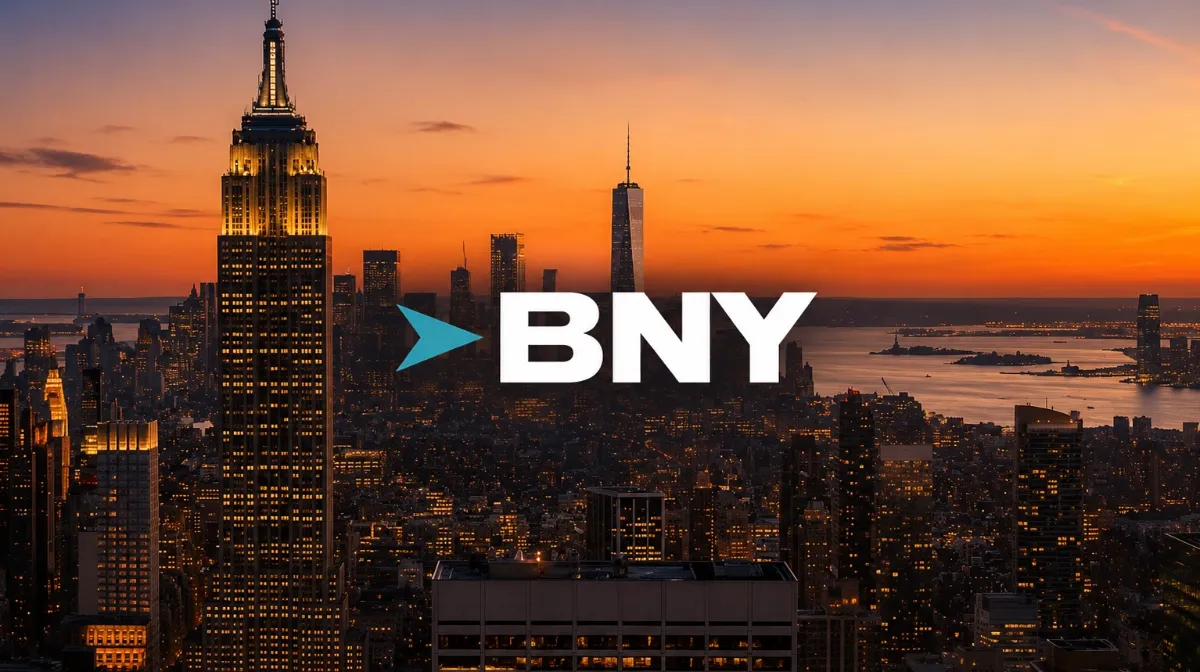
- BNY is changing its NYSE ticker from BK to BNY on May 21
- The substance behind the symbolic move is 18 months of digital-asset partnerships across the board — Goldman's GS DAP, Ripple RLUSD custody, OpenEden's tokenized Treasury fund, UAE bitcoin custody, and a tokenized-deposits launch
- SEC approval for expanded crypto custody and the SAB 121 exemption created the regulatory environment, and the stock is up 65% YTD
Tokenized deposits, Ripple custody, Goldman blockchain, UAE custody — "the bridge between traditional finance and digital assets."
The Bank of New York Mellon (BNY) is changing its NYSE ticker from BK to BNY on May 21. A company founded by Alexander Hamilton in 1784 and first traded on the precursor to the NYSE in 1792 is changing its market identity for the first time.
CEO Robin Vince said the firm "is redefining itself as a financial-services platform company."
To understand what a single-letter ticker change symbolizes, look at the past 18 months.
The partnership map — what BNY is connecting
Over the past year, BNY has moved simultaneously at every traditional-finance touchpoint with digital assets.
July 2025 — partnership on Goldman Sachs' GS DAP blockchain platform to mirror money-market-fund ownership records on-chain. BlackRock, Fidelity, and Federated Hermes also joined. Same month: selected as the official reserve custodian for Ripple's RLUSD stablecoin. The structure supports stablecoin settlement and cash management together.
Q3 2025 — appointed investment manager and primary custodian for OpenEden (EDEN)'s tokenized US Treasury fund. The CEO highlighted it on the earnings call. Co-launched a tokenized credit fund with Securitize on Ethereum. One of the first cases of BNY offering operating products directly on a public chain.
January 2026 — officially launched tokenized deposit services, representing client account balances as on-chain digital assets for collateral / margin trading and faster settlement.
April — partnered with Singapore Gulf Bank (SGB) so crypto-native clients can access US Treasuries and MMFs 24/7.
May — at Abu Dhabi Global Market, partnership with Finstreet and the ADI Foundation to launch UAE bitcoin custody services.
"Big banks lead the next phase of crypto adoption"
Big banks lead the next phase of crypto adoption. Creating digital shares of money-market funds and tokenizing existing products are the core agendas.
Robin Vince, BNY CEO — NY Digital Asset Summit, March 2026
A declaration that BNY will serve as the bridge between traditional finance and digital assets.
The infrastructure for that declaration is already laid. In September 2024, the SEC granted approval to expand crypto-custody services beyond ETFs to individual asset management. The exemption from SAB 121 accounting guidance was also obtained, removing the constraint that required banks to record custodied crypto as a liability. The regulatory environment for traditional institutions to seriously enter crypto custody is now in place.
BNY explicitly says it will not issue its own stablecoin. Instead it builds infrastructure that supports the stablecoin ecosystem — Ripple RLUSD custody is the example. The CEO sidestepped questions on in-house issuance and stressed the partnership strategy.
Stock up 65% — markets read it first
BNY shares are up 65% YTD. The market priced in the pivot well before the ticker-change announcement.
AUM of $59.4T, more than 90% of the Fortune 100, and nearly all of the top 100 global banks as clients — when a firm of that scale announces it will be the bridge into digital-asset infrastructure, the market calculated the meaning ahead of time.
On May 21, BNY will ring the NYSE closing bell to mark the change. It is the day a company Alexander Hamilton founded in 1784 changes its market identity for the first time in 240 years.
Frequently Asked Questions
Does the ticker change affect existing shareholders?
No. The legal entity, capital structure, CUSIP, and shareholder rights remain unchanged. Held shares will automatically convert to the new ticker.
Why isn't BNY issuing its own stablecoin?
The strategy is to build ecosystem infrastructure rather than issue directly. Supporting existing stablecoins (e.g., Ripple's RLUSD via custody) carries lower regulatory risk and a clearer revenue structure than first-party issuance.
Why does the SAB 121 exemption matter?
Under the old rule, a bank custodying client crypto had to record an equal-amount liability — raising capital requirements and effectively making custody unviable. The exemption removed that constraint and lets BNY scale custody seriously.
How does BNY's digital-asset strategy differ from JPMorgan's?
JPMorgan builds its own blockchain platforms (Onyx, Kinexys). BNY differentiates by providing infrastructure on top of existing public chains like Ethereum and Ripple. Build-your-own vs connecting infrastructure — that is the difference.

Sunday's SEC 8-K Earnings Filings Quiet, but Royal Gold Doubles Net Income and Launches Buyback
 RGLD
RGLDVeritone Earnings Shock Sends Shares Down 23%...York Space Systems Among 25 US Companies Filing SEC 8-K Earnings Reports
 YSS
YSS CODX
CODX IPWR+26
Applied Materials Posts Record Q3 Revenue of $9.1 Billion, All-Time High EPS
 AMAT
AMATWall Street's Defining Moments
See more
Sunday's SEC 8-K Earnings Filings Quiet, but Royal Gold Doubles Net Income and Launches Buyback
RGLDVeritone Earnings Shock Sends Shares Down 23%...York Space Systems Among 25 US Companies Filing SEC 8-K Earnings Reports
YSSCODXIPWR+26Applied Materials Posts Record Q3 Revenue of $9.1 Billion, All-Time High EPS
AMATSmart Money Briefing
Weekly summaries of Wall Street guru moves and crypto whale activity.