Five consecutive years of double-digit GDP growth, per capita GDP surpassing Uruguay… Contract structure allowing ExxonMobil to take 85% remains a bottleneck
Until 2019, hardly any Koreans knew about Guyana. A small nation of 800,000 people. An English-speaking country located in the northeastern tip of South America. A nation that was difficult to find on a world map.
But in 2022, Guyana's real GDP growth rate reached 62%. An unprecedented figure in history for a single country. In 2024, it recorded 43.6%, ranking first globally, with projected growth of 19.3% in 2025 and 16.2% in 2026. According to the IMF, it's the world's fastest-growing country for five consecutive years.
What happened?
An Oil Field Named Stabroek
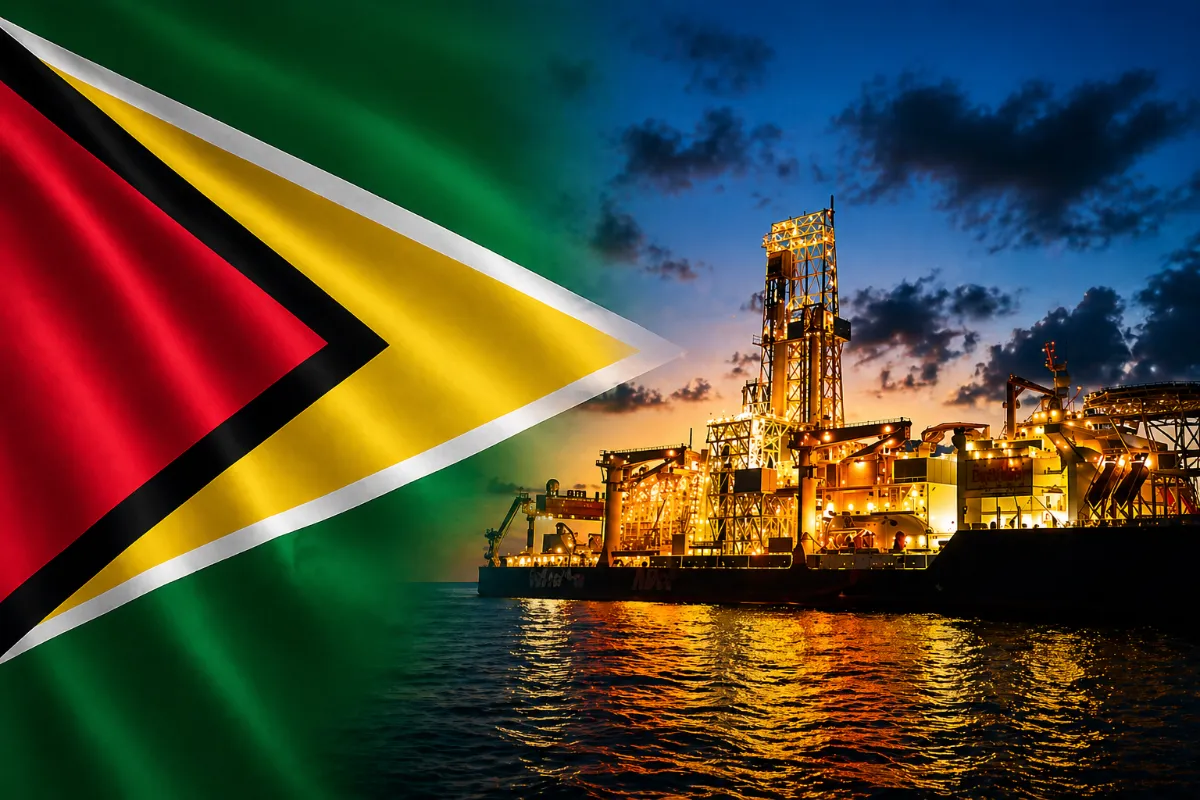
In 2015, ExxonMobil discovered a major oil field in the Stabroek Block off Guyana's coast. Subsequent exploration confirmed reserves of approximately 11 billion barrels. When converted to per capita oil reserves by population, it ranks among the world's highest.
Production began in earnest with Liza Phase 1 in 2019. Daily production surpassed 900,000 barrels in June 2025, with a target of 1.7 million barrels by 2030.
- Uaru — Completion 2026, 250,000 barrels/day
- Whiptail — Completion 2027, 250,000 barrels/day
- Hammerhead — Approved 2029, 150,000 barrels/day
The numbers have already become reality. In 2024, per capita GDP reached approximately $26,590, surpassing Uruguay, South America's leader. In just five years, the country rose from among the world's poorest to middle-income status.
Hidden Traps in the Contract
However, behind these miraculous numbers lies an uncomfortable truth. Examining the structure of the Production Sharing Agreement (PSA) that ExxonMobil signed in 2016 reveals a different picture.
- Consortium takes 75% of total revenue upfront under "cost recovery" provisions
- Remaining 25% split 50:50 between government and companies
- 2% royalty separate — Government's actual share is about 14-15% of revenue
- New exploration costs can be deducted from existing field revenues
"Would Norway have signed such a contract?"
Internal criticism in Guyana
The consortium comprising ExxonMobil (45% stake), Hess (30%), and China's CNOOC (25%) has invested over $60 billion in this block. Given the investment scale, high cost recovery rates are understandable to some extent. However, Norway, which began developing North Sea oil fields in 1969, structured government equity from the start and recovered most profits for the state through state-owned Equinor.
The Shadow Named Venezuela
Another threat looms on the map of this economic miracle. Venezuela lies beyond the western border. The Maduro regime claims the Essequibo region (159,500 km²), which comprises about two-thirds of Guyana's territory, as its own.
The current border was established by the 1899 Paris Arbitration Award, and the case was referred to the ICJ (International Court of Justice) in 2018, where proceedings are ongoing. In 2023, Venezuela even passed legislation through a national referendum (95% approval) declaring Essequibo as a new state.
Since the maritime area of this Essequibo region borders part of the Stabroek oil field, the dispute is not merely a territorial issue but has the character of a resource conflict over oil development rights. While tensions eased somewhat after Maduro's arrest in the US in 2024, the ICJ proceedings remain unresolved.
Domestic Fault Lines — Indo-Guyanese vs Afro-Guyanese
External threats aren't the only problem. Indo-Guyanese, comprising about 40% of the population, and Afro-Guyanese, about 30%, have long competed for political power. Five years after an Indo-Guyanese party took power in the 2020 election, complaints are mounting in the Afro-Guyanese community that oil revenue distribution is tilted toward Indo-Guyanese interests.
The pattern of resource booms intensifying existing conflicts is known as the resource curse. Venezuela showed how this ends. Whether Guyana can avoid that path is now the most important question.
Sovereign Wealth Fund and Carbon Credits — Two Safety Valves
There are also optimistic signs. Since production began in 2019, Guyana has accumulated over $7.8 billion in its Natural Resource Fund. The law restricts the government from making arbitrary withdrawals without parliamentary approval.
More interesting is Guyana's unique dual model. With over 80% of its territory covered by rainforest, Guyana sells carbon credits from land while extracting oil from the sea. Countries that burn oil and emit carbon pay Guyana for carbon offset costs through its rainforests.
Data Sources
Stabroek Block disclosure documents, IMF World Economic Outlook (April 2026), World Bank, Guyana Ministry of Finance. InteliView Editorial analysis.