"Software valuations have been crushed far below intrinsic value — not because of business fundamentals, but because lenders are being forced to liquidate collateral. This is a prime buying opportunity."
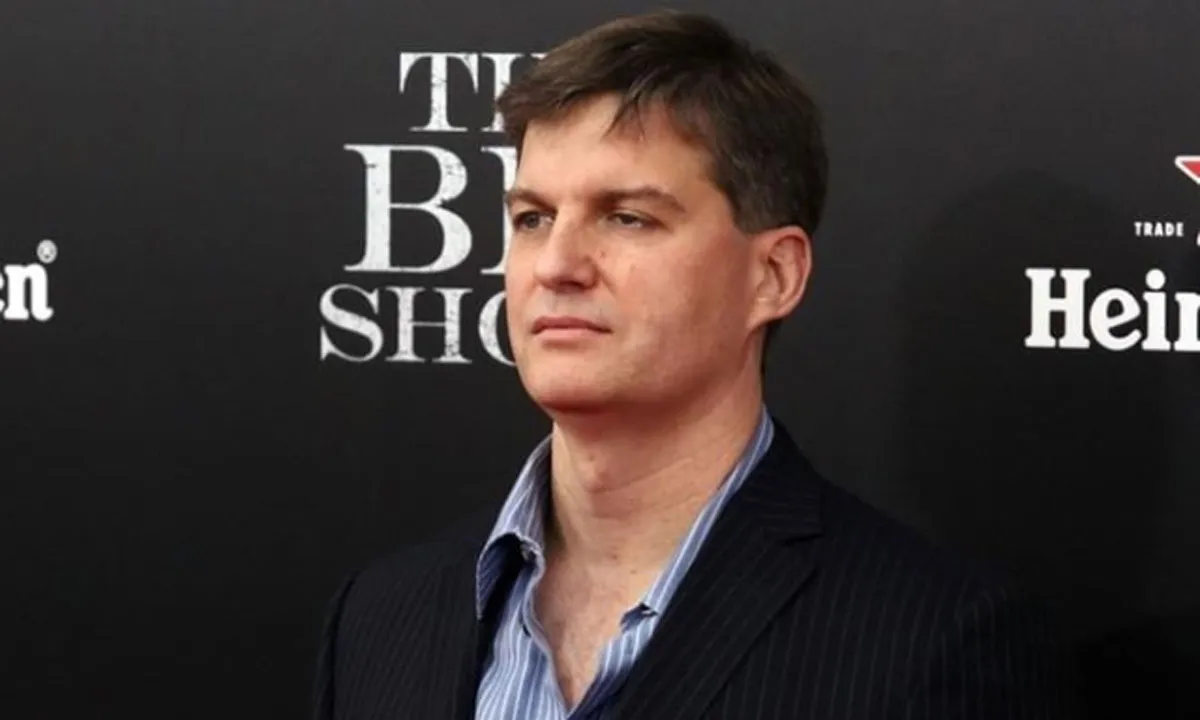
Michael Burry — the legendary investor immortalized in The Big Short and famed for predicting the 2008 subprime mortgage collapse — issued a strong buy signal on the software sector via his Substack on the 15th (local time). Once dubbed the loneliest man on Wall Street, Burry is now picking up software stocks that the market has panic-sold.
The Doom Loop Triggered by a $3 Trillion Private Credit Market
Burry's diagnosis is straightforward. The selloff in software equities is not driven by deteriorating business performance. Rather, it stems from a cascade of forced selling within the approximately $3 trillion private credit market.
The mechanics are as follows: software sector loans account for roughly 26% of total private credit market exposure. As fears that AI would disrupt SaaS business models spread, publicly listed software stocks plunged — triggering a doom loop of declining collateral values → redemption pressure on private credit funds → forced liquidations → further price declines. Lenders, spooked by falling collateral, were forced to sell, driving valuations down entirely independent of underlying fundamentals.
Ares Management and Apollo Global Management have already implemented gating measures on their private credit funds, restricting investor redemptions. Morgan Stanley has warned that default rates on private credit direct lending could surge from the historical average of 2–2.5% to as high as 8%. According to 9fin, 20–25% of all private credit transactions involve SaaS companies, and between 2015 and 2025, more than 1,900 software firms were acquired by private equity in deals totaling over $440 billion.
IGV Posts Its Worst Quarter Since 2008
The data supports Burry's thesis. The iShares Expanded Tech-Software ETF (IGV), the benchmark proxy for the software sector, fell more than 24% in Q1 2026 — its worst quarterly performance since Q4 2008. The ETF has dropped approximately 28% from its September peak, entering a full bear market, and on April 10th touched an intraday low of $74.67, its weakest level since November 2023.
Burry attributes the decline not to fundamental deterioration but to technical selling pressure. "I don't believe the technical pressure created by the private credit and software debt overhang is large enough to weigh on these stocks for much longer." In short, the forced sellers have been flushed out — the path of least resistance is now higher.
Burry's Shopping List — Low SBC Dilution, Strong Free Cash Flow Only
Burry is not indiscriminately buying software. He expanded his analytical universe to include payments stocks, constructing a combined software-payments universe, then screened for names with low stock-based compensation (SBC) dilution risk and reasonable valuations on a discounted owners' earnings basis. This is not a reflexive 'buy the dip' call — it is a disciplined selection of structurally sound businesses.
His specific portfolio moves are as follows. He initiated a new 3.5% position in PayPal (PYPL), estimated to have entered at approximately $49 per share. In his valuation model, PYPL ranked ahead of both Fiserv and Adobe. He also maintained existing positions in Fiserv (FISV), Adobe (ADBE), Autodesk (ADSK), and Veeva Systems (VEEV). He further disclosed plans to add positions in Salesforce (CRM) and MSCI (MSCI) the following morning.
"None of the companies I've selected rely on the private credit market. There are certainly software companies that face structural risk from AI — but the firms I've chosen, along with a significant number of others, do not."
Same Hand That Buys Software Is Shorting Palantir and Nvidia
Here is the crux of the story. Burry is not making a blanket bet on software. He is executing a two-sided trade: long AI-resilient software, short overvalued software that is vulnerable to AI disruption.
Concurrently, he disclosed holding put options on Palantir (PLTR) — a June 2027 expiry at a $50 strike and a December 2026 expiry at a $100 strike. He also added to his put position on Nvidia (NVDA), purchasing January 2027 expiry puts at a $115 strike. His view is that Palantir's intrinsic value is below $50 per share — implying a further 65% downside from its current price of around $143.
Burry's rationale: LLM providers like Anthropic are eroding Palantir's bespoke consultant-led deployment model, and plug-and-play generative AI solutions hold a structural competitive advantage. The long software / short Palantir positioning is not contradictory — it is two sides of the same logical coin.
'Think Trump Will Blink? That's Not the Real Story.'
Burry also pushed back directly on another prevailing market narrative. Against the so-called TACO trade — "Trump Always Chickens Out" — which has amplified volatility as investors position for a policy reversal, Burry flatly stated that the software selloff has nothing to do with tariffs or politics — it is a private credit cascade. Misidentifying the cause leads to misidentifying the cure.
The Man Who Always Gets In 'Too Early'
Burry's positioning is not a simple contrarian call. It is a sophisticated two-sided strategy: identifying the structural dislocation caused by private credit forced selling, selectively buying AI-resilient businesses, while simultaneously shorting names inflated by the AI hype cycle.
One important caveat, however. When Burry called the subprime crisis in 2005, he had to endure two years of pain before the trade worked. If the deleveraging of the private credit market takes longer than expected, technical selling pressure will persist accordingly. Being right on direction but wrong on timing can still blow up a portfolio — that, too, is a lesson from The Big Short.