Medallion — The Greatest Returns in Human Investment History
Medallion Fund achieved 66% pre-fee returns (39% after fees) from 1988-2020, turning $1 into $40,000 while beating market downturns. Simons' system—combining thousands of trading signals, automated execution, and short-term positioning—profited from market microstructure despite Simons himself being unable to explain why it worked.
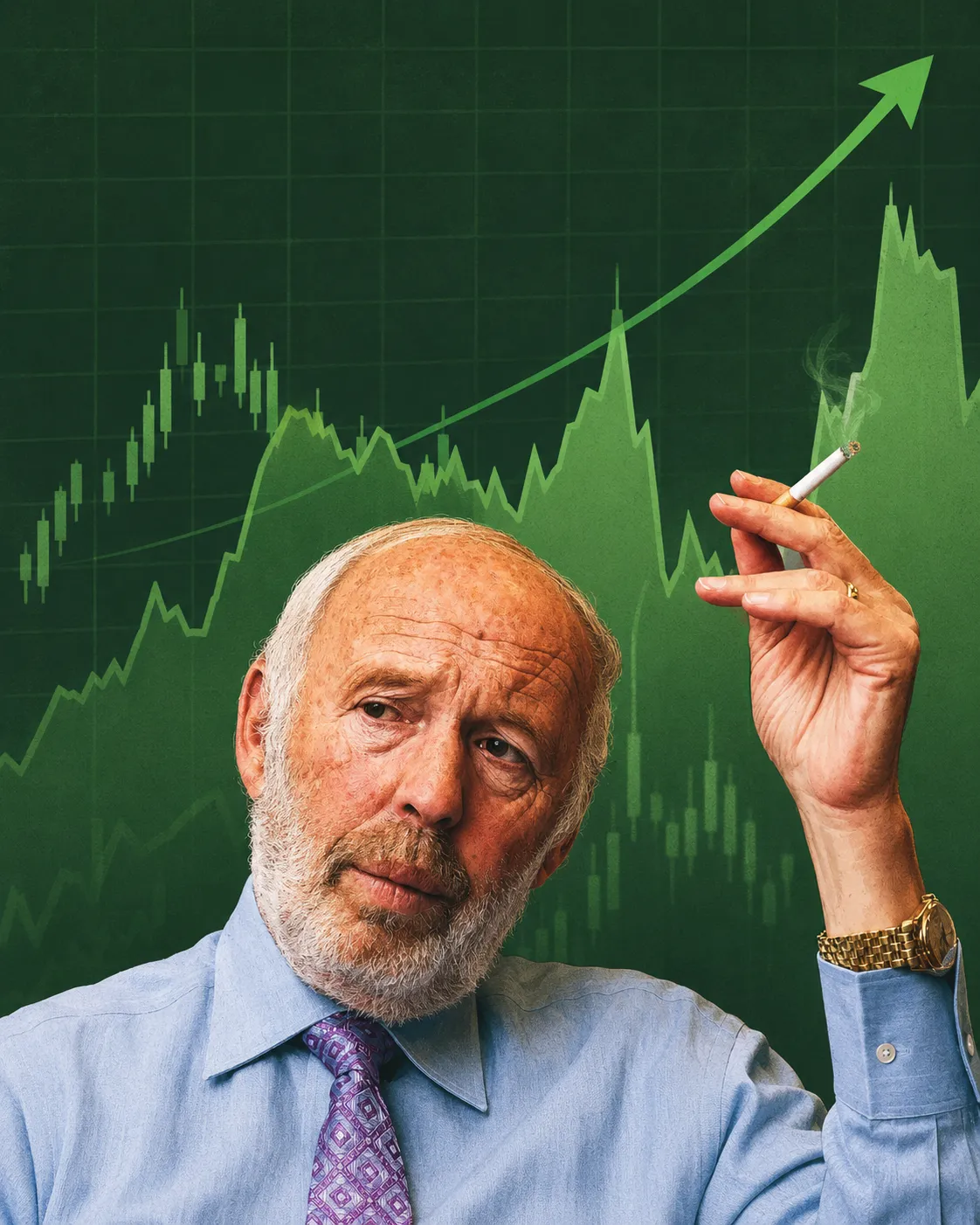
Medallion — The Greatest Returns in Human Investment History
Inteliview Guru Story — Jim Simons EP.2
In 2020, a hedge fund's 32-year track record was revealed. Average annual returns of 66% before fees. 39% after fees. If you invested $1 in this fund in 1988, it would have become roughly $40,000 by 2020. Over the same period, $1 invested in the S&P 500 would have become about $20. A 2,000x difference. This is the story of how the Medallion Fund shattered every record in human investment history.
1. The Numbers
First, let's look at the numbers. Medallion's annual returns (before fees).
1990: 55%. 1993: 39%. 1994: 71%. 1995: 38%. 1997: 21%. 1998: 42%. 1999: 24%. 2000: 99% (the dot-com crash year). 2001: 33%. 2002: 29%. 2003: 22%. 2005: 29%. 2007: 74%. 2008: 82% (the financial crisis year). 2009: 39%. 2010: 29%. 2020: 76% (the COVID year).
To understand what these numbers mean, we must compare them to other masters.
- Warren Buffett: 1965-2024, ~20% average annual. 60 years.
- George Soros: 1969-2011, ~30% average annual. 42 years.
- Peter Lynch: 1977-1990, 29% average annual. 13 years.
- Stanley Druckenmiller: 1986-2010, ~30% average annual. 24 years.
- Medallion: 1988-2020, 66% average annual (before fees), 39% (after fees). 32 years.
Even without fees, Medallion is overwhelming. And more importantly, Medallion has never had a loss year. Except for -4% in 1989 (before the model was substantially revised), it posted gains for 30 consecutive years from 1990 to 2020. Through the 2000 dot-com crash, the 2008 financial crisis, and the 2020 COVID collapse. While other funds took double-digit losses in market crashes, Medallion actually posted higher returns.
- 2000: S&P 500 -9%, Medallion +99%
- 2008: S&P 500 -37%, Medallion +82%
- 2020: S&P 500 +18%, Medallion +76%
Returns with almost no correlation to the market. This is Medallion's truly remarkable achievement. Whether the market rises or falls, it makes money.
2. How Is This Possible?
No one knows the complete answer to this question. Employees at Renaissance Technologies are bound by strict non-disclosure agreements (NDAs). Even after leaving, they cannot work for competitors for years. The specifics of the model are classified.
However, by synthesizing Gregory Zuckerman's book The Man Who Solved the Market, various interviews, and academic analyses, an outline emerges.
First, short-term trading.
Medallion does not engage in long-term investing. The average holding period for positions is measured in days or hours — sometimes minutes. The opposite of Buffett's "hold forever" philosophy.
Why short-term? Because market patterns are more stable over short periods. Long-term, unpredictable macroeconomic variables (wars, policy, pandemics) drive prices. Short-term, market microstructure — order flows, bid-ask spreads, volume patterns — dominates price. This microstructure can be modeled mathematically.
Second, thousands of small bets.
Medallion executes thousands to tens of thousands of trades per day. The expected profit from each trade is tiny. 0.01%, 0.001%. But when repeated thousands of times daily, these accumulate. And if each trade has a 50.75% success rate — just 0.75% higher than random — repeated thousands of times becomes statistically almost certain profit. The law of large numbers.
It's the same principle as a casino. A casino's edge on any single game is only 1-5%. But repeated over millions of games, the casino becomes almost certain to profit. Medallion created a strategy that makes it the casino.
Third, numerous signals.
Medallion's model is not a single strategy. Hundreds, perhaps thousands of independent signals operate simultaneously. Each signal captures a specific market pattern. Some correlate weather data with commodity prices. Others analyze word frequency in news headlines. Still others detect anomalous volume patterns.
Each individual signal has weak predictive power. Alone, it may be meaningless. But combining hundreds of weak signals produces strong predictions. In statistics, this is called the "ensemble" method — combining multiple weak learners into a strong one, the core principle of modern machine learning.
Fourth, automated execution.
All trades execute automatically by computer. No human intervention. When the model says "buy," it buys. When it says "sell," it sells. Emotion has no room to enter.
Simons followed one strict rule: "Never override the model." When the model's judgment conflicts with intuition, there's temptation to follow intuition. Simons forbade this. Humans can occasionally beat the model short-term, but long-term the model beats humans.
3. "We Don't Know Why We Make Money"
The most astonishing fact about Medallion: Simons himself could not fully explain why Medallion made money.
What he said in a TED talk:
"Why do we make money? I don't fully know myself. Our model contains thousands of signals. Each signal captures a small market inefficiency. But I can't fully explain why those inefficiencies exist or why they don't disappear."
What he added in another interview:
"When you ask why a specific signal works in our model, sometimes our scientists themselves say 'we don't know.' We know it's statistically significant, but we can't explain the economics. Some people find that uncomfortable. We don't. When the data speaks, we follow — explanation or not."
This fundamentally contradicts traditional investment philosophy. Buffett can clearly explain why he invests. Munger codified his thinking into 25 principles. Lynch created a six-category stock classification system. Simons doesn't ask "why." "It works" is enough.
This echoes a scientific tradition. Newton's law of universal gravitation explains how gravity works but not why gravity exists. Newton himself said "Hypotheses non fingo" (I frame no hypotheses). A working model is sufficient. Why it works can be discovered later by someone else. Simons applied Newton's approach to finance.
4. The Graveyard of Outsiders
After seeing Medallion's extraordinary returns, investors lined up to invest in Renaissance. But there was a problem — the Medallion Fund did not accept outside investors.
Starting in 1993, Medallion began returning outside capital. By 2005, all outside investor funds had been fully redeemed. Since then, Medallion has become accessible only to current and former Renaissance employees.
Why? Two reasons.
First, scale limits. Medallion's strategy exploits small inefficiencies in market microstructure. These inefficiencies are small. Too much capital would cause their own trades to move the market, eliminating the inefficiencies. Medallion's assets under management are capped at roughly $10 billion. Annual profits are returned to investors to maintain this level.
Second, secrecy. More outside investors increase information leakage risk. Limiting to employees preserves confidentiality.
So what do outside investors do? Renaissance operates separate funds for outside investors. RIEF (Renaissance Institutional Equities Fund), RIDA (Renaissance Institutional Diversified Alpha), and others. How did these perform?
Unremarkably. RIEF matched or slightly exceeded market returns. No comparison to Medallion's 66%.
Why such a gap between funds at the same firm? Medallion's core strategy is optimized for short-term, high-frequency trading — which only works at small scale. Outside funds are larger, so they can't use the same strategy. They must use different approaches, which aren't as effective.
This enraged outside investors. "Renaissance gives the good strategy only to employees and sells the bad strategy to outside investors." This exploded during the 2020 COVID crisis. The same year Medallion posted +76%, RIEF posted -33%. Same company, same year, 109 percentage point difference.
5. Fee Structure
Medallion's fee structure is the highest in Wall Street history.
Standard hedge fund fees: 2% management + 20% performance. Called "2 and 20."
Medallion's fees: 5% management + 44% performance.
From pre-fee 66% returns, after fees investors net 39%. The 27 percentage point difference goes to Renaissance.
This fee structure is bearable for one reason — 39% remains after fees. From the investor's perspective, paying 27% to a manager who delivers 39% is no bargain lost. The S&P 500 delivers 10%; Medallion delivers 39%.
The money Simons and Renaissance employees earned from these fees and internal Medallion investments is astronomical. At his death, Simons' personal wealth was estimated at $31 billion. Top 50 richest Americans on the Forbes list. A mathematician earned more money than any Wall Street financier.
6. The Efficient Market Hypothesis Under Challenge
Medallion's very existence challenges a core economic principle — the Efficient Market Hypothesis (EMH).
Established by Eugene Fama, it states: Market prices instantly reflect all available information. Therefore, consistently beating the market is impossible. If an investor appears to beat the market, it's luck, compensation for higher risk, or insufficient time elapsed.
Medallion is the strongest refutation of this hypothesis. 66% annually for 30 years. Returns nearly uncorrelated with the market. No major loss year. Probabilistically, this would be an almost-impossible level of luck.
EMH proponents counter: "Medallion is an exception. And that Medallion's success is unreplicable is itself proof markets are efficient. If Medallion's strategy became public, everyone would copy it, inefficiencies would vanish, and it would stop working."
Simons responded:
"If markets were completely efficient, we couldn't make money. If they were completely inefficient, everyone could. Reality is in between — markets are mostly efficient, but small inefficiencies exist. Finding those small inefficiencies requires the world's best mathematicians, scientists, and computers."
당신 앞에 두 가지 펀드가 있다. 둘 중 하나에 가입할 수 있다면?
7. Simons vs. Buffett
A question readers may ask: Who is the greater investor — Simons or Buffett?
By the numbers, Simons dominates. 66% vs. 20% annually. No comparison. But this comparison is unfair. Three reasons.
First, scale. Medallion operates with $10 billion. Berkshire Hathaway operates with over $900 billion. Larger scale makes high returns harder. Medallion wouldn't work above $10 billion. Buffett beats the market at $900 billion scale.
Second, transparency. Buffett fully discloses his investment principles, holdings, and thinking. Annual shareholder letters. Simons discloses nothing. Buffett's methods can be learned. Simons' cannot.
Third, sustainability. Buffett's methods have worked 50+ years and will continue under the same principles after his death. Medallion depends on Simons and his team. Whether Medallion maintains performance after Simons' death (May 2024) remains unknown.
Simons himself addressed this comparison:
"Buffett is a great investor. I am not a great investor. I built a great system. There's a difference. Buffett invests by his judgment. I invest by the system's judgment. Without Buffett, Buffett investing ends. The system can operate without me — at least in theory."
8. Three Lessons From This Story
First, the world's best strategy is one you cannot access.
Medallion delivered history's greatest returns. You cannot invest in it — you're not a Renaissance employee. You cannot replicate its strategy — you don't have 300 elite mathematicians and supercomputers. This is the paradox: knowing the best strategy differs from accessing it. For Korean retail investors, the implication is clear — don't envy others' strategies. Find the best strategy you can actually execute. Lynch's shopping-mall method. Buffett's long-term hold. Munger's inversion thinking.
Second, the courage to act without knowing "why."
Simons couldn't fully explain why his model worked. Yet he executed it. When data spoke, he followed — without explanation. Most investors need to understand "why" before acting. They need to explain why a stock should rise before buying. Simons skipped the "why." This lesson may not apply to most retail investors. But one thing can be learned: when your analysis says "buy" and emotion says "scary," follow analysis. Data is more reliable than emotion.
Third, scale has enemies.
Medallion cannot grow beyond $10 billion — the strategy fails at larger scale. Counterintuitively, this becomes an opportunity for retail investors. Medallion's inefficiencies only exist at small scale. Domains large institutions cannot enter — small-caps, niche markets, emerging industries. This echoes Lynch's observation that individual investors have advantages over institutions. Managing $1 million gives you access to places inaccessible to $10 billion managers — where small scale is strength, not weakness.
Once you've made your choice, reveal what the legend actually did
9. The Weight of 32 Years
1988 to 2020. 32 years.
Medallion generated over $100 billion in cumulative profits.
Over the same period, Berkshire Hathaway's market cap increase was roughly $600 billion. Berkshire generated more absolute dollars than Medallion. But Berkshire operated at hundreds-of-billions scale, Medallion at $10 billion. Per-dollar efficiency overwhelmingly favored Medallion.
And nearly all of that $100 billion went to Renaissance employees. Virtually none to outside investors. Roughly 300 mathematicians and scientists shared these profits.
300 mathematicians and scientists. 32 years. $100 billion earned.
This is Medallion — a machine that decodes the market. Built by the mathematician who cracked military codes, now cracking market codes.
The man who built this machine died in May 2024. Age 86. But the machine still runs. No one has switched it off.
Coming Next
EP.3 — A Mathematician's Legacy: What Jim Simons Left Before He Departed
May 10, 2024. Age 86. Simons passed away. $31 billion in assets. Nearly all donated to mathematics education and scientific research. And one question he left for the AI era.
What's your take on this story?
What do you think about Jim Simons's decision?
Sign in to participate
Sign InJim Simons (Estate) Today
Where is Jim Simons investing right now? See their latest 13F portfolio and current convictions.