Morgan Stanley: "AI is 6th Innovation Wave—Structural Shift, Not Job Apocalypse"
What 250 years of innovation history reveals — repeated cycles of short-term disruption and long-term productivity gains, but this time the pace could be different
- AI is the 6th innovation wave since the Industrial Revolution, with short-term disruption giving way to long-term productivity gains
- Capex is driving demand-side growth now; supply-side impact and inequality risks emerge later
A research team led by Morgan Stanley Global Chief Economist Seth Carpenter recently published a report defining AI as the sixth major innovation wave since the Industrial Revolution, analyzing AI's productivity and employment impact based on historical patterns from the previous five innovation cycles.
The conclusion is neither simple optimism nor fear. Innovation waves have invariably displaced some jobs in the short term, but over the long term, they have boosted productivity, created new roles, and expanded overall employment—this is what 250 years of data indicates. However, the report notes that history and economic theory point to more complex conclusions, and the final verdict remains unknown.
Patterns Revealed by 5 Innovation Waves
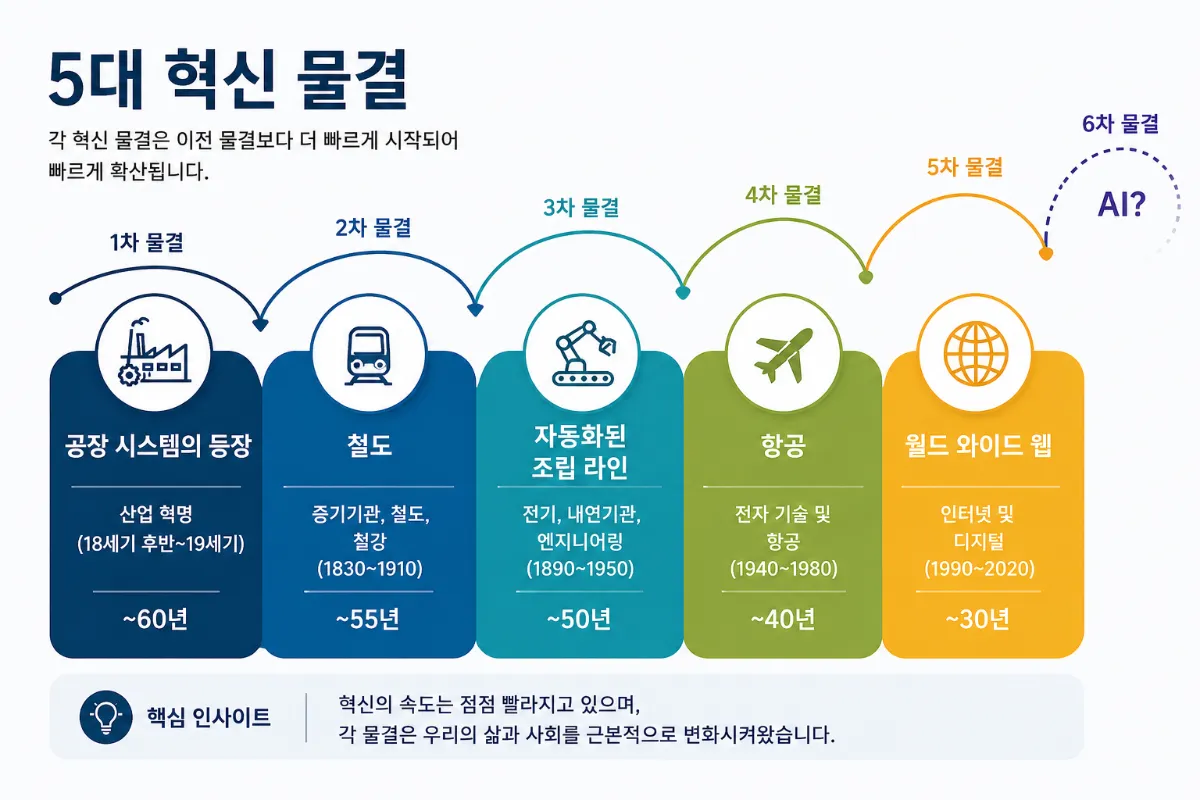
Morgan Stanley analyzed five innovation waves from the Industrial Revolution to the internet.
The Industrial Revolution (late 18th to mid-19th century) reduced the agricultural population from 75% to half. Steam and railways (1830-1900) lifted labor productivity by 1.5% annually. During the electricity and heavy industry era (1870-1940), manufacturing exceeded 30% of total GDP with productivity growing 2.0-2.5% annually. The post-war technology boom (1945-1970) raised labor productivity 2.5-3.0% annually as the service sector became dominant. The internet and digital network era (1990-2020) saw annual productivity growth accelerate to about 3% around 2000, with mid-skill manufacturing jobs declining while demand for software, data science, and cybersecurity roles exploded.
Morgan Stanley Chief US Economist Michael Gapen stated that "innovation waves are disruptive, capital-intensive, and often violent," adding that "they displace workers in the short term, concentrate early profits, and trigger political backlash." However, he noted that "in the long term, they boost productivity, restructure labor markets, and expand output."
What AI is Doing Now — Demand-Side Amplification, Supply-Side Not Yet
Carpenter explains AI's current economic role by distinguishing between demand-side and supply-side effects.
AI currently dominates the economy's demand side. Capital expenditures like data center construction and semiconductor purchases are consuming current resources and causing somewhat inflationary pressure. Supply-side productivity contributions will emerge over the coming years, with Carpenter diagnosing that the additional productivity growth contribution by 2026 will be about 0.25 percentage points—not significantly disinflationary.
According to estimates Carpenter presented in a 2023 Morgan Stanley report, current AI technology could impact up to 25% of jobs existing today, with related labor costs potentially reaching $2.1 trillion. Within three years, the proportion of affected jobs could rise to 44%, with related labor costs potentially increasing to $4.1 trillion.
Actual Employment Data — "Still Gradual Impact"
AI's labor market impact so far has been more gradual than expected. Much of the cost is concentrated among entry-level workers aged 22-27, with unemployment notably increasing in high AI-exposure occupations like analysts, accountants, and legal assistants. Morgan Stanley judges that the 250-year trend is still holding.
According to Morgan Stanley surveys, 27% of surveyed company employees received retraining over the past 12 months, with AI-adopting companies showing the greatest cost reduction potential in consumer goods distribution and retail, real estate management and development, and transportation.
"This Time Could Be Different" — Scenarios Breaking Historical Precedent
Morgan Stanley doesn't rule out the possibility that AI could bring more extreme outcomes that break historical precedent. If AI flows primarily toward replacing rather than complementing labor, the labor income share could decline and profits could become more concentrated. If AI adoption accelerates significantly, it could cause greater inequality, with policy, education, and corporate adaptation becoming decisive factors, the report notes.
Carpenter believes that combining corporate retraining investment with government social insurance programs is likely to emerge as a more realistic support mechanism than comprehensive universal basic income reform to address retraining needs.
AI Summary
Morgan Stanley defines AI as the sixth innovation wave since the Industrial Revolution. 250 years of history shows a repeated pattern of short-term disruption and long-term productivity improvement.
Currently, AI is supporting the economy on the demand side (capital expenditure), with supply-side productivity contributions expected to materialize in earnest only after several years. Employment impact has been gradual so far, concentrated among entry-level workers.
However, if adoption pace accelerates, inequality could intensify, and Morgan Stanley notes it doesn't rule out scenarios where AI breaks historical precedent.
FAQ
Q. Did jobs actually disappear in past innovation waves?
A. They disappeared in the short term. However, in the long term, new jobs were created and overall employment expanded. Even in the internet era, while mid-skill manufacturing declined, software and data science jobs exploded.
Q. When will AI's productivity effects appear?
A. Morgan Stanley expects about 0.25 percentage points of additional productivity growth by 2026, but full supply-side effects will appear after several years. This coincides with the completion of data centers currently under construction.
Q. What occupations are most at risk in the AI era?
A. Consumer goods distribution and retail, real estate management, and transportation show the greatest cost reduction potential from AI adoption. Entry-level workers with less experience appear particularly vulnerable.
Related Stocks & ETFs
AI Infrastructure: NVDA, TSM, AVGO, MSFT, AMZN
AI Adoption Beneficiaries: CRM, NOW, WDAY, ORCL
Retraining & Workforce Services: COUR, UDMY, MAN, RHI
ETFs: BOTZ, ROBO, ARKQ, IGV, QQQ
Frequently Asked Questions
과거 혁신 파동에서 일자리는 실제로 사라졌나요?
단기적으로는 사라졌습니다. 그러나 장기적으로는 새로운 직업이 창출되고 전체 고용이 확대됐습니다. 인터넷 시대에도 중간 숙련 제조업은 감소했지만 소프트웨어·데이터과학 일자리가 폭증했습니다.
AI의 생산성 효과는 언제부터 나타나나요?
모건스탠리는 2026년 약 0.25%포인트의 추가 생산성 성장을 예상하되, 본격적인 공급 측 효과는 수년 후에 나타날 것으로 봅니다. 현재 건설 중인 데이터센터들이 완성되는 시점과 맞물립니다.
AI 시대에 가장 위험한 직종은 무엇인가요?
소비재 유통·소매, 부동산 관리, 운송 분야가 AI 도입으로 가장 큰 비용 절감 가능성을 보입니다. 경험이 적은 22~27세 초급 근로자가 특히 취약한 것으로 나타났습니다.
이번 AI 파동은 과거와 다를 가능성이 있나요?
모건스탠리도 그 가능성을 배제하지 않습니다. AI가 노동을 보완보다 대체하는 방향으로 흐르거나 채택이 가속화되면 노동 소득 비중 하락과 불평등 심화가 발생할 수 있습니다. 정책·교육·기업 적응이 결정적입니다.


Philippe Laffont's Q1 2026 Portfolio: TSM Stake Boosted, Full Exit from ORCL, SNOW, and 3 Others
 TSM
TSM GEV
GEV LRCX+7
No SEC Earnings Filings on Aug 2 — Tim Cook's Final Call, Big Tech Earnings Week Ahead
 AAPL
AAPL MSFT
MSFT AMD+2
AMD+2Altria, Regeneron, Rimini Street, Mohawk Industries Among 25 US Companies Filing SEC Earnings Today
 SHOO
SHOO MO
MO MHK+23
Wall Street's Defining Moments
See more


Sunday's SEC 8-K Earnings Filings Quiet, but Royal Gold Doubles Net Income and Launches Buyback
 RGLD
RGLDVeritone Earnings Shock Sends Shares Down 23%...York Space Systems Among 25 US Companies Filing SEC 8-K Earnings Reports
 YSS
YSS CODX
CODX IPWR+26
Applied Materials Posts Record Q3 Revenue of $9.1 Billion, All-Time High EPS
 AMAT
AMATSmart Money Briefing
Weekly summaries of Wall Street guru moves and crypto whale activity.