
The Institution Behind Every Wall Street Trade Is Moving to Blockchain
DTCC has launched ComposerX, a tokenized securities platform on the Canton Network. America's largest clearinghouse — processing $4.7 quadrillion annually — has declared the move to T+0 settlement alongside BlackRock, Goldman, JPMorgan, and 50 institutions, triggering structural demand for USDC, Ondo, and RWA infrastructure.
- DTCC launched ComposerX, a blockchain tokenized securities platform on the Canton Network, with 50 institutions including BlackRock, Goldman, and JPMorgan
- The July pilot targeting Russell 1000 equities, ETFs, and Treasuries aims for full T+0 settlement by October 2026
The institution that clears 99% of U.S. securities trades is moving to blockchain. DTCC has launched ComposerX — America's largest securities clearinghouse, processing roughly $4.7 quadrillion annually, has unveiled a tokenized securities platform built on the Canton Network. More than 50 institutions, including BlackRock, Goldman Sachs, JPMorgan, Nasdaq, and the NYSE, have joined the working group.
One of Wall Street's quietest yet most powerful institutions has made its move. The Depository Trust & Clearing Corporation (DTCC) officially announced ComposerX in May 2026 — a blockchain-based tokenized securities infrastructure platform designed to migrate U.S. securities settlement, clearing, and custody onto distributed ledger technology.
DTCC spent two years in quiet negotiations with the SEC. A no-action letter came in December 2025, followed by approval into the SEC Innovation Exemption Sandbox in January 2026. The regulatory groundwork is in place.
What Is ComposerX?
ComposerX is built on three core layers:
- Factory (Token Issuance Engine) — Supports both ERC-20 and ERC-3643 standards. Fully integrated with CUSIP identifiers so institutions can keep the legacy identification systems they already use.
- CATF (Compliance Aware Token Framework) — Real-time, multi-jurisdiction compliance enforcement built directly into the token layer. Every transfer is automatically validated for KYC/AML, investor eligibility, and transfer restrictions on-chain.
- Canton Network Atomic Settlement — Compresses settlement from T+1 to T+0 (same-day). Billions in frozen collateral are freed; 24/7 trading becomes possible.
We are transforming market infrastructure built over decades. This is not an experiment — it is the next generation of settlement rails.
DTCC ComposerX launch statement
50-Institution Working Group — Mirae Asset as the Only Korean Firm
The participant list spans the full Wall Street ecosystem: asset managers, broker-dealers, exchanges, fintechs, and stablecoin issuers.
- Asset Managers & IBs: BlackRock, Goldman Sachs, JPMorgan, State Street
- Exchanges & Infrastructure: Nasdaq, NYSE
- Crypto & Stablecoins: Circle (USDC issuer), Ondo Finance, Ripple, Backpack, Fireblocks
- Only Korean Participant: Mirae Asset Global Investments US
Mirae Asset's position as the sole Korean participant is notable. With its Global X ETF franchise already managing substantial AUM in the U.S., being embedded in the early design of tokenized securities infrastructure is a strategic positioning move beyond simple investment.
Pilot Timeline: Russell 1000, ETFs & Treasuries in July; Full Service in October
- July 2026: Pilot launch. Asset classes: Russell 1000 equities, listed ETFs, and U.S. Treasuries
- October 2026: Full service rollout target
- Pilot participants limited to working group members that have received SEC sandbox approval
Russell 1000 equities, ETFs, and Treasuries are the highest-liquidity, most standardized asset classes in U.S. markets — an ideal testbed. If the October full-service transition holds, this marks a structural inflection point for U.S. securities settlement infrastructure.
Implications for Crypto and DeFi
- Structural USDC demand: The Canton Network settlement rail will likely use a dollar stablecoin as its primary settlement currency — Circle's presence in the working group signals USDC as the candidate.
- Ondo Finance RWA standardization: Ondo's tokenized Treasury products could become the default on-chain fixed-income asset if integrated into ComposerX.
- DeFi collateral expansion: T+0 settlement dramatically improves collateral velocity; tokenized securities eligible as DeFi collateral would expand on-chain liquidity pools significantly.
- Ripple (XRP) settlement rails: Ripple's participation in the Canton working group enhances its credibility as an institutional-grade payment network.
Tokenization is no longer the language of crypto startups. The clearinghouse is saying it directly.
Crypto research analyst commentary
Asset Mapping for Investors
- Mirae Asset / Global X: U.S. subsidiary in the working group. First-mover position for tokenized ETF product launches.
- USDC (Circle): Formalization of Canton Network settlement currency role means growing USDC circulation and fee revenue.
- ONDO: Most direct beneficiary of institutional RWA demand. If Ondo Vault / Ondo US Dollar Yield are adopted as the standard tokenized Treasury asset, AUM grows directly.
- BLK, GS, JPM, NDAQ: Tokenization fee revenue adds a structural growth layer on top of legacy institutional revenues.
One caveat: the July pilot → October full-service timeline is DTCC's own stated target but institutional infrastructure transitions routinely run late. The investment thesis holds; the timeline risk requires separate consideration.
Frequently Asked Questions
What is DTCC and why does it matter?
DTCC (Depository Trust & Clearing Corporation) is the central infrastructure that processes settlement, clearing, and custody for U.S. equities, bonds, and ETFs — handling roughly $4.7 quadrillion annually. It is effectively the hidden heart of U.S. capital markets. When DTCC moves to blockchain, it signals that the foundational layer of Wall Street is preparing for structural change.
How is ComposerX different from other tokenization projects?
Most RWA tokenization projects are led by startups or fintechs. ComposerX is operated directly by the incumbent infrastructure — DTCC itself. It launches with CUSIP integration already in place, SEC sandbox approval already granted, and 50 major institutions already committed. The "institutions will eventually adopt it" uncertainty that plagues most tokenization projects simply doesn't exist here.
What does T+0 settlement actually change?
Currently, equity trades settle the next business day (T+1) or two days later (T+2), with collateral frozen in between. T+0 means settlement completes simultaneously with execution — freeing billions in locked collateral instantly. For institutions, capital efficiency improves dramatically, and 24/7 trading becomes viable without systemic overnight risk.
What is the impact on USDC and ONDO prices?
USDC is likely to serve as the primary settlement currency on the Canton Network rail — Circle's inclusion in the working group supports this thesis. Rising transaction volume translates directly into USDC circulation growth and Circle revenue. For ONDO, if Ondo US Dollar Yield products are adopted as the standard tokenized Treasury asset within ComposerX infrastructure, AUM grows in direct proportion to platform volume. The July 2026 pilot outcome is the key prerequisite for either thesis to materialize.

SEC Receives 24 Earnings Filings, 14 Regional Banks Report en Masse — Newmont, Nasdaq, Snap-on Join In
 ASPS
ASPS PKG
PKG BPRN+20
Two Sigma Q1 2026 Portfolio — NVDA Up 832%, Exits AZN and 4 Others
 NVDA
NVDA AAPL
AAPL AMZN+7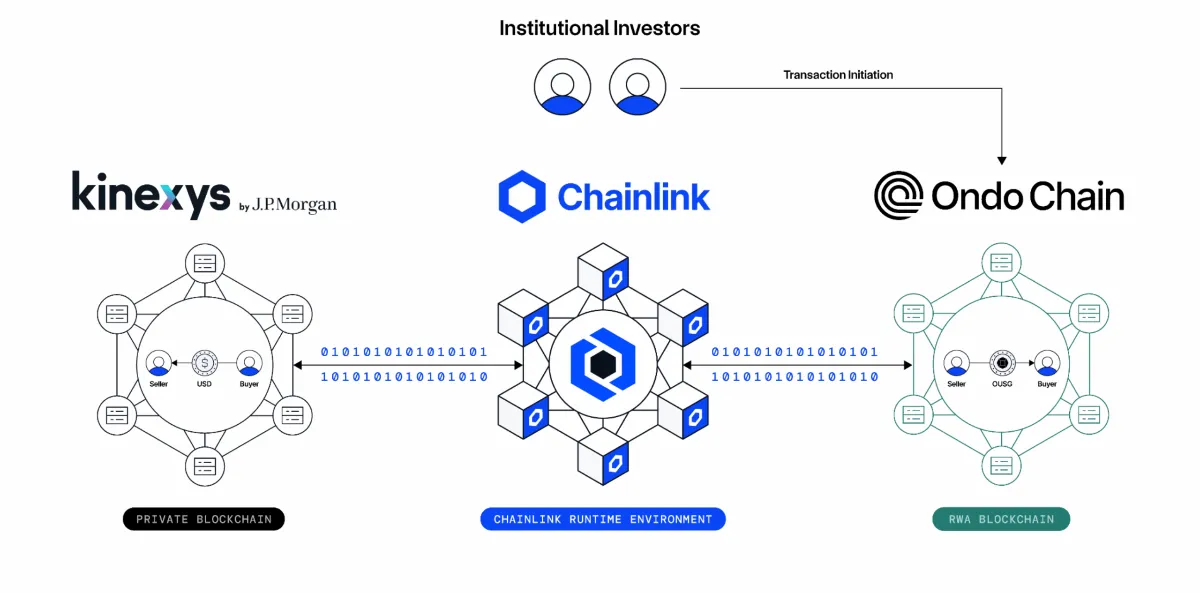
JP Morgan and Chainlink Lead the Top 15 On-Chain Finance Infrastructure Firms — Where Institutional Money Flows
 LINK
LINK BTGO
BTGO PYTH
PYTHWall Street's Defining Moments
See more

Sunday's SEC 8-K Earnings Filings Quiet, but Royal Gold Doubles Net Income and Launches Buyback
 RGLD
RGLDVeritone Earnings Shock Sends Shares Down 23%...York Space Systems Among 25 US Companies Filing SEC 8-K Earnings Reports
 YSS
YSS CODX
CODX IPWR+26
Applied Materials Posts Record Q3 Revenue of $9.1 Billion, All-Time High EPS
 AMAT
AMATSmart Money Briefing
Weekly summaries of Wall Street guru moves and crypto whale activity.