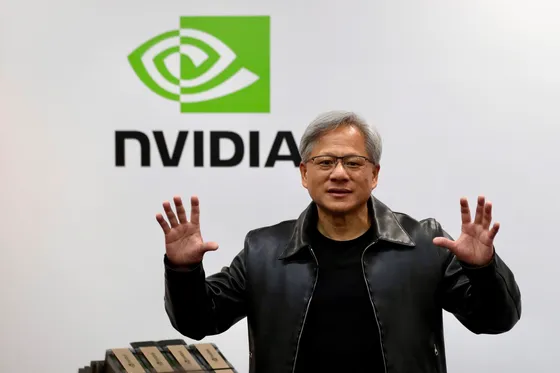
Jensen Huang: 'China Market Will Open Over Time' — H200 History, What It Means Two Days Before Earnings
Nvidia CEO Jensen Huang said China's AI chip market will eventually reopen to US suppliers, speaking the day after returning from Trump's Beijing summit. Two days before Nvidia's May 20 earnings, we break down how China went to zero revenue, why H200 purchases were blocked despite US licenses, and what a potential reopening means for investors.
- Jensen Huang said China's AI market 'will open over time,' one day after Trump's Beijing summit and two days before Nvidia's May 20 earnings
- Nvidia's China share has fallen from 90%+ to zero — Huang's comments put a $50 billion reopening option back on the table for investors
Nvidia CEO Jensen Huang said on May 18 in a Bloomberg Television interview that he believes China's AI chip market will eventually reopen to US suppliers. The timing is notable — two days before Nvidia's earnings release on May 20, and the day after Huang returned from accompanying President Trump on his state visit to Beijing.
Nvidia's market share in China once exceeded 90%. It is now at zero. Huang himself confirmed this last month, stating publicly: 'Today, in China, we have now dropped to zero.' Monday's comments represent the first concrete signal that this zero baseline could change.
What Huang Said — and the Context Behind It
Huang joined Trump's delegation of American business leaders for meetings with Chinese leader Xi Jinping in Beijing last week. On his return, he sat for a Bloomberg TV interview and delivered the clearest statement yet on the China question.
The Chinese government has to decide how much of their local market do they want to protect. My sense is that over time the market will open.
Jensen Huang / Nvidia CEO
Huang said he did not directly discuss H200 chip sales with Chinese officials, but confirmed the topic came up in government-level conversations between the two delegations. Trump separately told reporters that H200 'did come up, and I think something could happen on that' — while also noting that China had not approved purchases because 'they chose not to, they want to develop their own.'
How H200 Got Stuck — Licenses Approved, Purchases Blocked
Understanding this situation requires tracking H200's complicated commercial history. Trump agreed in December to allow Nvidia to ship H200 chips to Chinese customers. The US Commerce Department issued the required export licenses. That was the green light.
What followed was a surprise. Major Chinese tech companies — including Alibaba, Tencent, and Baidu — informed Nvidia they could not fulfill the purchases. According to people familiar with the matter, Beijing held up the approvals, citing semiconductor self-sufficiency goals and its push to build out Huawei's Ascend chip ecosystem as a domestic alternative.
- Nvidia's identified China AI chip market opportunity: approximately $50 billion
- H20 export restrictions cost Nvidia $4.5 billion in inventory charges in Q1 FY2026
- Nvidia's Q1 FY2027 guidance ($78 billion): explicitly excludes all China data center compute revenue
- China's AI accelerator market projected to reach nearly $50 billion by 2030 (Nvidia CFO)
Huang's Argument — Blocking Sales Doesn't Stop China's AI
Huang has made the same case consistently. Restricting US chip sales does not slow Chinese AI development — it simply redirects Chinese spending to domestic alternatives like Huawei. The financial damage lands on American companies, not on China's AI ambitions.
Huawei's Ascend chips lag H100 in raw performance but are gaining ground rapidly. In Huang's framing, export controls are doing the opposite of their intent: instead of keeping China dependent on American platforms and the CUDA software ecosystem, they are accelerating the development of a rival AI stack that could eventually compete globally.
Two Days to Earnings — What Markets Are Watching
Nvidia reports Q1 FY2027 results on Wednesday, May 20. Analyst consensus puts revenue at approximately $78 billion, up 77% year over year — a figure that already excludes any contribution from China's data center market.
There are two variables markets care about most.
- The headline result: by how much does Nvidia beat the $78 billion consensus
- The China signal: whether Huang's comments and Trump's language translate into a concrete policy shift or remain aspirational
If China reopens, the upside is material. Huang himself has called it a $50 billion opportunity. If the status quo holds, Nvidia has already demonstrated it can compound at 77% annually on US, European, and Asian demand alone. The China question is binary optionality on top of an already-strong base.
 NVDA
NVDAFrequently Asked Questions
What exactly did Jensen Huang say about China?
In a Bloomberg TV interview on May 18, Huang said: 'The Chinese government has to decide how much of their local market do they want to protect. My sense is that over time the market will open.' The comments came the day after he returned from accompanying Trump on his state visit to Beijing.
What is Nvidia's current revenue from China?
Huang himself confirmed Nvidia's China market share has fallen to zero. H20 export restrictions and Beijing's decision to block H200 purchases effectively eliminated China as a revenue source. Nvidia's Q1 FY2027 guidance of $78 billion explicitly excludes all China data center compute revenue.
Why are H200 chip sales blocked if the US approved licenses?
The US Commerce Department issued export licenses, but major Chinese tech companies — including Alibaba, Tencent, and Baidu — told Nvidia they could not fulfill their purchases. Beijing held up approvals due to semiconductor self-sufficiency goals and its push to develop Huawei's Ascend ecosystem as a domestic alternative.
What did Trump say about H200 and China?
Trump told reporters after the Beijing summit that H200 'did come up, and I think something could happen on that.' He also said China had not approved purchases because 'they chose not to, they want to develop their own' — suggesting the obstacle is primarily on the Chinese side.
When does Nvidia report earnings?
Wednesday, May 20, 2026. Analyst consensus calls for Q1 FY2027 revenue of approximately $78 billion, up 77% year over year. That figure already excludes any contribution from China's data center market, which Huang has called a $50 billion opportunity.





Wall Street's Defining Moments
See more
Sunday's SEC 8-K Earnings Filings Quiet, but Royal Gold Doubles Net Income and Launches Buyback
 RGLD
RGLDVeritone Earnings Shock Sends Shares Down 23%...York Space Systems Among 25 US Companies Filing SEC 8-K Earnings Reports
 YSS
YSS CODX
CODX IPWR+26
Applied Materials Posts Record Q3 Revenue of $9.1 Billion, All-Time High EPS
 AMAT
AMATSmart Money Briefing
Weekly summaries of Wall Street guru moves and crypto whale activity.