From Seoul to the World — How a Korean Asset Manager Became a Global ETF Player
A KRW 10B firm built in 1997 by a salaryman on a 120,000-won salary became a global financial group with offices in 16 countries 29 years later. Global X acquisition, India entry, Mirae Asset 3.0 — the closing chapter of the Park Hyun-joo trilogy.
From Seoul to the World — How a Korean Asset Manager Became a Global ETF Player
In 2018 Park Hyun-joo sat in a New York office. On the table in front of him was an acquisition agreement for Global X, an American ETF firm. A Korean asset manager acquiring an American ETF house. Wall Street raised an eyebrow. "A Korean firm?" Seven years later Global X's AUM crossed roughly $35B. This is the story of how Park turned a $7M company in Seoul into a global financial group with footholds in 16 countries.
1. "98% of the opportunity is outside Korea"
In 2003 Park opened his first overseas office. Hong Kong. The first Korean asset manager to do so.
Why Hong Kong? China. In the early 2000s the Chinese economy was growing explosively — the world's factory, GDP growth above 10%. Park saw China as the closest giant growth market for Korea, and Hong Kong was the gateway into it.
His logic was simple.
"Korea is less than 2% of global equity markets. 98% of the opportunity is outside Korea. Investing only in Korea means giving up 98% of the opportunity."
The structure mirrors Peter Thiel's "competition is for losers" — instead of fighting other Korean managers in Korea, find opportunity where no one else has gone.
After Hong Kong the map widened.
- 2008: India. Mirae Asset Global Investments India established.
- 2011: Acquires Horizons ETFs, Canada.
- 2018: Acquires Global X, USA.
- 2019: Joint venture with Daiwa Securities — Global X Japan.
- 2022: Acquires GHCO (now GTX), UK. European ETF market making.
- 2022: Acquires ETF Securities, Australia.
- 2024: Acquires Sharekhan, India. ~$420M.
16 countries in 20 years. A company that started in Korea writing its name across the global map.
2. Global X — the key to the US market
The 2018 Global X acquisition was the most decisive moment in Mirae Asset's global expansion.
Global X was founded in New York in 2008 as an ETF specialist. Not traditional index ETFs (S&P 500 trackers) but thematic ETFs — robotics, cloud computing, lithium & battery, uranium, social media. Funds that bet on specific trends.
This may sound like Cathie Wood's ARK. They were in fact competitors — both built thematic, innovation-led ETFs. The difference: Global X carried a wider line-up and was strong in income (dividend, covered-call) ETFs.
The price Mirae Asset paid was undisclosed but estimated at hundreds of millions of dollars — significant relative to its size.
Why this acquisition mattered.
The US ETF market is more than 70% of the global ETF market. Without operating in the US you cannot be a global ETF player. And building US ETF brand from scratch is nearly impossible for a Korean firm — no recognition, no distribution, no regulatory experience. An acquisition was the only viable route.
Post-acquisition, Global X grew explosively.
- 2018 acquisition AUM: ~$7B.
- 2025 AUM: ~$35B. 5x.
94 products listed in the US. A dominant position in thematic ETFs and income ETFs. Covered-call ETFs (QYLD, XYLD) in particular caught fire with US retail and powered the asset surge.
The effect shows up at home as well. Mirae's TIGER ETF brand in Korea has imported product-development know-how from Global X to expand thematic and income ETFs. Global X has been a major reason TIGER holds the top spot in the Korean ETF market.
3. India — the bet for the next 20 years
Park's most recent big bet is India.
Mirae Asset already established an Indian asset management subsidiary in 2008 — the only independent foreign-capital manager operating there. Over 16 years it quietly accumulated about 9 million customer accounts. Steady, patient.
Then in November 2024 Park made his move. Acquisition of Sharekhan, an Indian brokerage. Roughly $420M.
Sharekhan is India's 9th–10th largest broker. 3.1M customers. ~120 branches. 4,400+ business partners. A nationwide physical network.
The way Park decided is striking. In 2021 he spent three weeks traveling India himself — Mumbai, Delhi, Bangalore. Meeting business leaders, watching markets, observing consumers.
Just as Lynch found stocks in shopping malls, Park found the future on India's streets.
"Seeing India directly gave me conviction. 1.4 billion people. Average age 28. Digitization advancing explosively. This is what Korea experienced in the 1990s. The transition from saving to investing is starting in India now."
The man who pulled off "from saving to investing" in Korea now intends to do it again in India. Same formula, different market, 20× the population.
Goal: India's 5th largest broker within 5 years. From #10 to #5.
4. Mirae Asset 3.0
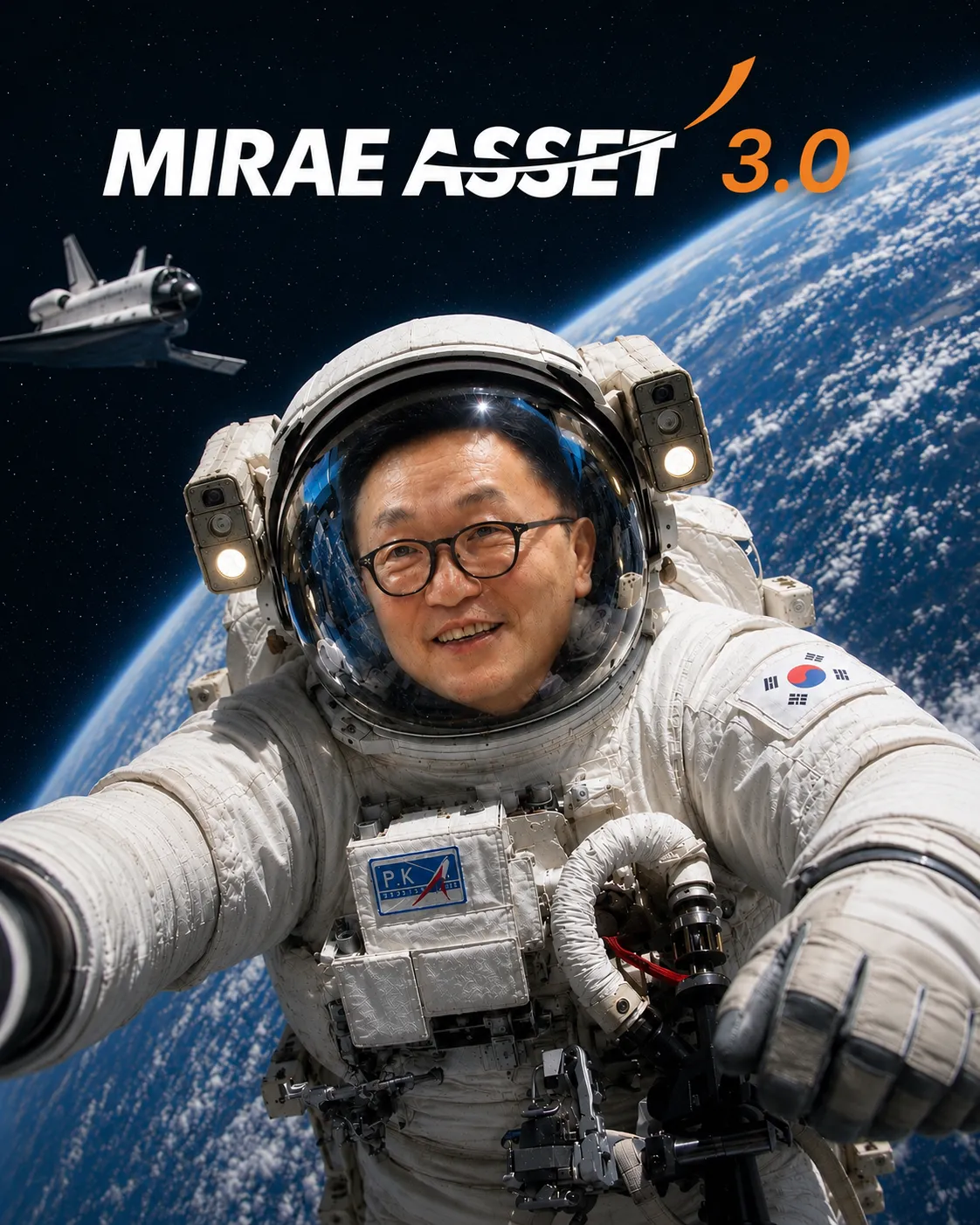
At the end of 2025 Park unveiled a new vision: "Mirae Asset 3.0."
Mirae Asset's three-stage evolution:
- Mirae Asset 1.0 (1997-2010): Founding. Mutual funds. "From saving to investing." Pioneering the Korean market.
- Mirae Asset 2.0 (2010-2025): Global expansion. Mainstreaming ETFs. Acquiring Global X, Horizons, Sharekhan. Reaching 16 countries.
- Mirae Asset 3.0 (2025-): Convergence of traditional and digital assets. Financial innovation built on AI, web3, blockchain.
Mirae Asset 3.0's first concrete move came at the end of 2025. A move to acquire Korbit — Korea's first-generation crypto exchange. Estimated price: roughly $70-100M.
From mutual funds to ETFs to crypto. The vision is to wire traditional and digital finance into a single ecosystem.
In Park's words.
"There is no growth without investment. We must hold the belief that investment can change the future."
5. The journey, in numbers
1997 to 2026. 29 years. The numbers tell the story.
- 1997: Founding capital KRW 10B. Dozens of staff. Korea only.
- 2006: Tens of trillions of won under management. #1 in Korean asset management.
- 2016: Acquires Daewoo Securities. #1 by equity capital in Korean securities. 19th largest chaebol.
- 2025: Global ETF AUM crosses 100 trillion won. 16-country footprint. Global X (US) 50T won. Horizons (Canada) C$49B.
From KRW 10B → a global financial group worth hundreds of trillions of won.
Compared with other figures in the Guru Story series:
- Buffett: $105K → $900B Berkshire. 60 years.
- Thiel: $55M PayPal sale → Founders Fund + Palantir. 20 years.
- Park: KRW 10B → a global financial group. 29 years.
Buffett compounded capital through investing. Thiel built and invested in parallel. Park built the financial industry itself. Three different methods, one shared trait — compounding patiently, over a long time.
— What if it were you? —
2021. You are Park Hyun-joo. 63 years old. Chairman of Korea's largest brokerage. Global ETF AUM past 100 trillion won. Successful enough. Now: do you acquire an Indian broker for ~$420M?
- A. Don't. The risk is too high. India is still uncertain.
- B. Start small. A joint venture or minority stake.
- C. Acquire it directly. Three weeks on the ground in India produced conviction.
Park chose C. After three weeks of field work he put $420M on the table. Just as Lynch found stocks in shopping malls, Park found the future on India's streets. His line: "Data shows the past. The future you have to see and feel directly."
6. Park Hyun-joo and the Guru Story masters
Compared with the other figures profiled in this series, Park's position is distinct.
Vs. Buffett: Both built financial empires under their own names. Both saw opportunity in crisis. Both refused to hand the firm to family. Where Buffett stayed an "investor," Park became a "builder of the financial industry."
Vs. Peter Thiel: Both did "0 to 1." Just as Thiel created PayPal as a new market, Park created Korean mutual funds as a new market. Both used M&A for global expansion.
Vs. Cathie Wood: Both built ETF businesses. Both emphasized innovation. Where Cathie Wood concentrated on stock selection, Park concentrated on building infrastructure. Cathie Wood is "what to buy"; Park is "what platform to build."
Vs. Lynch: Both put the field first. Lynch found stocks in shopping malls; Park found business opportunities on the streets of India. Both follow the same principle — see directly, experience directly, then decide.
One thing sets Park apart from every other figure in this series.
He is Korean.
Buffett, Soros, Munger, Lynch, Thiel, Simons. All American — starting in the world's largest capital market. The dollar's reserve-currency power, New York as financial capital. They grew on top of that infrastructure.
Park started in Korea. The won as a minor currency. Seoul as an Asian city. Less than 2% of global capital markets. From that small market he built a global financial group with offices in 16 countries.
The message for Korean retail investors: where you start does not matter. Direction and speed do. Just as a farmer's son from Gwangju became chairman of a global financial group, Korean retail investors can find opportunity in global markets. 98% of the opportunity is outside Korea.
7. Three lessons this episode leaves us
First, look outside Korea. Korea is less than 2% of global equity markets. Buying only Korean stocks means surrendering 98% of the opportunity. Park acquired Global X, entered India, and reached 16 countries for this reason. The same applies to Korean retail investors. US stocks, Indian stocks, global ETFs — this is the era when the world fits in a portfolio. The same logic underlies why InteliView's Guru-folio tracks US 13F data: the great investors' portfolios are not in Korea, they are in the world.
Second, M&A buys time. Park's Global X, Horizons, and Sharekhan deals all "bought time." If building a US ETF brand from scratch takes 10 years, an acquisition compresses those 10 years into a single day. The lesson does not translate one-to-one for retail investors, but the principle does — instead of entering a domain you do not know from zero, going through someone, a company, or a fund that already excels in it is more efficient. ETFs are exactly that tool.
Third, apply the same formula to a different market. Park made "from saving to investing" real in Korea, and is now applying the same formula in India. 1.4B people, average age 28, digitization underway — strikingly similar to Korea in 1998. When you have a formula that works, the core of expansion is applying it to a different environment. Lynch's "shopping mall method" works outside the US too. If a strategy worked for you in Korea, try it in the US, India, Vietnam.
8. Epilogue — the windmill is still turning
2026. Park Hyun-joo, 67.
Founder of Mirae Asset. Global Strategy Officer. 16-country financial footprint. Global ETF AUM 100 trillion won. 16 consecutive years donating his entire dividend. Cumulative donations: 34.7 billion won.
A company that started with KRW 10B. 29 years.
And he is still running. Toward India's #5 broker. Toward Mirae Asset 3.0. Toward a digital-asset platform.
1990. A branch of Hanshin Securities.
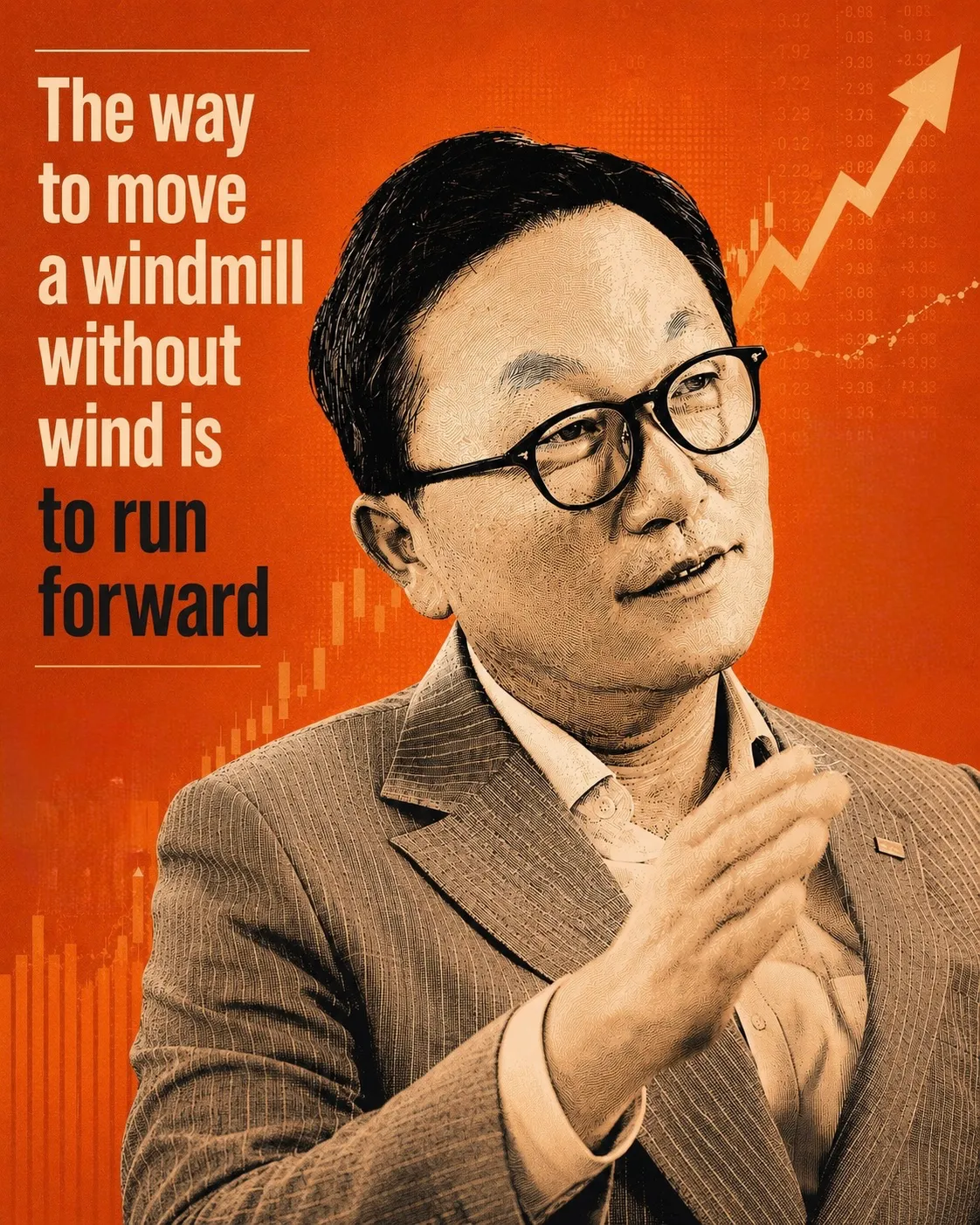
The 32-year-old branch manager hung a single line on the wall.
"The way to move a windmill when there is no wind is to run forward."
36 years have passed. Wind has come; wind has stopped.
The wind stopped during the IMF crisis. He ran. The windmill turned.
The wind stopped during the global financial crisis. He ran. The windmill turned.
The wind stopped during COVID. He ran. The windmill turned.
At 67 he is still running.
Wind or no wind.
The windmill is still turning.
▶ To track the portfolios of global investing masters — Inteliview Guru-folio.
Investment Decision Simulation
What would you have done? Compare your decision with the legend's actual choice.
2021년. 당신이 박현주다. 63세. 한국 최대 증권사 회장. 글로벌 ETF 100조 원 돌파. 충분히 성공했다. 이 시점에서 인도 증권사를 5,800억 원에 인수한다?
Once you've made your choice, reveal what the legend actually did
What's your take on this story?
What do you think about Park Hyun-joo's decision?
Sign in to participate
Sign In