
Semiconductor Peak in Early 2027, KOSDAQ Is a Bubble: Kwak Sang-jun's Warning
Matrix Investment Advisor CEO Kwak Sang-jun warns: real economy imbalance, KOSDAQ bubble, semiconductor stock peak in early 2027. Caution on ELS products.
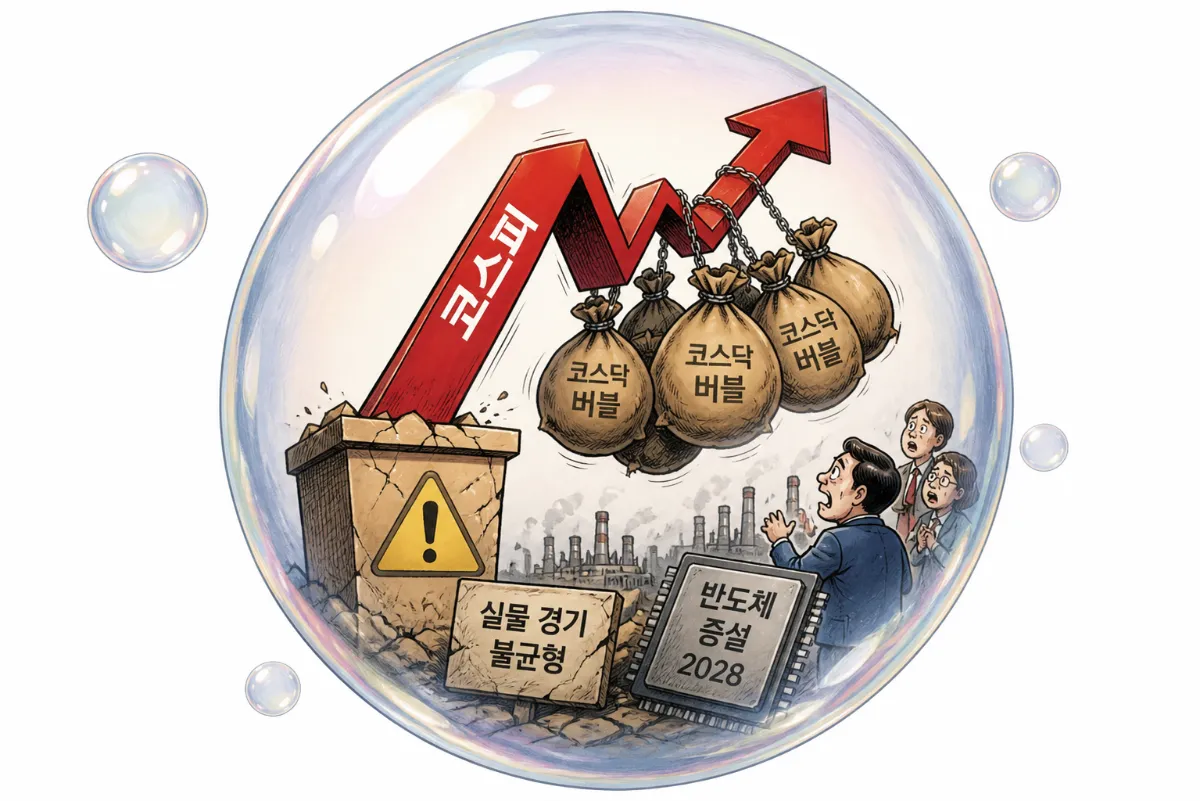
- Matrix Investment CEO warns KOSPI's rise driven by just two semiconductor stocks masks real economy weakness
- Semiconductor valuations may peak in early 2027 before 2028 capacity expansions
"KOSPI soared on Samsung and SK Hynix's wings, but the real economy is imbalanced… even restaurants in Yeouido empty out by 9 PM"
As KOSPI broke above the 6,900 level on the strength of two semiconductor stocks and Goldman Sachs mentioned a KOSPI target of 8,000, a note of caution emerged. Kwak Sang-jun, CEO of Matrix Investment Advisor, recently appeared on the Chosun Ilbo Money YouTube channel and made sobering remarks against the market's euphoria.
"The capital markets improved first, but the real economy remains imbalanced. Even restaurants in Yeouido are empty by 8 or 9 PM. The broader economy isn't really in great shape yet.""""— Kwak Sang-jun, CEO of Matrix Investment Advisor"
Two Reasons Behind KOSPI's Rise
Kwak attributed KOSPI's ascent to two factors. First, the surge in profits at Samsung Electronics and SK Hynix. Since October last year, both companies' earnings have grown beyond expectations. Second, the value-up policy and its multiplier effect. "Japan saw its index quadruple to quintuple over 10 years through value-up initiatives, so similar expectations have emerged for Korea," he explained.
However, even if these two pillars push KOSPI near 7,000, further upside in valuation multiples will be difficult without earnings participation from other companies. Valuation multiples represent how many times a stock trades relative to earnings—they expand as market sentiment improves.
Semiconductor Stock Peak May Come in Early 2027
He also provided specific insight on when semiconductor stocks might peak.
"Both Samsung Electronics and SK Hynix have confirmed capacity expansions scheduled for 2028. Looking at historical patterns, stock peaks have preceded earnings peaks by 1 to 1.3 years. Samsung Electronics' stock peak in January 2021 is an example—actual earnings peaked in 2023. Given the supply increases in 2028, we should prepare for the possibility of a stock price peak in early 2027.""""— Kwak Sang-jun, CEO of Matrix Investment Advisor"
It's noteworthy that Morgan Stanley analyst Sean Kim recently raised Samsung Electronics' operating profit forecast to mid-600 trillion won through 2028, shifting from bearish to bullish. "When everyone turns positive, it means everyone has already bought. Without new buyers, stock prices won't rise further."
KOSDAQ Is a Bubble
He used even stronger language about KOSDAQ breaking the 1,200 level: "It's not just expensive—it's a bubble." His reason: there are barely any companies generating real profits.
He specifically noted that secondary battery stocks have seen their price appreciation driven by optimism about sector improvement, but actual earnings haven't caught up yet. Construction stocks that have risen on overseas reconstruction tailwinds also warrant caution. "Historically, more construction firms have lost money on overseas projects than made it. The stock market isn't a food game—it's about not breaking your plate."
ELS: Attractive to Whom?
He expressed caution about the recent surge in capital flowing into ELS (Equity Linked Securities). ELS issuance by the top 10 securities firms in Q1 this year reached 5.59 trillion won, up 16.2% year-over-year.
"ELS is definitely an attractive product for financial companies. Whether it's attractive for investors requires careful scrutiny." He pointed out the structural issue: investors receive fixed annual returns of 5-6%, but financial company fees are charged separately.
He explained that as stock prices continue rising, the option premiums that generate returns behind ELS decline, and as early redemptions repeat, the yield of newly issued ELS gradually falls. This mirrors the pattern from 2020-2021 when capital flooded into ELS during the COVID rally, only for investors to be hit hard by the Hong Kong ELS crisis.
Frequently Asked Questions
What does it mean that valuation multiple increases will be difficult?
Stock price equals earnings multiplied by valuation multiple. Even if earnings grow, if the multiple doesn't expand, there's a ceiling on stock price gains. Unless earnings from companies beyond Samsung and SK Hynix improve, the market-wide multiple will struggle to climb.
Why do stock peaks precede earnings peaks?
Stock markets anticipate the future. Once investors see earnings approaching their peak, they begin selling. With 2028 bringing capacity increases that will compress earnings, stock prices could peak in early 2027 before that deterioration becomes visible.
What should I verify before buying ELS?
Check the underlying asset (which index or stocks it tracks), knock-in conditions (how far prices must fall before you lose principal), redemption terms, and fee structure. Index-linked ELS is generally safer than single-stock ELS.
How does Kwak's view differ from other analysts?
Goldman Sachs targets KOSPI 8,000; Morgan Stanley's Sean Kim raised Samsung's 2028 operating profit to mid-600 trillion won. Global banks favor strength. Kwak distinctly interprets consensus positivity as a contrarian signal: "everyone bullish means everyone bought, with no new buyers left."

25 Companies Including PayPal, NXP Semiconductors File Earnings With SEC Today...SK Hynix Operating Profit Tops $41.6B
 PYPL
PYPL NXPI
NXPI HUBB+19
South Korea's Kospi Hits All-Time High as U.S.-Iran Deal Hopes Lift Asia Markets
 005930
 000660
 EWY
EWY
Samsung and SK Hynix Workers Are Buying Ferraris as AI Memory Boom Mints New Wealth
005930000660 NVDA
NVDAWall Street's Defining Moments
See more



Sunday's SEC 8-K Earnings Filings Quiet, but Royal Gold Doubles Net Income and Launches Buyback
 RGLD
RGLDVeritone Earnings Shock Sends Shares Down 23%...York Space Systems Among 25 US Companies Filing SEC 8-K Earnings Reports
 YSS
YSS CODX
CODX IPWR+26
Applied Materials Posts Record Q3 Revenue of $9.1 Billion, All-Time High EPS
 AMAT
AMATSmart Money Briefing
Weekly summaries of Wall Street guru moves and crypto whale activity.