
Dimon Warns: Bond Crisis Coming—Prepare Now or Face Worse
Jamie Dimon, JPMorgan Chase CEO, warned of simultaneous bond crisis and credit recession at Norway's sovereign wealth fund conference. U.S. federal debt of $39 trillion and monthly interest payments of $21 billion represent structural headwinds.
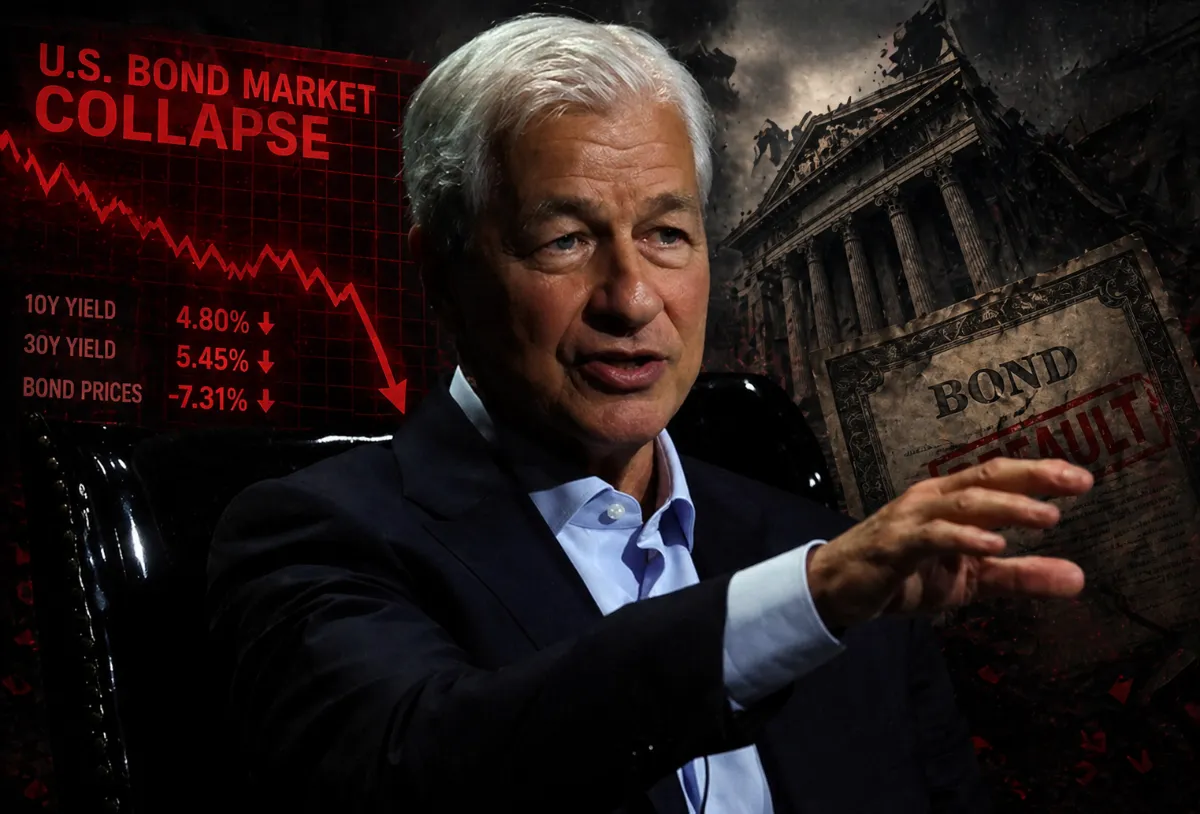
- Dimon warns of simultaneous bond crisis and credit recession at sovereign wealth fund conference
- debt service burden—$39T principal, $21B monthly interest—poses structural risk
Jamie Dimon, CEO of JPMorgan Chase, warned of an imminent bond crisis and credit recession simultaneously at a conference hosted by Norway's sovereign wealth fund (Norges Bank Investment Management). U.S. federal debt stands at $39 trillion, with average monthly interest payments of $21 billion—a reality already upon us, according to Joint Economic Committee calculations.
$39 Trillion Debt and $21 Billion Monthly Interest: The Reality
Dimon's warning is concrete, not speculative. U.S. federal debt currently stands at $39 trillion. Over the past year, average monthly interest payments on this debt have reached $21 billion, according to Joint Economic Committee data. This interest burden is not fixed. Bonds issued during the low-rate era face refinancing at current elevated rates as they mature, creating a structural increase in debt service. Dimon identified three key risk factors: geopolitical instability, oil prices, and expanding fiscal deficits. He noted: 'These factors could disappear, or they might not. We don't know which combination will trigger the problem.'
The 2022 U.K. Gilt Crisis: A Cautionary Tale
Dimon cited the 2022 British gilt crisis as a concrete example. When the U.K. government announced tax cuts without a funding plan, gilt yields spiked within days, pension funds faced margin calls, and the Bank of England was forced to intervene. That crisis affected one nation. Dimon warns of similar dynamics unfolding at a vastly larger scale—in U.S. Treasuries and major developed-market bond markets. Scale determines the magnitude of the shock.
The Second Warning—Credit Recession
'We haven't experienced a credit recession for far too long. When it comes, it will be far worse than people expect. It could be devastating,' Dimon stated. His logic: during extended credit booms, lending standards loosen and risk assumptions turn overly optimistic. When cycles turn, losses materialize far larger than models from the boom period predicted. The roughly $1.7 trillion private credit market is not immune to this dynamic.
Implications for Investors
Dimon's remarks were primarily directed at policymakers, not portfolio managers. His core message: 'Government must act before markets force a solution.' For investors, the implications are clear: it's time to reassess long-duration bond exposure, compressed credit spreads, and the assumption that current low volatility will persist.
Related Securities & ETFs
- Direct exposure: JPMorgan Chase (JPM)
- Treasury hedges: TLT (long-duration Treasuries), TBT (inverse long-duration Treasuries), SHY (short-duration Treasuries)
- Credit risk: HYG (high-yield bonds), LQD (investment-grade corporate bonds)
- Safe havens: GLD, SGOV, BIL
Frequently Asked Questions
How exactly will a bond crisis manifest?
When Treasury yields spike sharply, government interest burdens explode and bond prices collapse, inflicting losses on major institutional holders. If pension funds, insurers, or other large bond holders face margin calls or liquidity crises, shocks ripple across the entire financial system.
Why is the private credit market particularly vulnerable?
Private credit lends to non-public companies with limited liquidity. During downturns, loan losses mount significantly, and illiquidity prevents rapid cash recovery, amplifying systemic stress.
What should Korean bond investors monitor?
A spike in U.S. Treasury yields affects global bond markets broadly. Korean government and corporate bonds face adjustment pressure; dollar strength could add strain on foreign-currency-indebted firms and emerging markets.

Welltower Q2 Adjusted FFO Rises 25% to $1.60/Share, but Full-Year Net Income Guidance Cut
 WELL
WELLBloom Energy Q2 Revenue Surges 166% to Top $1 Billion for First Time as Stock Plunges 11%
 BE
BE25 Companies Including PayPal, NXP Semiconductors File Earnings With SEC Today...SK Hynix Operating Profit Tops $41.6B
 PYPL
PYPL NXPI
NXPI HUBB+19
Wall Street's Defining Moments
See more

Welltower Q2 Adjusted FFO Rises 25% to $1.60/Share, but Full-Year Net Income Guidance Cut
WELLBloom Energy Q2 Revenue Surges 166% to Top $1 Billion for First Time as Stock Plunges 11%
BE25 Companies Including PayPal, NXP Semiconductors File Earnings With SEC Today...SK Hynix Operating Profit Tops $41.6B
PYPLNXPIHUBB+19Smart Money Briefing
Weekly summaries of Wall Street guru moves and crypto whale activity.