Google & Marvell in AI Inference Chip Talks — A Second Crack in Nvidia's Dominance
Google (GOOGL) is in discussions with Marvell (MRVL) to co-develop AI inference chips and memory. Google has already signed a long-term TPU agreement with Broadcom (AVGO) through 2031. As the anti-Nvidia coalition expands, MRVL shares have surged 56% YTD.
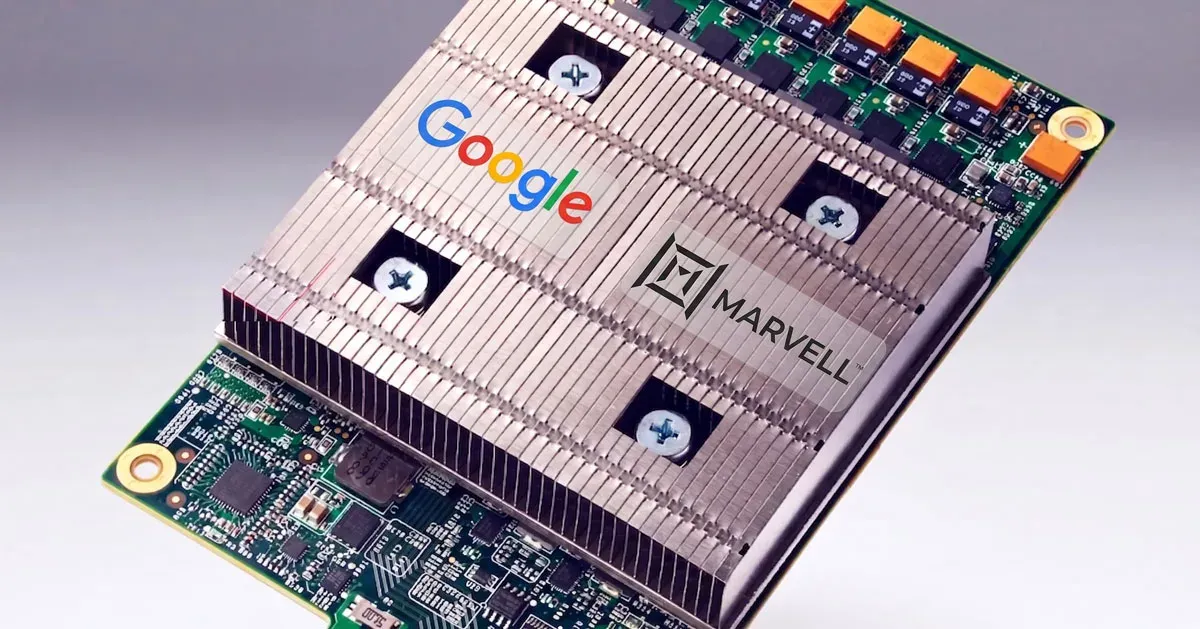
Google (GOOGL·GOOG) is reportedly in talks with Marvell Technology (MRVL) to co-develop next-generation AI chips. The move signals Marvell's potential addition as a key partner in Google's effort to displace Nvidia (NVDA) from the AI accelerator market by scaling its proprietary TPU ecosystem.
According to reports from The Information and Funda AI, the Google-Marvell collaboration is targeting AI inferencing chips — not for training models like Gemini, but for handling the large-scale serving traffic of already-trained models. Marvell is also expected to manufacture AI memory chips designed to work alongside Google's processors.
Cracks Forming in the Nvidia-Broadcom Duopoly
Google's TPU has emerged over the past two years as the most credible real-world alternative to Nvidia's market dominance. Nvidia itself is developing proprietary inference chips leveraging Groq's technology, signaling that the battle for the inference market is now fully underway.
Google already holds a chip manufacturing partnership with Broadcom (AVGO). Broadcom recently announced a long-term agreement to co-develop next-generation TPUs with Google through 2031. Separately, Anthropic announced an expanded deal to access greater TPU computing capacity through Google.
Based on Guru holdings data, GOOGL/GOOG is currently held by 69 gurus, Broadcom (AVGO) by 28, Nvidia (NVDA) by 37, and Marvell (MRVL) by 18. The Google-Marvell news could serve as a catalyst for portfolio rebalancing across all four names.
Google is projected to generate over $10 billion in intellectual property licensing revenue in 2026–2027 alone.
Wells Fargo — TPU Licensing Estimate
Earnings Calendar: Google Q1 Results Due April 29
Google kicks off its annual cloud computing conference this week. TPUs serve as a core infrastructure component within Google Cloud data centers.
For the December quarter, Google's Cloud revenue surpassed $16 billion, growing 47% year-over-year — an acceleration from 34% in the prior quarter. The Cloud backlog rose 55% quarter-over-quarter to $240 billion.
Google's Q1 earnings are scheduled for April 29. The stock is up 9% in 2026 and gained 65% last year. Investors are watching the $349 cup-base breakout point per IBD analysis.
CapEx Surging 97% — The Market's Key Concern
Google has guided 2026 capital expenditures to $175–$185 billion, representing approximately a 97% increase year-over-year. The stock pulled back in February on CapEx concerns before recovering.
The sharp rise in CapEx is fueling debate around buyback capacity, free cash flow, and return on invested capital (ROIC). The expanded Marvell partnership represents a structure through which a portion of that investment could be recouped via real revenue and licensing — effectively serving as the economic justification for Google's CapEx cycle.
Investor Checklist
▲ Official announcement timing and contract size of the Google-Marvell deal ▲ Google Q1 Cloud revenue and any TPU-related commentary on the April 29 earnings call ▲ Near-term market share shifts among the four-way AI chip dynamic: Nvidia, Google, Broadcom, and Marvell ▲ Progress on additional TPU customer agreements beyond Anthropic — these four checkpoints will likely determine the direction of AI semiconductor stocks over the coming weeks.
2026 YTD performance: Nvidia +8%, Broadcom +17%, Google +9%, Marvell +56%. The market has already placed a bold bet on Marvell, and the Google partnership reports are reinforcing the fundamental case behind that trade.
Frequently Asked Questions
구글-마벨 협력의 타깃은 무엇인가요?
AI 추론(inferencing)용 칩입니다. 제미나이 같은 모델을 학습시키는 게 아니라 이미 학습된 모델을 대규모 서비스 트래픽에 적용하는 처리 단계를 맡습니다. 마벨은 구글 프로세서와 함께 쓰이는 AI 메모리 칩도 생산할 것으로 알려졌습니다.
마벨이 2026년 56% 급등한 배경은?
구글-브로드컴 TPU 생태계가 엔비디아 지배력에 가장 현실적인 대안으로 부상했고, 이번 마벨 협력설이 베팅 근거를 보강했기 때문입니다. 2026년 YTD 기준 엔비디아 +8%, 브로드컴 +17%, 구글 +9%, 마벨 +56%로 시장은 마벨에 가장 공격적으로 베팅 중입니다.
구글의 1,750억 달러 CapEx가 왜 논쟁거리인가요?
전년 대비 약 97% 증가한 규모라 자사주 매입 여력, 자유현금흐름, ROI에 대한 우려를 불러일으켰습니다. 마벨 등 추가 파트너십은 이 투자 일부를 실질 매출과 라이선싱으로 되돌려 받는 구조로 CapEx 경제 정당화와 맞닿아 있습니다.
AI 반도체 섹터에서 다음 체크포인트는?
구글-마벨 계약의 공식 발표 시점·물량, 4월 29일 구글 1분기 클라우드·TPU 매출 코멘터리, 추론 시장 4자(엔비디아·구글·브로드컴·마벨) 점유율 변동, Anthropic 외 추가 TPU 고객사 계약 진척도가 핵심입니다.






Wall Street's Defining Moments
See more

Sunday's SEC 8-K Earnings Filings Quiet, but Royal Gold Doubles Net Income and Launches Buyback
 RGLD
RGLDVeritone Earnings Shock Sends Shares Down 23%...York Space Systems Among 25 US Companies Filing SEC 8-K Earnings Reports
 YSS
YSS CODX
CODX IPWR+26
Applied Materials Posts Record Q3 Revenue of $9.1 Billion, All-Time High EPS
 AMAT
AMATSmart Money Briefing
Weekly summaries of Wall Street guru moves and crypto whale activity.