Peter Thiel Leads $140M Investment in Wave-Powered Offshore AI Data Center; Valuation Hits $1B
Peter Thiel spearheaded a $140M investment round in Panthalassa, a wave-energy-based offshore AI data center startup. The deal signals how acute AI's power bottleneck has become—driving venture capitalists to bet on sci-fi solutions and structurally supporting power infrastructure beneficiaries.
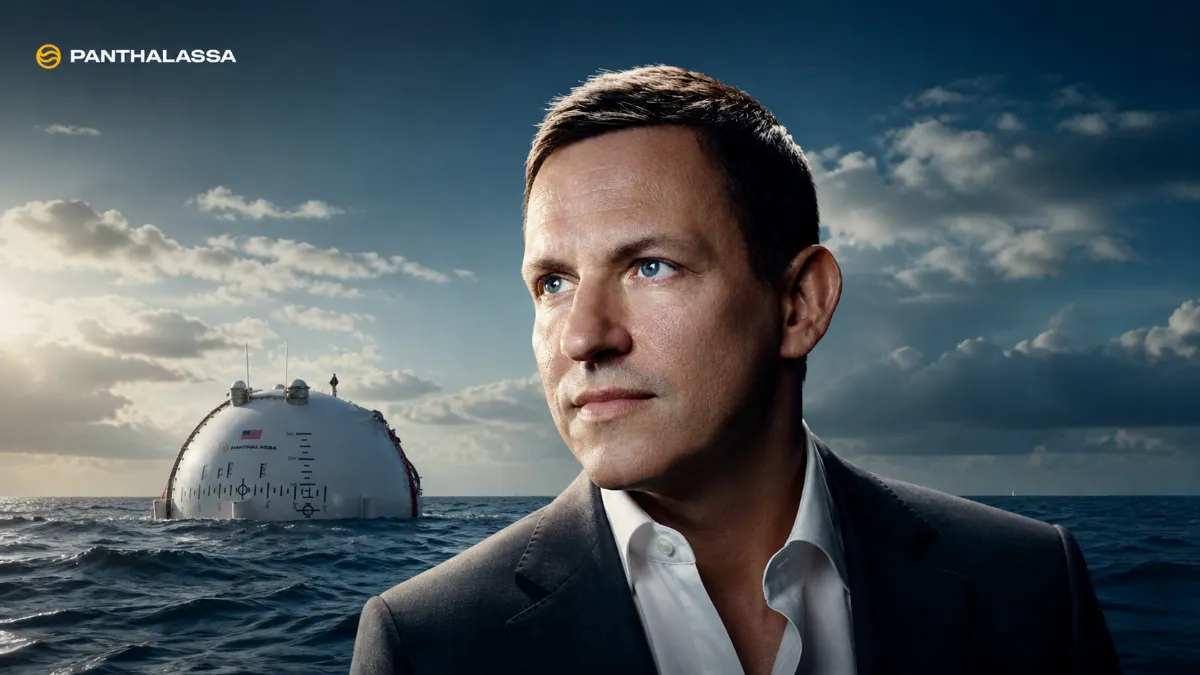
- Peter Thiel led $140M Series funding in wave-powered offshore AI data center Panthalassa, valued at $1B, with Benioff and Levchin
- AI power crisis driving multi-decade structural tailwinds for power infrastructure, SMRs, and HVDC technology companies
Steel structures the height of Big Ben floating at sea, running AI chips… Benioff, Doer, and Levchin also participating
A startup that floats AI data centers on the ocean has captured serious capital from Silicon Valley heavyweights.
Peter Thiel led a $140 million funding round in Panthalassa through his personal fund, valuing the company at $1 billion. Salesforce CEO Marc Benioff, Affirm co-founder Max Levchin, and Kleiner Perkins partner John Doerr also participated. The engineering team comprises veterans from SpaceX, Boeing, NASA, Tesla, and Apple.
What they're betting on is a technology that doesn't yet exist at scale. But understanding why these figures deployed this capital reveals the real story.
Wave Energy Powers AI Chips
Panthalassa's structure is an 85-meter steel vessel—roughly the height of Big Ben. It floats at sea with most of its mass submerged.
The mechanism works like this: as waves surge up and down, internal seawater passes through turbines. That motion generates electricity. That power runs the internal AI chips. Cooling uses seawater directly. Data transmits via Starlink satellites. An onboard propulsion system lets it navigate autonomously.
The core philosophy is singular: generate electricity locally and consume it on-site. Transmitting wave-generated power to shore via undersea cables causes transmission losses and incurs massive infrastructure costs. Running the data center in place eliminates that problem.
Why the Ocean—AI's Power Bottleneck Is That Severe
There's a reason heavyweights are funding this sci-fi concept: AI computing demand is overwhelming electricity supply.
A single NVIDIA GPU consumes 400 watts. An AI data center stacked with tens of thousands of them requires the output of one or two nuclear power plants. The U.S. grid cannot keep pace. Building new substations takes 5–10 years. This explains why Big Tech is seriously betting on sci-fi solutions: reactivating retired nuclear plants, small modular reactors (SMRs), and even space-based solar.
Panthalassa's CEO argues that only solar, nuclear, wave, and wind can deliver dozens of terawatts of clean energy. That's orders of magnitude larger than current global AI data center power demand.
The Technology Remains Unproven at Scale
Let's be direct: wave energy generation has not been commercially proven at scale. Unlike onshore solar or wind, durability, maintenance, and cost-competitiveness in the marine environment remain unvalidated.
The $140 million funds technology development, not an operational data center. Investors like Thiel and Benioff understand this is high-risk venture capital.
What this investment symbolizes, however, is the severity of AI's power crisis and how far investors are willing to venture for solutions.
The Real Beneficiaries Are Elsewhere
Panthalassa may or may not succeed. But the AI power bottleneck this deal illustrates is structural and multi-decade.
The most reliable beneficiaries are power infrastructure companies: SMR developers, gas turbine manufacturers, transformer and power equipment makers, and HVDC (high-voltage DC) technology firms.
If Big Tech is desperate enough to float data centers on the ocean, it signals that trillions in capital will flow into traditional bottleneck-solving solutions—power grids, reactors, and transmission systems.
Frequently Asked Questions
Is wave energy generation commercially viable at scale?
Not yet proven at commercial scale. Unlike solar/wind, marine durability, maintenance, and cost-competitiveness remain unvalidated. The $140M funds technology development—not operational data centers. This is explicitly high-risk venture capital.
How severe is AI's power bottleneck?
Acute. Single NVIDIA GPU clusters consume nuclear-plant-level power. New substation construction takes 5–10 years. By 2030, U.S. AI data center demand may claim 8–12% of grid capacity, forcing extreme solutions: SMRs, offshore platforms, space-based solar.
Which power infrastructure stocks benefit?
SMR plays: NuScale Power, Oklo (OKLO). Traditional power equipment: Eaton (ETN), Vertiv (VRT), Hubbell (HUBB), ABB. Data center EPC: Quanta Services (PWR). HVDC: Siemens Energy, ABB. Nuclear: Cameco (CCJ), Sprott Physical Uranium (SRUUF).
How can Korean investors access this theme?
Direct stocks: ETN, VRT, HUBB, PWR, OKLO, CCJ, URA. ETFs: GRID (power infrastructure), ICLN (clean energy), NLR (nuclear), URA (uranium). Domestic: Doosan Enerbility (034020), HD Hyundai Electric (267260) move on same thesis.
Is Thiel a serial sci-fi bet maker?
Yes. PayPal Mafia veteran Thiel bets unconventionally: Facebook seed ($500K → ~2000x), Palantir co-founder, 2014 Bitcoin accumulation, SpaceX early investor, Anthropic backer. Pattern: contrarian entry when others laugh. Often deploys via personal fund separate from Founders Fund.
Why did Benioff and Doerr join this round?
Signal amplification. Thiel attracts capital; Benioff (cloud/enterprise), Levchin (fintech/payments), and Doerr (venture royalty) lending credibility validates that power infrastructure truly is the bottleneck constraining AI scaling—worth extreme solutions.

Sunday's SEC 8-K Earnings Filings Quiet, but Royal Gold Doubles Net Income and Launches Buyback
 RGLD
RGLDVeritone Earnings Shock Sends Shares Down 23%...York Space Systems Among 25 US Companies Filing SEC 8-K Earnings Reports
 YSS
YSS CODX
CODX IPWR+26
Applied Materials Posts Record Q3 Revenue of $9.1 Billion, All-Time High EPS
 AMAT
AMATWall Street's Defining Moments
See more

Sunday's SEC 8-K Earnings Filings Quiet, but Royal Gold Doubles Net Income and Launches Buyback
RGLDVeritone Earnings Shock Sends Shares Down 23%...York Space Systems Among 25 US Companies Filing SEC 8-K Earnings Reports
YSSCODXIPWR+26Applied Materials Posts Record Q3 Revenue of $9.1 Billion, All-Time High EPS
AMATSmart Money Briefing
Weekly summaries of Wall Street guru moves and crypto whale activity.