
When Layoff Announcements Became Bullish — How AI Rewrote the Market's Grammar
Coinbase cut 700 people and its stock went up. In a world where 11 Hyperliquid engineers generated $857M in revenue, the market's evaluation criteria have shifted from headcount to per-employee productivity.
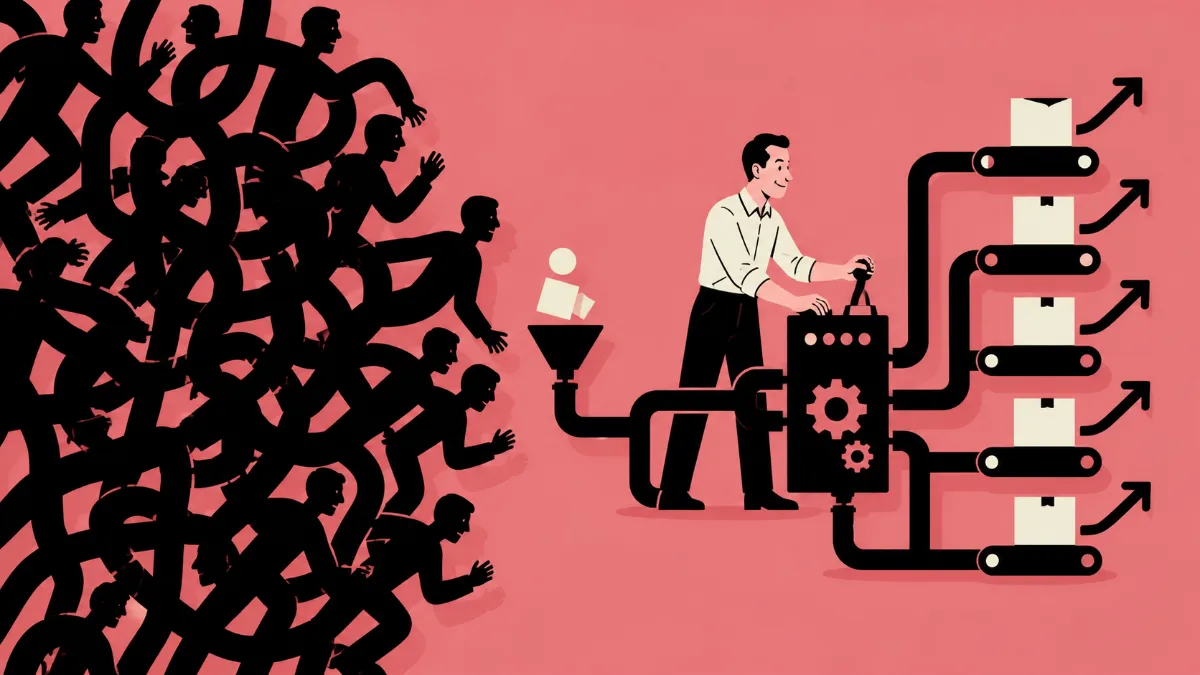
- Coinbase cut 700 staff and announced a reorganization into AI-native pods, sending shares up 4%
- With Hyperliquid's 11 people producing $857M in revenue, the market's grading rubric has moved from headcount scale to per-employee productivity
Coinbase cuts 700, stock pops 4% — inside the world where 11 Hyperliquid engineers built an $857M-revenue machine
Mass layoff announcements used to be a flashing red signal. Stocks fell, investors questioned management. In 2026, the market does the opposite.
Coinbase Cut 700 People — and the Stock Went Up
On May 5, Coinbase announced it would cut roughly 700 jobs — about 14% of its workforce. CEO Brian Armstrong framed it not as cost-cutting but as a "transition to an AI-native operating model." Pre-market shares jumped about 4% on the news.
Things played out differently when Coinbase first cut 18% of staff in 2022. That move was a defensive reaction to the structural crypto winter, and the market read it as a crisis signal. The break came in 2023, when an additional 20% cut actually sent the stock soaring. Something had started to shift.
What changed wasn't the size of the cuts — it was the narrative.
Layoffs used to be downstream of weakening fundamentals, and shares fell. Today layoffs are downstream of AI adoption, and shares rise. When Jack Dorsey's Block trimmed a meaningful slice of headcount with the line "thanks to AI, smaller teams can deliver bigger output," the stock surged. Oracle, Amazon, Meta, and Microsoft sit on the same curve. Tens of thousands of global tech jobs vanished in Q1 2026 alone, and the market is reading that as future investment, not distress.
Hyperliquid's 11 People Proved It First
The extreme version of this trend wasn't set by a legacy company. Hyperliquid, a decentralized derivatives exchange, generated roughly $857 million in 2025 revenue with a team of just 11. That's about $77.9 million in revenue per person — at the time, higher than the per-employee revenue of Apple or Nvidia.
Hyperliquid has no marketing team and no business-development team. Smart contracts replace operations, so the points where humans are needed simply don't exist. Half the core team is engineers; the rest cover product and ops. With no approval ladder, response speed to market changes isn't in the same league as a several-hundred-person organization.
Other companies have run a similar playbook. Solana-native memecoin launchpad Pump.fun reached $100 million in revenue seven months after launch — the fastest record in crypto history. Tether produces several billion dollars in annual profit with about 100 employees, beating JP Morgan on per-employee earnings. Uniswap, run by a small team, processes a meaningful share of global DEX volume.
They share one trait: a decision-making layer that's either absent or razor-thin. A CEO can have an idea today and ship it tomorrow. Coinbase's 700-person reduction is, in the end, an attempt to bend toward that shape.
How AI Redefines What "Capability" Means
In legacy companies, capability scaled with team size. More people produced more output. AI and smart contracts broke that equation.
The market's logic for treating layoffs as bullish hinges on one bet: per-employee productivity could spike. The belief — that one engineer with AI coding tools can ship the code of ten, that one analyst with AI research tools can replace a 20-person research team — is showing up in valuations. Hyperliquid's 11 people already proved the extreme.
Investors aren't looking at headcount anymore — they're looking at whether the org is built to extract maximum output from each person. Armstrong's "AI-native pods" announcement is, ultimately, an experiment in grafting Hyperliquid-style high-density teams onto a legacy exchange.
Don't Hire More People — Design the System
The old playbook for scaling a business was hiring more people, but that explodes management cost and complexity. Today the job isn't to be a person who does the work — it's to be the person who designs the system that does the work.
Competitive advantage is no longer about how many people are on the team. It's about how much revenue you can generate with how few people. More important than the technology itself is the ability to define a problem and turn it into a system.
The Logic Doesn't Always Hold
Even VC Marc Andreessen pushed back:
Companies used to fire people because of market corrections. Now everyone's using AI as a silver-bullet excuse.
Marc Andreessen, a16z co-founder
Oracle popped 7.5% the day after its layoff announcement, then drifted back to prior levels within a few days. Amazon also surged on a layoff print before fading over the following months. Whether a layoff is a real structural reinvention or a restructuring dressed up in AI language is something the market itself sometimes can't tell.
"Layoff = bullish" isn't a change of heart from the market — it's a shift in evaluation criteria. The benchmark moved from "how many people you employ" to "how efficiently you create value." With AI taking root as a productivity tool, maintaining a large workforce is increasingly being read as evidence of wasted competitiveness.
Whether this is genuine structural reinvention will be answered, in the end, by the next quarter's earnings.
Frequently Asked Questions
Why were layoffs once bearish but now read as bullish?
The evaluation criteria moved. Historically, weakening revenue and earnings drove layoffs, and the market read that lagging indicator as a distress signal. Today, AI tool adoption is assumed to lift per-employee productivity — so maintaining a large headcount is being read as evidence of inefficiency rather than strength.
Can every company replicate the Hyperliquid 11-person, $857M-revenue model?
Structurally, no. Hyperliquid is a decentralized exchange where smart contracts replace operations, settlement, and clearing — so the surface area requiring humans is small. A traditional exchange like Coinbase can't flip into the same model overnight; instead, it's gradually thinning the approval layer in that direction.
Is the Coinbase reaction a real bullish signal or a temporary pop?
Past cases like Oracle and Amazon showed an immediate post-announcement surge followed by a return to prior levels within days to months. Whether this is genuine structural reinvention or restructuring dressed up in AI language gets decided in the next quarter's per-employee operating profit and revenue. At this stage it's closer to a bet than a confirmation.
Which stocks benefit from the AI-driven layoff trend, and which get hurt?
Beneficiaries: AI coding, research, and customer-support automation SaaS (Nvidia, Microsoft, names with Anthropic infrastructure exposure, ServiceNow, Palantir). Casualties: BPO, SaaS call centers, and legal-review services that depend on large-scale headcount. As of Q1 2026, the market is awarding multiple premiums to the former.
How can Korean investors get exposure to this trend?
Direct names: Coinbase (COIN), Block (SQ), Oracle (ORCL), Microsoft (MSFT), Meta (META). For per-employee productivity-themed exposure, ARKK and BOTZ have partial overlap; for the broadest indirect exposure, US big-tech-heavy QQQ and VGT capture the most of it. Hyperliquid is private, but the HYPE token offers exposure with very high volatility.









Wall Street's Defining Moments
See more







Smart Money Briefing
Weekly summaries of Wall Street guru moves and crypto whale activity.