SEC/CFTC jurisdiction codified, staking institutionalized, custody legalized… Polymarket passage probability at 61%
The most consequential event in U.S. crypto regulation is approaching. The Digital Asset Market Structure Act (CLARITY Act, H.R. 3633) passed the House last July by a sweeping bipartisan vote of 294 to 134 and is now awaiting a Senate markup. A coalition of more than 100 crypto firms, including Coinbase and Ripple, submitted an open letter to the Senate Banking Committee on April 23 urging immediate advancement to markup. Polymarket puts the probability of enactment in 2026 at 61%, and Treasury Secretary Bessent is pushing hard to get it signed before the midterm elections.
On March 17, the SEC and CFTC jointly released a 68-page interpretive guidance explicitly designating Bitcoin, Ethereum, Solana, Ripple (XRP), and Chainlink as digital commodities (non-securities). The CLARITY Act would give this interpretation permanent legal force through legislation. If enacted, it would end a decade of 'regulation by enforcement.'
4 Core Provisions of the Bill
The CLARITY Act introduces four structural changes.
① Legal separation of SEC and CFTC jurisdiction: Assets are classified into three categories — digital commodities, investment contract assets, and permitted payment stablecoins — with each category's regulator defined by statute.
② Formal registration framework for digital commodity exchanges, brokers, and dealers: Platforms that previously operated in regulatory gray areas would be brought into a sanctioned framework.
③ 'Mature blockchain' certification provision: Networks deemed sufficiently decentralized would automatically qualify as CFTC-regulated commodities.
④ DeFi carve-out: Non-custodial developers would be exempt from standard broker-dealer regulations.
The Central Flashpoint — Stablecoin Yield
The pivotal issue holding up the bill is whether stablecoins should be permitted to pay yield. The banking industry — JP Morgan, BofA, and Wells Fargo — is lobbying with $56.7 million to push for an outright ban on stablecoin interest payments.
Trillions of dollars could migrate out of bank deposits and into yield-bearing stablecoins.
Brian Moynihan, CEO of Bank of America
Coinbase withdrew its support for the bill on January 14 in protest over the provision banning stablecoin rewards. By contrast, Ripple's Brad Garlinghouse and a16z's Chris Dixon have taken the position that the bill should pass even if imperfect.
Top 5 Beneficiary Stocks
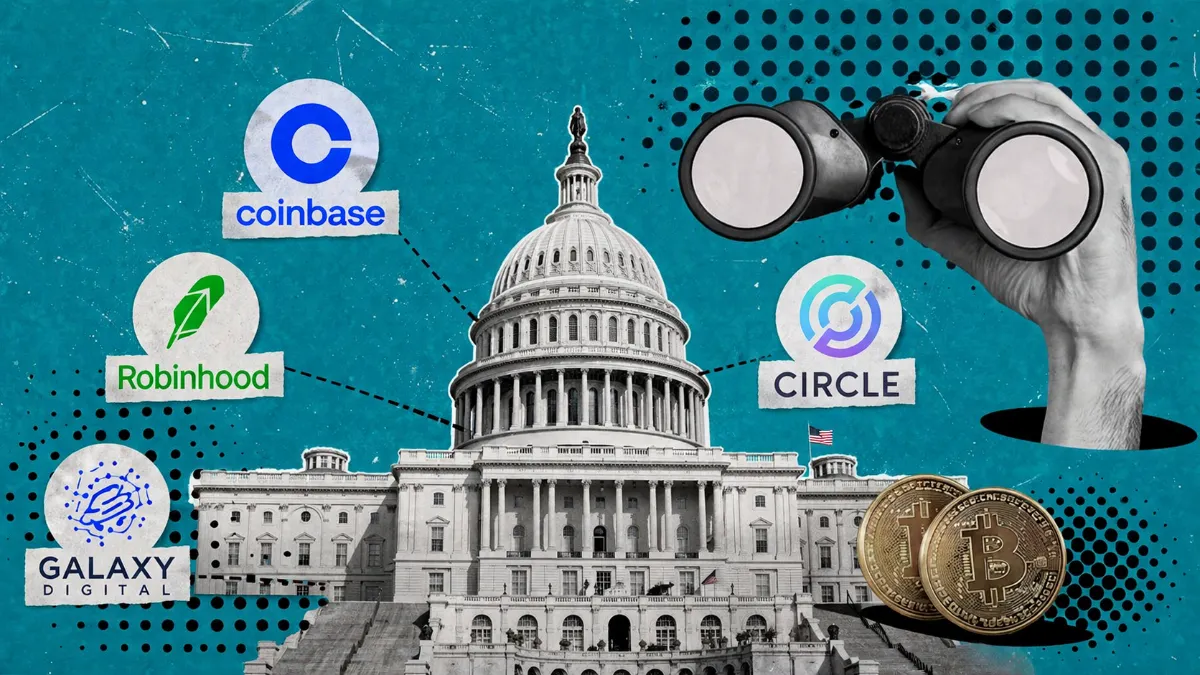
Coinbase is the most direct beneficiary. It operates across every domain the bill would institutionalize — exchange, custody, USDC, staking, and institutional trading. However, depending on how the stablecoin yield restriction language is finalized, its USDC revenue model could be materially impacted. Coinbase has spent over $2 million on direct lobbying and $25 million through the Fairshake PAC.
Robinhood stands to benefit directly from a recovery in retail crypto trading volume. Having bolstered its crypto infrastructure through the acquisition of Bitstamp, it carries high sensitivity to any volume recovery driven by regulatory clarity.
Circle is a second-stage beneficiary of stablecoin institutionalization — following the GENIUS Act, the CLARITY Act would be the next catalyst. USDC circulation stood at $75.3 billion at end-2025. However, stricter stablecoin yield restrictions could pressure its reserve interest income model.
Galaxy Digital is an institutional infrastructure play with comprehensive exposure across institutional trading, lending, asset management, and staking. In 2025, the digital assets segment reported approximately $505 million in adjusted gross profit, ~$6.4 billion in AUM, and ~$5 billion in staking assets under management.
CME Group is the cornerstone of regulated crypto derivatives infrastructure. Its crypto average daily volume (ADV) surged 139% year-over-year in 2025 to an all-time high. It is pursuing 24/7 crypto futures and options expansion in 2026. While its price beta relative to Coinbase and Robinhood is lower, the regulatory clarity tailwind is more durable.
Beneficiary stock ranking: Coinbase > Robinhood > Circle > Galaxy Digital > CME Group
Top 5 Beneficiary Coins
Ethereum is the most compelling beneficiary coin. It is directly tied to the staking provisions, and institutional demand across custody, ETFs, and CME derivatives is already well-established. It is the most likely first candidate for mature blockchain certification.
Solana is a high-beta L1 candidate. CME Solana futures and options data reflect strong institutional interest, and passage of the bill would compress the listing and institutional trading risk premium. Volatility is higher than Ethereum, but so is the upside beta.
Ripple (XRP) carries significant beta to legal overhang resolution. XRP accounted for 14% of Coinbase's spot trading revenue in 2025. CME Ripple derivatives are also validating institutional demand.
Bitcoin is the most stable institutional beneficiary asset. It sits at the core of exchange, custody, CME, and ETF demand, but given its already well-established commodity status, the incremental benefit is lower than for Ethereum, Solana, and Ripple.
Chainlink, Cardano, and Stellar Lumens are secondary spillover candidates. CME has referenced expansion into related futures products, and institutional derivatives exposure is expected to broaden beyond Ethereum, Solana, and Ripple following initial adoption.
Beneficiary coin ranking: Ethereum > Solana > Ripple > Bitcoin > Chainlink / Cardano / Stellar Lumens
5 Key Catalysts to Watch
① Senate Banking Committee markup schedule — Senator Lummis is targeting final passage before August.
② Stablecoin yield restriction language — Currently the top contested issue and the primary source of legislative delay.
③ Whether the DeFi and non-custodial developer carve-out provisions survive.
④ Scope of CFTC registration and provisional listing permissions.
⑤ Mature blockchain certification criteria — This will determine whether major L1s such as Ethereum and Solana automatically qualify as regulated commodities.