
Druckenmiller Exits SanDisk Entirely, Buys Bloom Energy — 'AI Bottleneck Is Power, Not Memory'
Confirmed in Q4 2025 13F filing: 740K shares acquired at an average cost of ~$96. The thesis: the AI infrastructure bottleneck is shifting from memory to power.
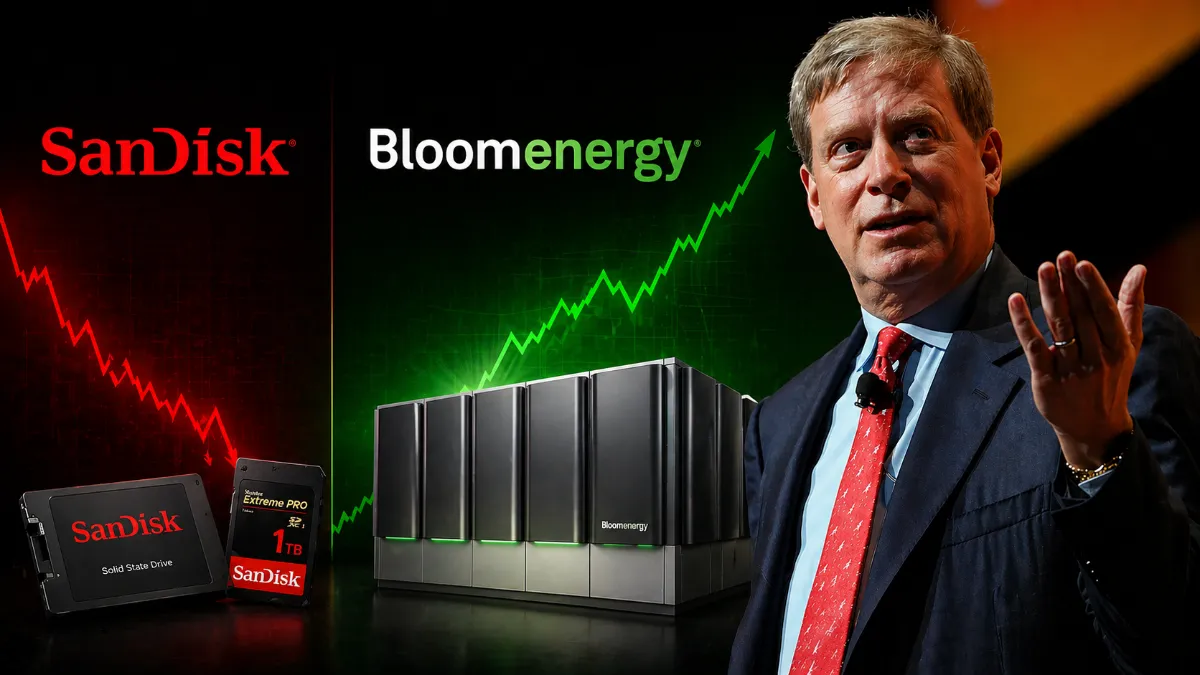
- Druckenmiller exited SanDisk after a 400%+ gain and bought 740K shares of Bloom Energy at ~$96 avg
- His thesis: AI infrastructure's bottleneck has shifted from memory to power, with BE up 800%+ since IPO
Billionaire investor Stanley Druckenmiller (Duquesne Family Office) has fully exited his position in SanDisk (SNDK) while initiating a new position in Bloom Energy (BE). The rotation signals his view that the center of gravity in AI infrastructure investment is shifting away from memory and computing toward power.
The Bloom Energy purchase is not newly disclosed. It was already on record in the Q4 2025 13F filing. The position stands at approximately 740,000 shares, with an estimated average cost basis of around $96. Bloom Energy shares currently trade near $234, representing a gain of more than 800% since its 2018 IPO.
Booked 400% and Moved On
Druckenmiller held SanDisk for just a single quarter before liquidating the entire position. During that holding period, SanDisk shares surged more than 400%. The Motley Fool noted that "Druckenmiller doesn't overstay a good story," adding that "he rode the momentum of the memory supercycle, then rotated capital before the next bottleneck even became consensus."
Wall Street's read on SanDisk remains nuanced. While memory and storage demand is clearly central to AI infrastructure buildout, some analysts warn that the cycle is demand-driven and prone to sharp margin compression in the event of oversupply. Druckenmiller was out before that debate took center stage.
Power Is the Real Bottleneck
Bloom Energy manufactures solid oxide fuel cells that convert natural gas into electricity. Its key differentiators are rapid deployment, modular scalability, and continuous 24/7 operation. As legacy grid infrastructure struggles to keep pace with the power demands of GPU clusters, Bloom's fuel cells can be deployed in a "behind-the-meter" configuration — delivering electricity directly to data centers without grid interconnection.
Oracle, CoreWeave, and Equinix are among the major data center operators that have already signed contracts for Bloom systems. Meanwhile, projected capital expenditures by the Big Five AI hyperscalers in 2026 reach up to $720 billion, a significant portion of which is earmarked for new data center capacity.
The policy backdrop is also favorable. The Trump administration's energy abundance agenda and streamlined permitting processes are creating tailwinds for the adoption of natural gas-based fuel cell solutions.
From Megabytes to Megawatts
The message in Druckenmiller's portfolio rotation is clear. He hasn't abandoned the AI trade — he's moved capital to the scarcest, hardest-to-solve constraint in the value chain. Memory remains important, but reliable power has become the new bottleneck.
The Motley Fool summed it up this way: "The AI era may be measured not in megabytes, but in megawatts."
Related Stocks & ETFs
Direct Plays: Bloom Energy (BE), SanDisk (SNDK)
Power Infrastructure: Constellation Energy (CEG), Vistra Energy (VST), Entergy (ETR), FuelCell Energy (FCEL)
Data Center Operators: Equinix (EQIX), Digital Realty (DLR), CoreWeave (CRWV)
ETFs: GRID, AMPS, ICLN, XLE
Frequently Asked Questions
드러켄밀러가 샌디스크를 매도한 이유는 무엇인가요?
드러켄밀러는 샌디스크를 한 분기 보유하며 400% 이상의 수익을 거둔 후 전량 매도했습니다. 메모리 슈퍼사이클의 모멘텀을 활용했지만, AI 인프라의 진짜 병목이 메모리가 아닌 전력이라고 판단해 블룸에너지로 자본을 이동시켰습니다. 메모리 수요의 사이클성과 공급 과잉 우려가 본격화되기 전에 선제적으로 빠져나온 것으로 해석됩니다.
블룸에너지는 어떤 회사이고 왜 주목받나요?
블룸에너지는 천연가스를 전기로 변환하는 고체산화물 연료전지를 만드는 기업입니다. 전력망 연계 없이 데이터센터에 직접 전력을 공급하는 '비하인드 더 미터' 방식으로, GPU 클러스터의 막대한 전력 수요를 빠르게 해결할 수 있습니다. 오라클, 코어위브, 에퀴닉스 등 대형 데이터센터 운영사들이 이미 도입 계약을 체결했으며, 2018년 IPO 이후 800% 이상 상승했습니다.
AI 인프라 투자에서 전력이 병목이라는 것은 무슨 의미인가요?
AI 데이터센터의 GPU 클러스터는 막대한 전력을 소비하지만, 기존 전력망은 이 수요를 따라가지 못하고 있습니다. 메모리나 칩은 공급을 늘릴 수 있지만, 전력 인프라 구축에는 시간과 인허가가 필요해 '가장 해결하기 어려운 병목'이 되고 있습니다. 2026년 빅5 AI 기업의 자본지출 7,200억 달러 중 상당 부분이 데이터센터 전력 용량 확보에 투입될 예정입니다.
한국 투자자가 전력 인프라 테마에 투자하려면 어떤 종목을 봐야 하나요?
직접 투자는 블룸에너지(BE), Constellation Energy(CEG), Vistra Energy(VST) 등 전력 공급 기업이 있고, 간접 노출로는 데이터센터 운영사인 Equinix(EQIX), Digital Realty(DLR), CoreWeave(CRWV)가 있습니다. ETF로는 GRID(전력망), AMPS(에너지 인프라), ICLN(청정에너지), XLE(에너지 섹터) 등을 고려할 수 있습니다.
드러켄밀러의 투자 스타일에서 배울 점은 무엇인가요?
드러켄밀러는 '좋은 스토리를 너무 오래 끌지 않는' 것으로 유명합니다. 샌디스크에서 단기간에 400% 수익을 내고 과감히 빠져나가 다음 병목 지점인 전력으로 이동한 것처럼, 테마의 핵심 가치 사슬에서 가장 희소하고 해결하기 어려운 지점을 먼저 포착해 자본을 배치하는 선제적 투자 접근법을 보여줍니다.






Wall Street's Defining Moments
See more








Smart Money Briefing
Weekly summaries of Wall Street guru moves and crypto whale activity.