
SK hynix's Solidigm — From "Winner's Curse" to AI Storage Monopoly
Once derided as a $9 billion winner's curse, Solidigm has flipped into a core asset of the AI data center era. A monopoly above 30TB enterprise SSDs and the QLC moat drove SK hynix to a 71.5% operating margin.
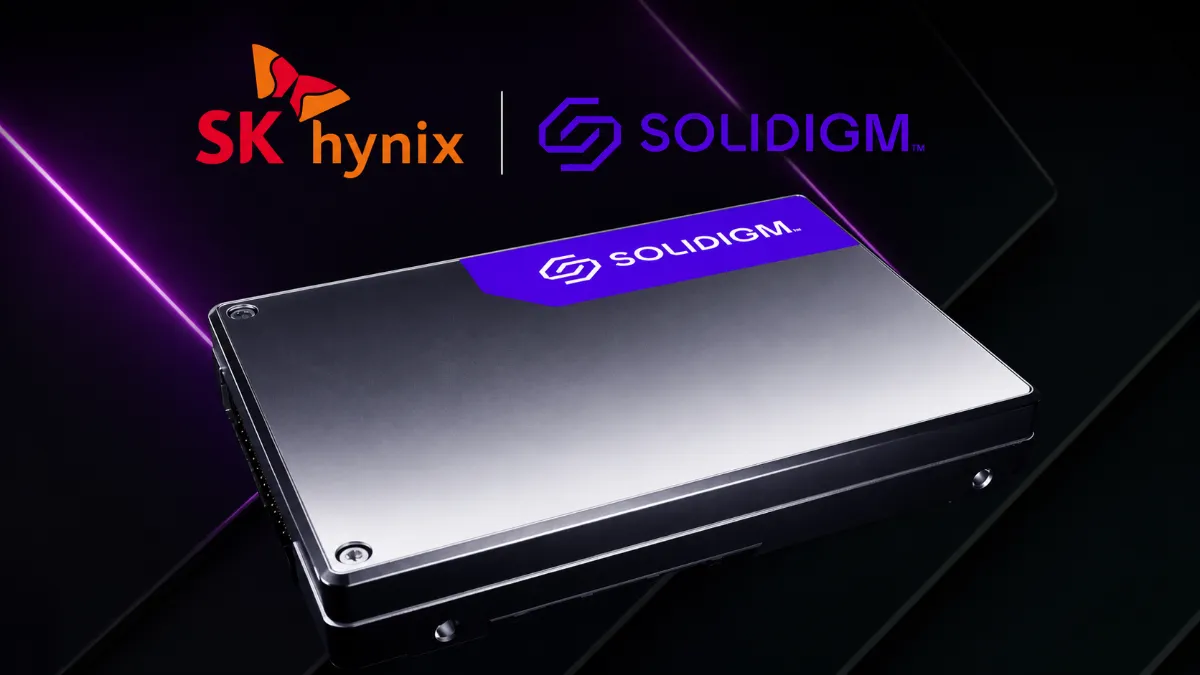
- Solidigm flipped from a $9 billion "winner's curse" into a core AI storage asset, driving SK hynix's 71.5% Q1 2026 operating margin
- QLC Floating Gate know-how and 321-layer 4D NAND readiness lock in the next chapter
What was once derided as a $9 billion mistake has become one of the most coveted assets of the AI data center era.
When SK hynix announced its $9 billion acquisition of Intel's NAND business in 2020, the market reaction was cold. "Why pay so much for a money-losing business?" The CEO who led the deal was effectively pushed out of operations afterward, and through 2023 the massive losses at Solidigm — the rebranded former Intel NAND division — weighed heavily on SK hynix's consolidated earnings.
Five years later, that deal is being re-evaluated as one of the most dramatic reversals in semiconductor history.
Start with the numbers
SK hynix posted KRW 47.2 trillion (~$33.7 billion) in operating profit in 2025 with a 49% operating margin — surpassing Samsung Electronics in annual operating profit for the first time ever. In Q1 2026, operating profit reached KRW 37.6 trillion (~$26.9 billion) at a 71.5% operating margin, exceeding NVIDIA (65%) and TSMC (58.1%). The NAND segment, now profitable, accounts for 21% of total revenue.
Behind those numbers stands Solidigm.
QLC: The technical moat
At the core of the turnaround is QLC (Quad Level Cell) technology. Storing four bits per cell delivers higher density than TLC at the same area, but the precision required to control voltage levels within each cell creates a steep barrier to entry.
Solidigm (formerly Intel) was the first in the industry to commercialize QLC-based SSDs in 2018. By 2023 it had launched a 61.44TB drive, and in November 2024 it began mass-producing the 122TB-class D5-P5336. In the segment of enterprise SSDs above 30TB, Solidigm has effectively no competition.
The technology traces back to Intel's Floating Gate Flash architecture. Unlike the Charge-Trap Flash used by Samsung and most rivals, Floating Gate offers superior data retention and endurance at QLC density. Critics initially argued there was no synergy in SK hynix running both its own Charge-Trap NAND and Intel's Floating Gate process — but in the AI era, the two technologies now function as a dual-engine structure covering different market segments.
AI data centers changed the game
The explosive growth of AI training and inference workloads has structurally lifted demand for high-density, high-capacity storage. Solidigm's own research shows that in a 100MW AI data center, QLC SSDs are 19.5% more power-efficient than TLC SSDs and up to 79.5% more efficient than HDDs. Within the same power budget, operators can house 26.3% more AI infrastructure than they could with HDDs.
A simultaneous HDD supply shortage has accelerated the migration to QLC SSDs. Tesla and other hyperscalers are placing large orders for Solidigm eSSDs. NAND prices spiked more than 70% in Q1 2026 versus the prior quarter against this backdrop.
From "winner's curse" to "return of the king"
What the market missed in 2020 was simple. The Intel NAND business wasn't merely a money-losing memory factory. It came packaged with decades of Floating Gate process know-how, first-mover commercialization of QLC, and direct relationships with enterprise customers.
As AI redrew the data center, the value of those assets exploded into view. The $9 billion price turned out to buy effective monopoly status in the AI storage market.
Samsung Electronics retained the top position by enterprise SSD revenue in Q4 2025 and is preparing a counterattack with a complete 176-layer QLC eSSD lineup. But the 30TB-plus high-capacity segment remains Solidigm territory. With AI inference infrastructure expansion translating directly into demand for high-capacity eSSDs, this lead will be hard to close in the short term.
The next chapter is already loaded. SK hynix completed development of the world's tallest 321-layer 4D NAND in the first half of 2025 and is ready for mass production — a foundation to remain ahead in the next-generation eSSD race beyond 200TB.
Remaining risks
The core production hub at Dalian, China, is a potential pinch point amid escalating U.S.–China technology tensions. If Intel were to leverage residual Optane-era assets to re-enter the memory market, that could become an unpredictable variable. As of now, there is no signal of re-entry.
But this much is clear. What SK hynix bought for $9 billion in 2020 wasn't a money-losing factory. It was the storage throne of the AI age.
Frequently Asked Questions
Why is Solidigm ahead of Samsung in high-capacity enterprise SSDs?
Solidigm commercialized the industry's first QLC SSD in 2018 and began mass-producing a 122TB drive in 2024 — a multi-year head start. Its Floating Gate Flash architecture also offers superior data retention and endurance at QLC density, giving it a structural edge in the ultra-high-capacity segment.
Why are AI data centers using SSDs instead of HDDs?
AI workloads demand fast data access and power efficiency. QLC SSDs are up to 79.5% more power-efficient than HDDs and allow more infrastructure within the same physical and power footprint. A concurrent HDD supply shortage has further accelerated the SSD transition.
How serious is the Dalian fab risk?
A core Solidigm production site is located in Dalian, China, exposing it to potential export controls or operational restrictions if U.S.–China tech tensions escalate. SK hynix is exploring diversification, but a short-term substitute is difficult.
What is the difference between QLC and TLC?
QLC stores four bits per cell; TLC stores three. QLC achieves higher density in the same area but requires extreme voltage-level precision, limiting the number of companies able to mass produce it. For AI storage, where retaining vast amounts of data matters most, QLC has the advantage.
Could Intel re-enter the memory market?
There is no formal signal at present. Intel still holds residual Optane-era technology and IP, so re-entry is not impossible if policy and market conditions shift. If realized, it could become a variable in Solidigm's Floating Gate dominance.

Applied Materials Posts Record Q3 Revenue of $9.1 Billion, All-Time High EPS
 AMAT
AMATCoherent, Performance Food Among 25 US Firms File SEC 8-K Earnings Disclosures as AI Chip, Biotech Earnings Season Kicks Off
 COHR
COHR CBRS
CBRS AOSL+21
25 SEC 8-K Earnings Disclosures Flood In, Including Owens Corning, Extreme Networks, Utz Brands
 HBB
HBB NC
NC EPC+27
Wall Street's Defining Moments
See more


Sunday's SEC 8-K Earnings Filings Quiet, but Royal Gold Doubles Net Income and Launches Buyback
 RGLD
RGLDVeritone Earnings Shock Sends Shares Down 23%...York Space Systems Among 25 US Companies Filing SEC 8-K Earnings Reports
 YSS
YSS CODX
CODX IPWR+26
Applied Materials Posts Record Q3 Revenue of $9.1 Billion, All-Time High EPS
AMATSmart Money Briefing
Weekly summaries of Wall Street guru moves and crypto whale activity.