Think Backwards
In 1994, a 70-year-old Charlie Munger stood before USC students and said, "Don't ask how to succeed first. Ask how to fail first." Inversion thinking, multidisciplinary mental models, circle of competence, avoiding stupidity, lifelong learning — the complete architecture of a 99-year intellectual system.
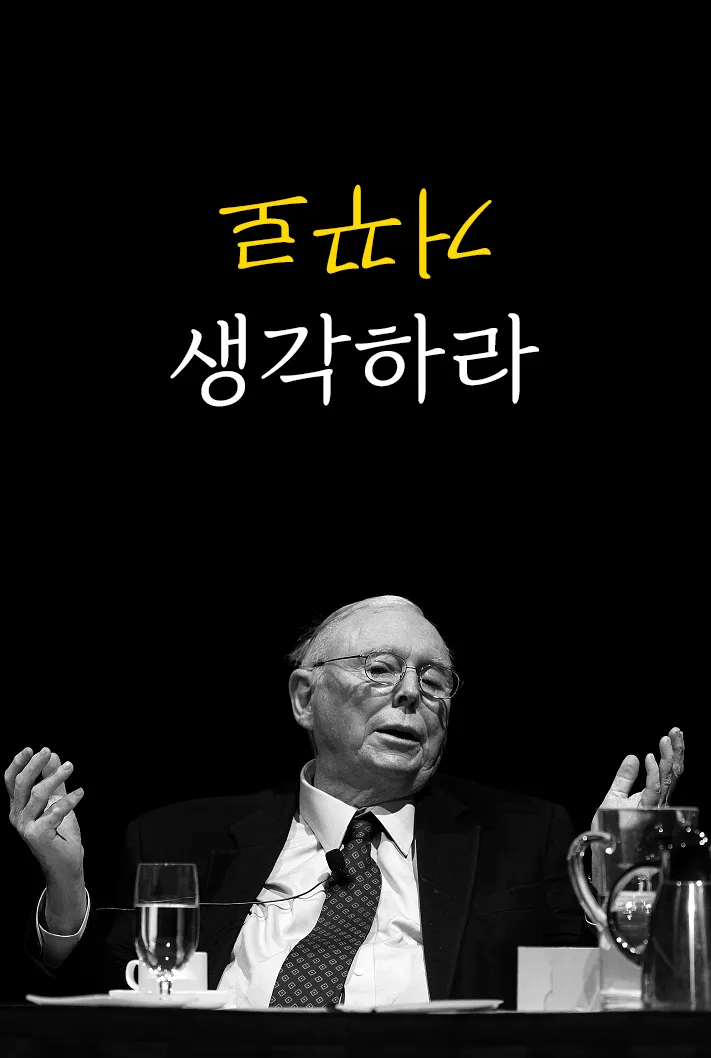
Think Backwards
In 1994, 70-year-old Charlie Munger stood at the podium of USC Business School. He said to the students: "If you want to succeed in life, don't start by asking how to succeed. Start by asking how to fail. Then avoid it." This is the record of the thinking framework Charlie Munger built across a lifetime.
1. One Line from a 19th-Century Mathematician
To understand Munger's way of thinking, you first need to know one person.
Carl Gustav Jacobi. A German mathematician of the 19th century. He had a method he liked to use when solving math problems: "Invert, always invert." When a difficult problem is hard to solve head-on, flip it over and solve it in reverse.
Munger applied this principle not to mathematics but to all of life.
"If you want to be happy, don't ask how to be happy — ask first how to be miserable. Then don't do that."
"If you want to be a good investor, don't ask first how to make money — ask first how to lose money. Then avoid it."
This is Inversion. The first pillar of Munger's thinking system.
He applied this principle to every actual investment decision. When Buffett listed 10 reasons to buy a company, Munger listed 5 reasons the company could fail. And if those 5 were unsolvable, he wouldn't buy the company no matter how attractive it looked.
Buffett once described investment discussions with Munger:
"I recommend a company to Charlie and explain why it's good. Charlie listens and then says: 'Warren, all that's right. But give me three scenarios where this company could go bankrupt in five years.' If I can't come up with three, Charlie says, 'You haven't thought hard enough.' If I give three, Charlie stares at them, and if even one is realistic, he says 'No.'"
This process prevented countless mistakes in Berkshire's investment decisions.
2. The Man Who Only Carries a Hammer
Munger's second thinking principle is Multidisciplinary Thinking.
He repeated one analogy all his life:
"To a man with a hammer, everything looks like a nail."
What does this mean? To an economist, every problem looks like an economics problem. To a psychologist, every problem looks like a psychology problem. To a lawyer, every problem looks like a legal problem. A person with only one tool sees only the problems that tool can solve. The rest are invisible.
To avoid this trap, Munger argued that you must carry the core models from multiple disciplines simultaneously. He called these "Mental Models."
In his 1994 USC lecture, the core mental models he presented were:
- From Mathematics: The compound interest effect. Probability and expected value. The law of large numbers.
- From Physics: Critical mass and tipping points. Inertia. Nonlinearity. Structures where small causes create large effects.
- From Biology: Evolution and adaptation. What survives competition is not the strongest species but the most adaptable. Business works the same way.
- From Psychology: Human cognitive biases. Confirmation bias, social proof, loss aversion. Munger called this the "Psychology of Human Misjudgment" and compiled a list of 25 biases.
- From Economics: Opportunity cost. Incentive structures. Economies of scale.
- From Accounting: Quality of earnings. The difference between cash flow and profit. Assets beyond the balance sheet.
Munger's argument: use these models one at a time and you're ordinary. Apply multiple models simultaneously and you see what no single tool can reveal.
3. See's Candy Through Mental Models
Breaking down how Munger analyzed See's Candy in 1972 using mental models:
Psychology model: See's Candy is a gift product. When buying gifts, people are less price-sensitive. You might save 50 cents on something for yourself, but you'll spend $2 more on a gift. This is a structural feature of human psychology. It doesn't change.
Economics model: See's has pricing power. Raising prices 5–10% annually doesn't reduce sales volume. In economics this is called "inelastic demand." Products with inelastic demand are resilient to inflation — when costs rise, you can raise prices along with them.
Biology model: See's brand is a moat. A competitor can make chocolate of equal quality, but the consumer habit of "if you're giving a gift in California, it's See's" cannot be replicated. In biology this is called an "ecological niche." Once occupied, it's hard for another species to enter.
Math model: Compounding. If See's raises prices 10% annually while maintaining volume, profits grow at compound interest. Ten years: 2.6x. Twenty years: 6.7x. Thirty years: 17x. Accelerating over time.
Through Graham's method, See's was "a company priced at three times net assets." Through Munger's mental models, See's was "a compounding machine whose value accelerates over time."
Same company. Different tools. Completely different conclusions.
You're about to make an investment decision. A stock looks attractive. All your friends are buying it. YouTubers are recommending it. Your own analysis looks positive. Every signal is telling you to buy. But Munger would stop and ask one question: "Wait — am I caught in a confirmation bias right now? Let me come up with just three scenarios where this investment could fail."
4. The Psychology of 25 Human Misjudgments
The most distinctive part of Munger's intellectual system is psychology.
Most investors study financial statements, industry analysis, and macroeconomics. Munger added to this "why humans make wrong judgments." His systematization of this was "The Psychology of Human Misjudgment — 25 Causes", presented in his 2005 Harvard-Westlake School address.
It's impossible to list all 25, but the five most directly applicable to investing:
1. Incentive-Caused Bias
"If you want someone to understand something, first check whether their paycheck comes from not understanding it."
This was the root cause of the subprime crisis. Loan officers' bonuses were tied to loan volume — not loan quality. So they issued loans to people who couldn't repay. Rating agencies' revenue came from bond issuers. Give a low rating and you lose the client. So they stamped AAA.
Munger's lesson: when analyzing any system, the first thing to look at is the incentive structure of the participants.
2. Social Proof
"Other people are doing it, so I will too. This is the cause of the most foolish behavior in human history."
The people who jumped in at $483 during the GameStop surge of 2021. The people who first bought Bitcoin at $60,000 in 2021. Most of them had one investment thesis: "because everyone's buying."
3. Confirmation Bias
"Humans seek only information that confirms what they already believe. They ignore contradictory information."
Why Gabe Plotkin maintained his GameStop short position. His analysis started from the conclusion that "GameStop is a declining industry" and only looked at information supporting that conclusion. He ignored signals that tens of thousands on Reddit were buying.
4. Overconfidence
"The most dangerous person is the one who doesn't know the limits of what they know."
Munger called this the "Circle of Competence." Knowing where the boundary of your deep understanding lies is critical. Investing outside that boundary leads to failure.
5. Loss Aversion
"People feel the pain of losing $100 more than twice as intensely as the joy of gaining $100."
This is why most individual investors can't cut losses. The pain of confirming a loss is so great that they hold on as the loss grows larger — and ultimately take an even bigger loss.
Munger said to memorize all 25 biases. "Keep this list in your head and the probability of making foolish decisions will be cut in half."
5. "I Don't Know Anything"
Munger's third thinking principle is the Circle of Competence.
Buffett uses this concept frequently as well, but it was originally Munger who systematized it.
The principle is simple: no one understands every industry and every company in the world. There are areas you understand deeply, areas you only know superficially, and areas you don't know at all. To succeed in investing, you must invest only within the areas you understand deeply.
Munger practiced this to an extreme.
He almost never bought tech stocks. Internet, semiconductors, software. During the 1990s dot-com bubble, when tech stocks were rising tenfold, Berkshire didn't buy tech. Wall Street mocked Buffett and Munger as "out-of-touch old men."
In March 2000, the Nasdaq collapsed. Tech stocks fell 80–90%. Because Buffett and Munger held no tech stocks, they had no losses.
In 1999, a shareholder at the Berkshire annual meeting asked: "Why don't you buy Microsoft? It's clearly a good company."
Munger answered:
"Microsoft is a good company. But whether we understand it — no. We don't know how the software industry will look five years from now. Investing in what we don't know is not investing — it's gambling."
Then he added this line, which became more famous:
"We have a 'Too Hard' file. Anything that's too difficult to understand goes in there. And we never open it."
The "Too Hard" file. This may be the most practical tool in Munger's thinking system. Most of the world is "Too Hard." Acknowledging that is the first wisdom.
But in 2016, Munger broke his own principle with an investment.
Once you've made your choice, reveal what the legend actually did
6. Alibaba and BYD
In 2016, 92-year-old Munger was chairman of Daily Journal Corporation — originally a legal newspaper company, whose excess cash Munger was investing in stocks.
One of the stocks he bought through Daily Journal was Alibaba — China's e-commerce giant. It was a tech stock, which Munger had avoided all his life, and China was an unfamiliar market.
Wall Street was shocked. "Munger didn't put a Chinese tech stock in his 'Too Hard' file?"
Munger's explanation:
"Alibaba looks like a technology company, but its essence is a marketplace. It's a platform connecting Chinese consumers and sellers. This isn't something that requires understanding technology — it requires understanding market structure. And market structure is within my domain."
There was another investment: BYD. China's EV and battery company. Munger had already bought BYD in 2008 and convinced Berkshire to invest. At the time BYD was a small battery company. By 2024, BYD had become China's largest EV company and was competing with Tesla for first and second place in global EV sales.
Munger's reason for buying BYD also wasn't technical analysis:
"BYD's founder Wang Chuanfu is a combination of Thomas Edison and Jack Welch. What he builds is not technology — it's systems. A vertically integrated structure from batteries to cars. This isn't about understanding engineering — it's about understanding business structure."
Munger kept his circle of competence narrow, but made the way he applied that circle flexible. Tech stocks were "Too Hard," but companies that looked like tech stocks but were actually market-structure businesses were within his circle. He looked at essence, not labels.
7. "The Cost of Stupidity"
Munger's fourth thinking principle is avoid foolishness.
He focused more on "how to avoid being stupid" than "how to become smarter." Another application of inversion.
His "list of foolish behaviors in investing":
- Leverage. "There are only three ways that smart people go broke: alcohol, women, and leverage."
- Investing in what you don't understand. "It's not intelligence to know things you don't know. What's dangerous is not knowing what you don't know."
- Following others. "If you do something just because others are doing it, you get average results. Average results are fine if that's enough. But most people don't want average."
- Lack of patience. "Big money is made not from buying — it's made from waiting."
- Over-diversification. "If you diversify across 20 stocks, even when one goes up, your life doesn't change. Diversification is insurance against ignorance. If you know what you're doing, diversification is meaningless."
This list is a "don't do" list, not a "do" list. Munger's entire investment philosophy is like that. Not "make great investments" — but "don't make stupid investments." Just avoiding foolishness puts you in the top 10%.
8. "A Book with Legs"
Munger's fifth and most fundamental principle is constant learning.
His family called him "a book with legs." Every morning he woke up and read books. He read newspapers. He read annual reports. He read in the evenings. He read in bed.
What he read wasn't only investment books. He especially loved biographies — Benjamin Franklin, Charles Darwin, Albert Einstein, Andrew Carnegie. He read the biographies of people who had failed more carefully than those who had succeeded.
"Learning from other people's mistakes is far cheaper than learning from your own."
His words in the 1994 USC speech summarize this principle:
"I have never met a single wise person in my life who didn't read constantly. Not one. Warren reads, I read. People are astonished by how much we read. My children laugh at me. They call me a book with legs."
And he added:
"Every night before you go to sleep, you should be at least a little wiser than when you woke up. Every day. Without exception. Do this for 50 years and you will arrive at a remarkable place in the second half of your life."
- 역전 사고 (Inversion)
- "성공할 방법"이 아니라 "실패할 방법"을 먼저 묻는다
- 다학제적 멘탈 모델
- 수학·물리·생물·심리·경제·회계 모델을 동시에 적용
- 능력의 범위
- 깊이 이해하는 영역에서만 투자, 나머지는 "Too Hard" 파일
- 어리석음 회피
- 레버리지·무지·추종·조급함·과잉 분산 5가지를 피한다
- 끊임없는 학습
- 매일 책을 읽어 어제보다 조금이라도 현명해진다
- 핵심 25가지 인지 편향
- 인센티브·사회적 증거·확증 편향·과잉 자신감·손실 회피 외 20가지
- 결론
- "합리적이 되라. 똑똑할 필요는 없다. 어리석은 짓을 하지 마라."
9. Three Lessons This Story Left Behind
First, imagine failure first.
When making investment decisions, most people first calculate "how much do I make if this goes up?" Munger was the opposite. He first calculated "what happens to me if this fails?" Inversion. This alone can prevent half your investment mistakes. Before buying a stock, construct the scenario where it falls 50%. If you're still okay with that, buy. If that frightens you, reduce the size or don't buy.
Second, widen your toolkit.
What tools do you use when analyzing investments? P/E, P/B, charts, moving averages. These are all good tools. But there are things they cannot reveal: consumer psychology, management incentive structures, the ecological structure of an industry, the direction of regulation. Munger saw all of these simultaneously, which let him see what others couldn't. Don't read only investment books. Read psychology, history, biology. Widening your tools widens your vision.
Third, create your "Too Hard" file.
Don't invest in what you don't understand. Acknowledging that you don't understand something is the first wisdom. Many Korean individual investors invest in cryptocurrency without being able to explain what blockchain is. Many buy AI stocks without knowing what a transformer model is. To them, Munger would say: "Put that in your 'Too Hard' file. And never open it. Invest only in what you understand."
10. The Intellectual Legacy
Munger died on November 28, 2023, 33 days before his 99th birthday.
What he left behind was not money. Buffett was the one who raised Berkshire Hathaway's stock price. What Munger left behind was a way of thinking.
Inversion. Multidisciplinary mental models. Circle of competence. Avoiding foolishness. Constant learning.
These five principles apply not only to investing. They apply to business, careers, relationships, and all of life. Munger himself lived that way.
His last public appearance was at the November 2023 Daily Journal annual meeting. At 99, seated in a wheelchair, his mind was still sharp. A shareholder asked:
"Mr. Munger, what is the most important lesson from your life?"
He answered:
"Try to be rational. You don't need to be brilliant. Just rational. And the best way to be rational is to avoid doing stupid things."
The conclusion of the intellectual system built across 99 years by a man born in 1924 was contained in this one sentence.
Be rational. Don't do stupid things.
And that was not a lesson about investing — it was a lesson about life.
Sources: Charlie Munger, "A Lesson on Elementary, Worldly Wisdom" (1994 USC) / "The Psychology of Human Misjudgment" (2005 Harvard-Westlake) / Daily Journal Annual Meeting (2017–2023) / Peter D. Kaufman, "Poor Charlie's Almanack" (2005) / Tren Griffin, "Charlie Munger: The Complete Investor" (2015) / Janet Lowe, "Damn Right!" (2000)
What's your take on this story?
What do you think about Charlie Munger's decision?
Sign in to participate
Sign In