
Michael Burry Exits GameStop Entirely: 'Wall Street Confuses Debt with Creativity'
Michael Burry liquidated his entire GameStop position on the day eBay announced its $56B acquisition. Now he's betting on Chinese tech longs (JD, BABA) paired with NVDA and PLTR puts—a dual strategy positioning for an AI bubble collapse.
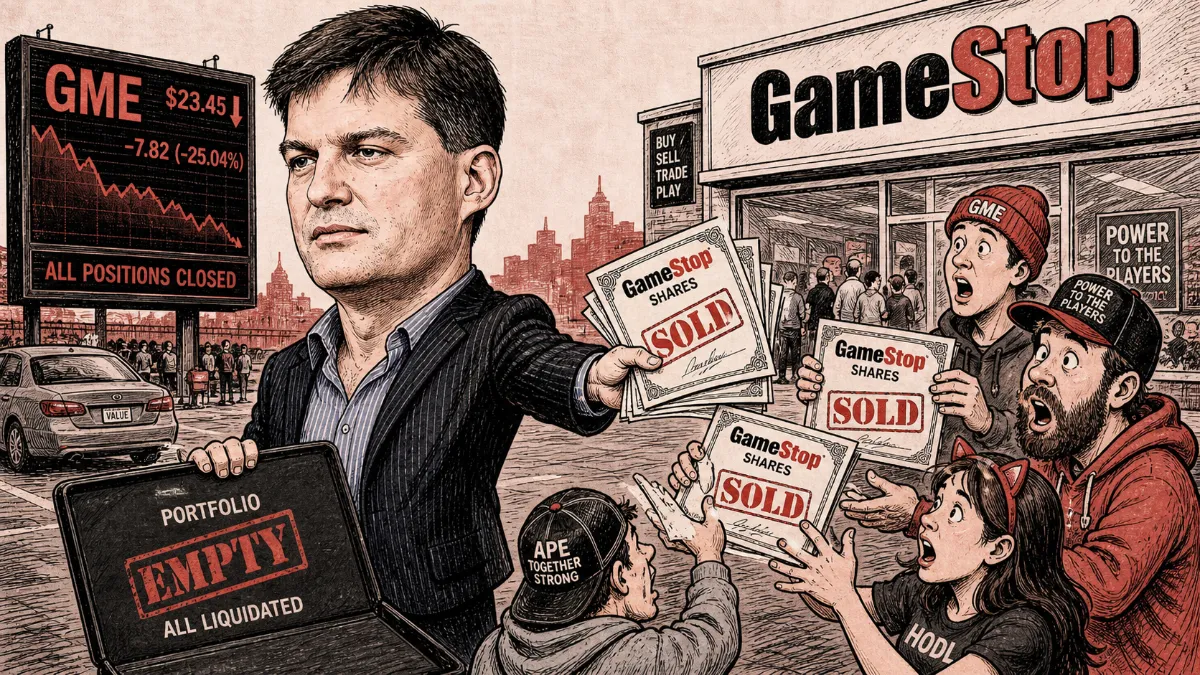
- Michael Burry sold his complete GameStop position on eBay's $56B acquisition announcement, citing Wall Street's confusion of debt with creativity
- He now pairs Chinese tech longs (JD, BABA) with NVDA and PLTR puts, betting an AI bubble collapse
Liquidated immediately following eBay's $56B acquisition announcement… portfolio repositioned via Chinese mega-cap longs and NVDA puts
Michael Burry is the investor who predicted the 2008 subprime collapse and made billions on it—the real-life subject of the film 'The Big Short.' He's legendary for betting contrarian when convinced the market has it wrong. In November 2025, he formally liquidated his hedge fund Scion Asset Management and now operates as an individual investor through his paid Substack newsletter 'Cassandra Unchained.' With 13F filing obligations now gone, this newsletter is his only official channel for tracking investment moves.
GameStop—Six-Month Bet Liquidated in One Day
Burry disclosed a GameStop (GME) repurchase in January this year. He characterized Ryan Cohen as a 'Buffett-like long-term value investor,' arguing the stock was attractive trading around book value. Following this announcement, GME surged 6–8%.
By late March, he more than doubled his position from 6% to 13% of his portfolio—a clear signal of increased conviction.
Then on May 4th, the moment GameStop announced its ~$56 billion eBay acquisition, Burry sold his entire position. His own words explain the exit: 'Wall Street confuses debt with creativity.'
His original thesis was a 'cash-rich, debt-free undervalued value stock.' But the eBay deal requires complex leverage—borrowing $20 billion from TD Bank plus equity issuance. The core premise collapsed. Burry exited immediately. GameStop stock plummeted over 10% on the news.
What Burry Holds Now—China and AI Bets
Post-GameStop, Burry's confirmed portfolio consists of three long positions and two put options.
JD.com and Alibaba, added in April, each represent roughly 6% of the portfolio. Both are beaten-down Chinese mega-caps hit hard by U.S.–China trade tensions—a classic Burry deep-value play on oversold risk assets. He also added fintech player Fiserv to new positions.
The core of his short strategy: expanded NVDA puts expiring January 2027 at a $115 strike. He maintains PLTR puts as well. Both names are AI darlings. Burry's thesis is crystal clear: the AI bubble will eventually burst.
Why He's Doing Both Simultaneously
On the surface, Burry's strategy looks contradictory—buying Chinese stocks on one flank while shorting AI leaders on the other. But from his perspective, it's one coherent logic.
When the AI bubble deflates, tech broadly gets crushed. In that downturn, Chinese mega-caps—already heavily sold off—become relatively safer havens. He warned in March about 'institutional day-trading as a sign of market end-times,' flagging the Korean KOSPI as a red alert. His macro stance remains unambiguously bearish across global asset bubbles.
Whether Burry redeploys GameStop exit proceeds hasn't been announced.
Frequently Asked Questions
Why did Burry liquidate his hedge fund?
He never disclosed the official reason. However, running a hedge fund carried regulatory burdens like 13F filings. As an individual, he now has zero public disclosure obligations, giving him freedom to build and adjust positions privately. He shares insights only when he chooses, via his Substack.
What does the NVDA $115 January 2027 put strike mean?
If NVDA falls below $115 by January 2027, the put pays off. With NVDA currently trading in the low $100s, he's very close to breakeven. This strike embodies his core thesis: the AI bubble will deflate.
Is Burry's China bet currently profitable?
Since his April entry, JD and BABA have recovered modestly on U.S.–China trade deal optimism. However, Burry hasn't disclosed specific P&L, so exact returns are unknown.
What lesson does the GameStop exit offer Korean investors?
The key is activist discipline: exit immediately when the original thesis breaks. Burry took just four months (January–May) to go from 13% to zero when capital structure changed. Korean retail investors should apply the same rigor—avoid holding losers waiting for recovery when a fundamental assumption (M&A, debt load, management change) invalidates your original reason for buying.

Sunday's SEC 8-K Earnings Filings Quiet, but Royal Gold Doubles Net Income and Launches Buyback
 RGLD
RGLDVeritone Earnings Shock Sends Shares Down 23%...York Space Systems Among 25 US Companies Filing SEC 8-K Earnings Reports
 YSS
YSS CODX
CODX IPWR+26
Applied Materials Posts Record Q3 Revenue of $9.1 Billion, All-Time High EPS
 AMAT
AMATWall Street's Defining Moments
See more

Sunday's SEC 8-K Earnings Filings Quiet, but Royal Gold Doubles Net Income and Launches Buyback
RGLDVeritone Earnings Shock Sends Shares Down 23%...York Space Systems Among 25 US Companies Filing SEC 8-K Earnings Reports
YSSCODXIPWR+26Applied Materials Posts Record Q3 Revenue of $9.1 Billion, All-Time High EPS
AMATSmart Money Briefing
Weekly summaries of Wall Street guru moves and crypto whale activity.