SK Square Joins "Emperor Stock" Club at KRW 1,149,000 — KOSPI Hits 7,417 All-Time High
SK Square traded as high as KRW 1,149,000, joining the "emperor stock" club and putting market cap at KRW 145T (~$104B) — KOSPI #3. The KOSPI index hit an intraday all-time high of 7,417. Three engines fire in parallel: semi earnings, Value-Up re-rating, and IBKR-driven foreign liquidity.
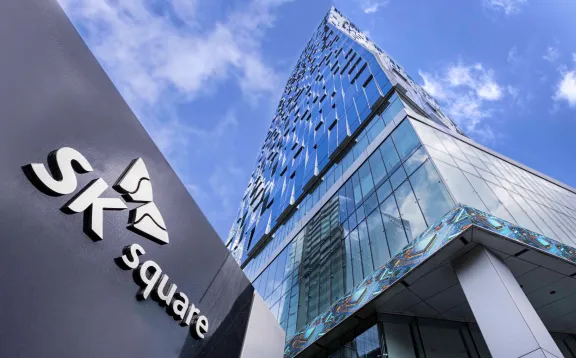
- SK Square traded as high as KRW 1,149,000, joining the emperor-stock club at market cap KRW 145T (~$104B), KOSPI #3, +192% YTD
- KOSPI hit an intraday all-time high of 7,417
- Three engines fire in parallel: SK hynix earnings (Q1 op profit +405% YoY), Value-Up re-rating, and IBKR-led foreign liquidity
Market cap KRW 145T (~$104B), KOSPI #3 ranking, YTD +192% — SK hynix HBM order pipeline + buyback-and-burn close the holding-company NAV discount
Two records broke simultaneously when KOSPI opened on May 6.
SK Square (402340) traded as high as KRW 1,149,000, joining the "emperor stock" club of names trading above KRW 1 million per share. Market cap of about KRW 145 trillion (~$104B) put it third on KOSPI behind Samsung Electronics and SK hynix. Year-to-date the stock is up 192%.
The KOSPI index hit an intraday all-time high of 7,417.54 on the same day — up over 57% YTD. Bloomberg called it "the most prominent equity rally in the world." Taiwan (+16.6%) and Japan (+16.3%) trail by a wide margin.
Why SK Square Jumped
SK Square is the holding company that owns 20% of SK hynix. About 80% of its net asset value (NAV) is the SK hynix stake. When SK hynix rises, SK Square's NAV rises with it. But historically SK Square traded at a 45-46% discount to NAV. That discount is now closing rapidly — and that's the engine behind the share-price surge.
Two reasons the discount is narrowing.
First, SK hynix earnings have lifted NAV itself dramatically. Q1 operating profit of KRW 37.6T (~$26.9B), up 405% YoY, with the company's market cap crossing KRW 1,000 trillion (~$715B).
Second, SK Square has been restructuring. Large-scale share buybacks and burns, divestitures of non-core assets like TMAP and 11st, and a clear pivot to an AI / semiconductor holding company. Activist hedge funds have piled additional pressure on shareholder returns.
The SK hynix Order Pipeline — What "Sold Out" Really Means
Korean media often describes SK hynix HBM as "fully sold out." The precise meaning is this:
Unlike commodity DRAM, HBM is sold to big-tech buyers via long-term agreements (LTAs) that lock in 1-2 years of volume in advance. "Sold out" doesn't mean shelves are empty; it means most of next year's allocated volume already has a contracted home. Actual supply continues to expand alongside customer demand.
- HBM3E 12-Hi → ships into Nvidia GPUs
- Google TPU HBM supply share ~57% (de-facto exclusive)
- Also ships to Amazon Trainium3 and Microsoft Maia 200
- Q2 2026 operating-profit consensus: KRW 64T (~$45.7B), +589% YoY
Risks remain. US chip-export rules to China leave HBM-to-China supply uncertain. If Samsung passes HBM3E qualification, the SK hynix near-monopoly thins. And Trump tariffs could swing big-tech capex quarter-to-quarter.
Three Engines Behind the KOSPI Rally
KOSPI took roughly a month to clear 5,000 → 6,000 and about 70 days to clear 6,000 → 7,000. Three engines fired in parallel.
First, earnings. SK hynix surpassed Samsung Electronics in 2025 to claim the #1 annual operating-profit slot in Korea for the first time ever. Combined 2026 operating-profit guidance for the two companies is around KRW 300 trillion (~$214B).
Second, re-rating. The government's corporate Value-Up policy is closing the KOSPI P/B discount. WGBI (FTSE World Government Bond Index) inclusion is expected to bring an additional $50-60B in passive inflows.
Third, liquidity. Tighter real-estate regulation has pushed Korean retail savings into equities. Foreign-ownership share is approaching the historical high of 38%. On top of that, the Samsung Securities × Interactive Brokers partnership now lets 4.6 million accounts in 170 countries buy Korean equities directly.
Frequently Asked Questions
Should I invest in SK Square or SK hynix?
SK hynix gives direct exposure to the underlying semiconductor business. SK Square holds that stake indirectly at a NAV discount — if you believe the discount keeps narrowing, SK Square offers leverage. The trade-off is the holding-company structure complexity and exposure to non-core assets.
What does "NAV discount" mean here?
It's when SK Square's stock trades below the marked-to-market value of its holdings (mainly the SK hynix stake). Example: NAV at KRW 2,000,000/share but stock at KRW 1,150,000 — that's a ~42% discount. Higher shareholder returns or governance improvements compress that discount.
Is there room above KOSPI 7,000?
Goldman Sachs has flagged KOSPI 8,000. On the other side, Kwak Sang-jun of Matrix Asset Management warns that further multiple expansion is hard without earnings participation from names beyond Samsung and SK hynix. The two key variables are whether the semi cycle keeps producing results and whether MSCI moves Korea to developed-markets status.
How big a tailwind is WGBI inclusion for Korean equities?
WGBI is one of the three major global bond benchmarks, with about $2.5 trillion in tracking AUM. Korean inclusion would funnel an estimated $50-60 billion into KRW government bonds in stages, supporting the won — which improves the FX setup for foreign equity inflows and adds upward pressure on KOSPI.
Beyond SK hynix, which Korean stocks can a US investor buy as ADRs?
ADR coverage of Korean large-caps is sparse: POSCO Holdings (PKX), KB Financial (KB), Shinhan Financial (SHG), KEPCO (KEP) are the main names. The SK hynix ADR planned for June-July would be the first Korean mega-cap ADR. Outside ADRs, the standard paths are EWY (iShares MSCI Korea ETF) or direct purchase via Interactive Brokers.

South Korea's Kospi Hits All-Time High as U.S.-Iran Deal Hopes Lift Asia Markets
 005930
 000660
 EWY
EWY
Samsung and SK Hynix Workers Are Buying Ferraris as AI Memory Boom Mints New Wealth
005930000660 NVDA
NVDA
Trump Bets $2 Billion on Quantum Computing — IBM Takes $1 Billion, Rigetti and D-Wave Surge 25%
 IBM
IBM INTC
INTC RGTI+3
Wall Street's Defining Moments
See more




Smart Money Briefing
Weekly summaries of Wall Street guru moves and crypto whale activity.