
Corporations Amass 1.15M Bitcoin as Morgan Stanley, BlackRock, Fidelity Join the Buying Spree
187 public companies hold 1.15M BTC worth $92.9B. Strategy surpasses BlackRock's IBIT (803K vs 818K BTC) to claim #1 institutional position. Morgan Stanley, BlackRock, Fidelity all participate. Concentration risk: Strategy alone accounts for 68%.
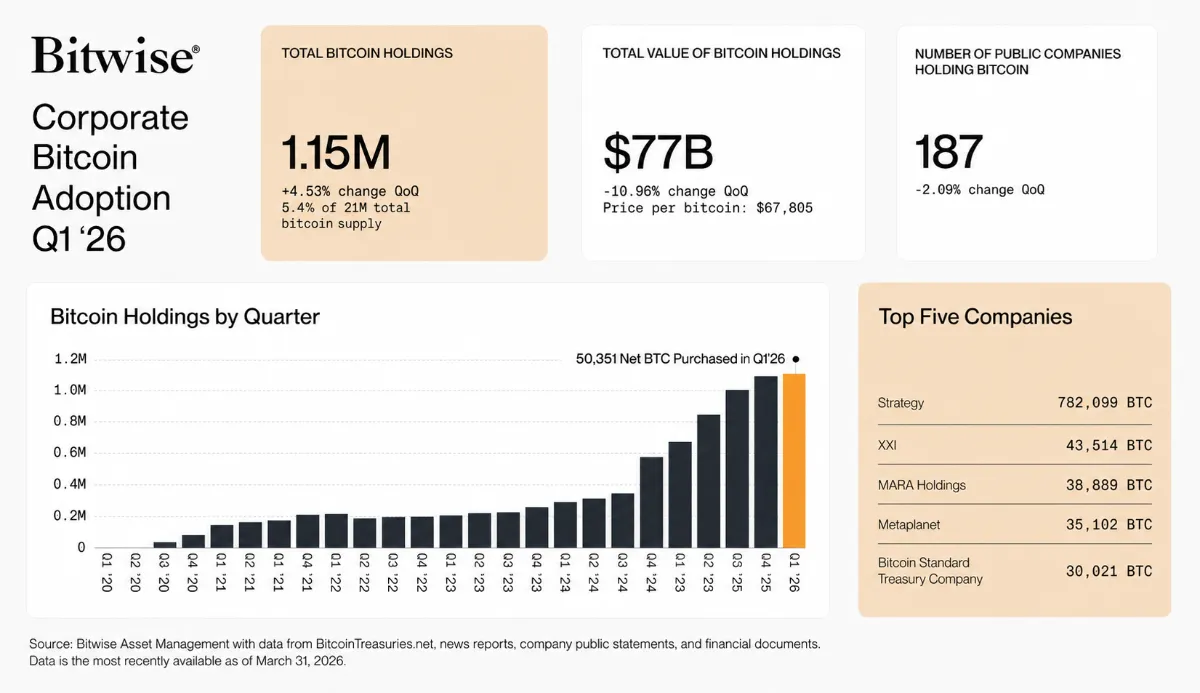
- Strategy becomes world's top institutional Bitcoin holder with 818K coins (68% of 187 companies' 1.15M BTC position), surpassing BlackRock as Morgan Stanley and Fidelity accelerate institutional adoption
- Extreme Strategy concentration creates structural vulnerability if the company halts purchases or fundraising
Strategy overtakes BlackRock to claim world's #1 position. 187 public companies' combined holdings worth $92.9 billion. However, 68% concentration poses structural risk.
Corporations are accelerating their Bitcoin purchases. According to Q1 2026 data compiled by Bitwise, listed companies' total Bitcoin holdings have surpassed 1.15 million coins—representing 5.4% of Bitcoin's total 21 million supply. In Q1 alone, they added 50,351 BTC in net purchases. At Q1 prices ($67,805), their cumulative holdings were valued at $77 billion. At current prices ($80,749), this figure has grown to $92.9 billion.
Equally important as the numbers is who is buying. Wall Street's traditional giants—Morgan Stanley, BlackRock, Fidelity—have begun publicly declaring and executing Bitcoin purchases, joining crypto-native firms in this asset class.
Strategy Surpasses BlackRock
The most dramatic shift belongs to Strategy (MSTR, formerly MicroStrategy). Michael Saylor's firm purchased 34,164 BTC for $2.54 billion during the week of April 13–19, at an average price of $74,395. This acquisition brought total holdings to 818,334 BTC, surpassing BlackRock's Bitcoin ETF (IBIT) position of 802,823 BTC. Strategy is now the world's largest institutional Bitcoin holder.
Strategy's capital structure is unconventional. It issues preferred shares (STRC) to raise capital, then deploys those funds to buy Bitcoin. Since July 29, 2025, this mechanism has raised $2.52 billion and acquired 21,379 BTC at an average price of $117,920—above current market levels. This structure creates a 'perpetual loop': raising capital through non-dilutive preferred shares while minimizing shareholder dilution, enabling continuous Bitcoin accumulation.
Cantor Fitzgerald set a price target of $212 (overweight); TD Cowen assigned $440 (buy).
Wall Street's Three Giants Speak
Morgan Stanley demonstrated through action. Via its Bitcoin ETF (MSBT), it added 57,338 BTC, bringing total holdings to 2,678 BTC (approximately $216 million).
BlackRock issued a statement: "Bitcoin solves a value-storage problem unsolved for centuries and represents the future of global value storage. It has no material competitors." Coming from the world's largest asset manager, this is not mere opinion—it signals the directional flow of capital under management.
Fidelity spoke through data. A 10-year backtest showed that adding 3% Bitcoin to a traditional 60/40 (equities/bonds) portfolio increased annualized returns from 9.4% to 14.6%—a 520 basis point improvement.
Rankings Beyond Strategy: The Broader Landscape
Examining Bitcoin holders outside Strategy reveals the market trend. XXI holds 43,514 BTC (2nd place), MARA Holdings 38,889 BTC, Metaplanet (Japan) 35,102 BTC (4th), and Bitcoin Standard Treasury Company 30,021 BTC (5th).
Metaplanet's 4th-place ranking stands out. A Japanese-listed company reaching this position in short order signals growing corporate adoption as a hedge against yen weakness and negative Japanese government bond yields—an alternative asset dynamic particular to Japanese firms.
The Real Risk: 68% Concentration
A structural vulnerability exists in this market. Strategy alone represents approximately 68% of all Bitcoin held by the 187 public companies. Corporate Bitcoin adoption is essentially dependent on one company's decisions.
If Strategy halts purchases, begins selling, or faces fundraising challenges, corporate Bitcoin demand collapses en masse. The presence of STRC holdings acquired above current prices adds latent pressure. The statement 'the corporate Bitcoin era exists because of Strategy' simultaneously means 'without Strategy, this market could unravel.'
Frequently Asked Questions
How does Strategy's STRC preferred share structure affect shareholders?
Preferred share issuance minimizes voting dilution compared to ordinary equity. However, STRC holders receive preferential dividends and liquidation priority, protecting them first if the company faces distress. Bitcoin price declines could pressure this structure.
Does Fidelity's '3% Bitcoin allocation' analysis apply to Korean investors?
The core logic applies universally: diversifying into uncorrelated assets improves risk-adjusted returns. However, Korean investors face additional currency risk—KRW/USD fluctuations layer on top of Bitcoin price movement, creating dual exposure.
Can Strategy's 68% concentration actually disrupt the market?
What does BlackRock's Bitcoin statement signal?
The world's largest asset manager (\$14T+ AUM) officially designated Bitcoin as a 'global value-storage medium.' This isn't opinion—it telegraphs future capital allocation, potentially opening the door for conservative institutional inflows.

Circle Posts $701M Q2 Revenue, Net Income Jumps but Stock Falls 3% on Revenue Miss
 CRCL
CRCLExxonMobil Posts 4-Year-High Profit but Misses Estimates as AbbVie, Colgate Among 23 Companies Report Earnings
 XOM
XOM LIN
LIN LYB+25
Bitwise's Jeff Park: Crypto Is 'NVIDIA Before the AI Boom' — Most Bullish Phase Ever
 BTC
BTC ETH
ETH IBIT+1
Wall Street's Defining Moments
See more


Sunday's SEC 8-K Earnings Filings Quiet, but Royal Gold Doubles Net Income and Launches Buyback
 RGLD
RGLDVeritone Earnings Shock Sends Shares Down 23%...York Space Systems Among 25 US Companies Filing SEC 8-K Earnings Reports
 YSS
YSS CODX
CODX IPWR+26
Applied Materials Posts Record Q3 Revenue of $9.1 Billion, All-Time High EPS
 AMAT
AMATSmart Money Briefing
Weekly summaries of Wall Street guru moves and crypto whale activity.