
Tencent Is Buying Korea — Games, K-Pop, and Dramas: A Silent Encirclement
Tencent ($562B market cap) is building a three-tier vertical integration across Korean games, K-pop, and dramas — holding 34.85% of Shift Up, 17.5% of Netmarble, 13.9% of Krafton, plus stakes in SM Entertainment and SLL Jungang. An estimated 60% of domestic game revenue is now linked to Tencent. Its U.S. designation as a Chinese military company is an emerging risk.
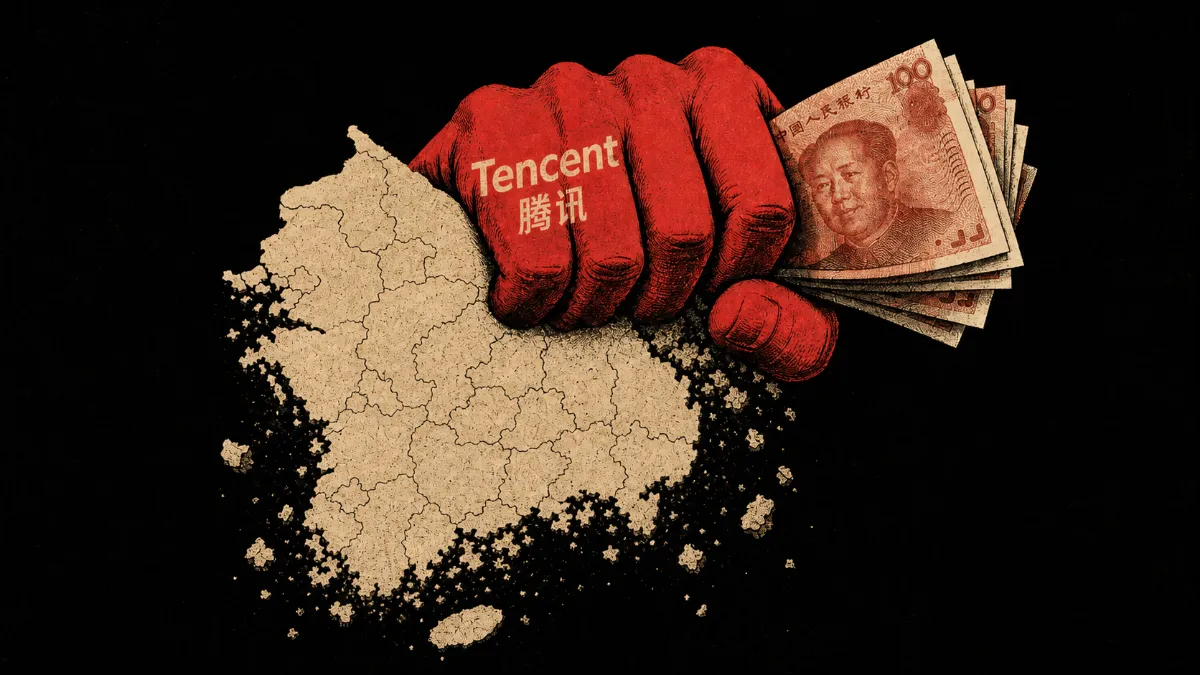
- Tencent has quietly built a 3-tier vertical integration across Korean games, K-pop, and dramas, becoming a top shareholder in Shift Up, Netmarble, Krafton, SM, and Kakao
- Its Jan 2025 U.S
- designation as a Chinese military company now threatens Korean portfolio firms' access to American markets
A $562B giant now connected to 60% of Korea's major game studio revenues… the reality behind the 'own but don't interfere' strategy
In 2001, South African media conglomerate Naspers invested $32 million in a cash-strapped Chinese startup. That company was Tencent. Today, Naspers' stake has multiplied hundreds of times over, and Tencent has grown into an empire with a market capitalization of $562B — larger than Samsung Electronics, LVMH, and ASML combined.
And Tencent is now buying Korea. Quietly, but systematically.
From Messenger to Empire
In 1998, Pony Ma and four college classmates launched QQ. It began as little more than a clone of Israeli messenger ICQ. But after going free-to-use, its user base exploded, making it China's dominant platform. WeChat, launched in 2011, became the digital infrastructure of Chinese daily life — combining messaging, payments, shopping, and content in a single app. WeChat Pay effectively replaced China's counterfeit cash problem with mobile payments, seizing control of the financial ecosystem.
Tencent's rise to become the world's largest gaming company followed an equally distinctive playbook: it doesn't build — it buys. The company holds 100% of Riot Games (League of Legends), 84% of Supercell (Clash of Clans), and 40% of Epic Games (Fortnite). In 2025, it expanded its stake in a newly carved-out Ubisoft gaming subsidiary (25%) and increased its holding in the parent company of FromSoftware (Elden Ring). International game revenue alone surpassed $10 billion in 2025. Unlike Alibaba's Jack Ma, founder Pony Ma is a recluse who rarely makes public appearances. Tencent's expansion happens in silence.
Korea Stake Map — The 'Second-Largest Shareholder' Strategy
There is a clear pattern to how Tencent invests in Korea. It does not pursue controlling interests. It quietly settles in as the second-largest shareholder.
Tencent holds 34.85% of Shift Up — just 3.5 percentage points behind founder and CEO Kim Hyung-tae's 38.43%. It is the second-largest shareholder in both Netmarble (17.52%) and Krafton (13.86%). Additional stakes include SLL Jungang (JTBC Studios) at 10.11%, SM Entertainment at 9.7%, Kakao Games at 6.6%, Kakao at 5.95%, and YG Entertainment at 4.3%. This is why analysts estimate that 60% of major Korean game studio revenues are now structurally connected to Tencent.
The SM Acquisition — Penetrating the Heart of K-Pop
On May 27, 2025, Tencent Music Entertainment (TME) acquired HYBE's entire stake in SM Entertainment for approximately $167M. Tencent moved in as HYBE divested the shares it had accumulated during the 2023 SM management dispute, treating them as non-core assets. SM immediately announced plans to 'build a comprehensive idol success model' with Tencent Music, and SM's revenue for the following second quarter rose 19% year-over-year.
The combined market capitalization of Korea's Big Four agencies — HYBE, JYP, YG, and SM — is less than one-fortieth of Tencent's. The asymmetry at any negotiating table is absolute.
Into K-Dramas — A Three-Tier Vertical Integration
Tencent's penetration of Korea extends beyond games and K-pop. It is the third-largest shareholder in SLL Jungang (formerly JTBC Studios) — producer of Extraordinary Attorney Woo and Reborn Rich — with a 10.11% stake. After committing $69M in a 2021 rights offering, Tencent subsequently increased its position. Immediately following the investment, the two companies signed an exclusive content supply deal for Tencent Video, China's largest OTT platform.
Viewed as three distinct layers, the strategic logic becomes clear. Layer one (platform): a 5.95% stake in Kakao enabling ecosystem linkage between WeChat and KakaoTalk. Layer two (production): stakes in SLL Jungang, SM, and YG to secure original IP across K-dramas and K-pop. Layer three (distribution): exclusive supply through Tencent Video into the Chinese OTT market. It is a complete vertical integration — with equity in both the creators and the distributors of Korean content.
The Naspers Philosophy — 'Own, But Don't Interfere'
Tencent's investment philosophy traces back to its controlling shareholder, Naspers: secure board nomination rights, but minimize operational interference. Leave management to the founders, and capture the financial returns. Meanwhile, draw portfolio companies' content into the Tencent ecosystem to generate global publishing revenue.
Reports have also surfaced of Tencent exploring an acquisition of roughly a $15 billion stake in Nexon, and a proposal to acquire a 40% stake in Kakao Mobility. Tencent denied both, but Nexon and Kakao Mobility declined to comment.
Risks — A Double-Edged Sword
Tencent's expansion carries two distinct categories of risk.
The first is Tencent-specific. Following Xi Jinping's 'Common Prosperity' campaign, a sweeping crackdown on Chinese Big Tech sent Tencent's share price plummeting more than 60% from its peak. The same government protection that enabled its domestic dominance means Tencent cannot operate freely from state control.
The second risk falls on Korean portfolio companies. In January 2025, the U.S. designated Tencent as a 'Chinese military company.' This effectively creates a potential barrier for Tencent-backed Korean firms seeking to enter or expand in the U.S. market. Concerns about historical distortion through game IP and pressure for content censorship are also persistently raised — fueling criticism that frames Tencent's activity as 'Northeast Project capital.'
Underlying all of these moves is anticipation of a lifting of China's ban on Korean cultural content (the hallyu ban). The prevailing view among analysts is that Tencent is positioning itself to control the gateway for Korean content entering China, ahead of any formal easing — capitalizing on the broader trend of expanding Sino-Korean economic cooperation.
Frequently Asked Questions
Is it true that Tencent's largest shareholder is a South African company?
Yes. South African media group Naspers invested $32 million in Tencent in 2001 and became its largest shareholder. Today the stake is held through Naspers' Dutch subsidiary Prosus. Notably, Naspers is also the largest shareholder of Delivery Hero, which acquired Baemin (Woowa Brothers) — making Tencent and Baemin effectively sister companies.
Does Tencent actually interfere in the management of its Korean portfolio companies?
Officially, Tencent maintains a minimal-interference philosophy. It secures board nomination rights but does not involve itself in day-to-day operations. That said, cases like Shift Up — where Tencent's stake trails the founder's by just 3.5 percentage points — are viewed as carrying significant latent influence.
What is the practical impact of the U.S. Chinese military company designation on Korean firms?
There are no direct transaction restrictions, but complications can arise in U.S. government procurement or certain partnerships. Korean game studios with Tencent as a shareholder may face heightened scrutiny when pursuing contracts with the U.S. Department of Defense or other government-related entities.
Is the expected lifting of China's hallyu ban actually underway?
No official announcement of a lift has been made by the Chinese government, but a partial resumption of Korean content exports has been observed alongside a broader trend of expanding Sino-Korean economic cooperation. The consensus among analysts is that Tencent's accelerating Korean content investments are a preemptive move to control the distribution gateway ahead of any formal easing.

Veritone Earnings Shock Sends Shares Down 23%...York Space Systems Among 25 US Companies Filing SEC 8-K Earnings Reports
 YSS
YSS CODX
CODX IPWR+26
25 SEC 8-K Earnings Disclosures Flood In, Including Owens Corning, Extreme Networks, Utz Brands
 HBB
HBB NC
NC EPC+27
ExxonMobil Posts 4-Year-High Profit but Misses Estimates as AbbVie, Colgate Among 23 Companies Report Earnings
 XOM
XOM LIN
LIN LYB+25
Wall Street's Defining Moments
See more

Sunday's SEC 8-K Earnings Filings Quiet, but Royal Gold Doubles Net Income and Launches Buyback
 RGLD
RGLDVeritone Earnings Shock Sends Shares Down 23%...York Space Systems Among 25 US Companies Filing SEC 8-K Earnings Reports
YSSCODXIPWR+26Applied Materials Posts Record Q3 Revenue of $9.1 Billion, All-Time High EPS
 AMAT
AMATSmart Money Briefing
Weekly summaries of Wall Street guru moves and crypto whale activity.